Understanding the Average Car insurance Cost in Alberta
So, what's the bottom line on car insurance costs in Alberta? While there’s no single price tag that applies to everyone, the **average car insurance cost in Alberta** typically lands somewhere between **$1,500 and $3,000 per year**.
That translates to approximately **$125 to $250 per month** for most drivers. Of course, your actual rate will be a unique reflection of your specific circumstances.
A Snapshot of Alberta Car Insurance Premiums
Understanding the provincial average is a great starting point for budgeting. It provides a ballpark figure—a general idea of what your neighbours might be paying. However, it's crucial to remember that this is just a benchmark. The final number on your insurance quote will be shaped by a host of personal factors we'll explore.
At its core, your premium is an insurer's calculation of the risk they assume to cover you. It's why two people with the exact same car, living on the same street, can receive vastly different quotes. Their age, driving history, and chosen coverages all influence the final price.
This principle is universal in insurance. For instance, a recent US-based analysis found that California drivers paid an average of **$3,119 per year** for full coverage, while the mandatory minimum was just **$916 per year**. This perfectly illustrates how your personal profile and coverage choices create a wide spectrum of costs.
Understanding Your Coverage Options
In Alberta, your insurance costs are primarily determined by two main types of coverage: basic liability and what's often called "full" or comprehensive coverage.
* **Minimum Liability Coverage:** This is the mandatory coverage required by law to operate a vehicle. It’s designed to cover damages or injuries you might cause to others but does not cover repairs to your own car. * **Full Coverage:** This is a package that typically includes both **collision** and **comprehensive** protection. It covers your vehicle from events like a fender bender, theft, vandalism, or a classic Alberta hailstorm.
> Because every driver's needs are unique, the "right" amount of coverage is a personal decision. Minimum liability gets you on the road legally for less money, but full coverage provides a critical financial safety net for your own vehicle, delivering true peace of mind.
We take a much deeper look into these options in our guide to [understanding Alberta auto insurance rates](https://www.insuranceshope.ca/blog/alberta-auto-insurance-rates). The key takeaway is that the "average" cost is always a moving target based on the level of protection you select.
To give you a clearer picture, here's a quick breakdown of what you might expect to pay.
Alberta Car Insurance at a Glance: Average Annual Premiums
This table provides a summary of estimated average car insurance costs in Alberta for different levels of coverage, illustrating the typical financial commitment for drivers.
| Coverage Level | Estimated Average Annual Premium | Estimated Average Monthly Premium | | :--- | :--- | :--- | | Minimum Liability | $1,500 - $1,900 | $125 - $158 | | Full Coverage | $2,400 - $3,200 | $200 - $267 |
While these numbers are a helpful benchmark, they remain estimates. The only way to discover your actual premium is to get a personalized quote based on your specific details.
Key Factors That Shape Your Insurance Premium
Ever wonder how insurance companies arrive at the specific number for your quote? While knowing the **average car insurance cost** provides a general idea, your final premium is a completely custom calculation. Think of it as a recipe with several key ingredients—each one altering the final price of your policy.
Ultimately, insurers are in the business of managing risk. They analyze a host of factors to determine the likelihood you will make a claim. The higher they perceive that risk, the more you'll pay. It’s the reason why your neighbour could get a vastly different quote for the exact same car.
Let's pull back the curtain and examine the primary ingredients that determine your rate.
Your Driver Profile and History
Who you are behind the wheel is a major piece of the puzzle. Insurance providers look closely at your personal details to assess risk, with a special focus on your age and driving experience.
* **Age and Experience:** Statistically, younger, less experienced drivers are involved in more accidents. That’s why drivers under **25** often see some of the highest premiums. Rates typically decrease as you gain more on-road experience and move into your 30s and 40s. * **Driving Record:** This is your driving report card. A clean record—free of at-fault accidents, speeding tickets, or other violations—signals to insurers that you’re a low-risk driver, resulting in lower costs. Conversely, at-fault collisions or serious tickets can cause your premiums to rise significantly.
Even a single ticket can make a difference. For instance, many drivers ask if photo radar tickets count. You can get the full story in our guide on **[how speed camera tickets affect insurance](https://www.insuranceshope.ca/blog/does-speed-camera-ticket-affect-insurance)**.
> Think of your driving record as your reputation with insurers. A history of safe, responsible driving builds trust and is rewarded with better rates, while a record with blemishes suggests a higher probability of future claims.
This graphic breaks down how different coverage levels influence the average cost, which is then fine-tuned based on all these personal factors.
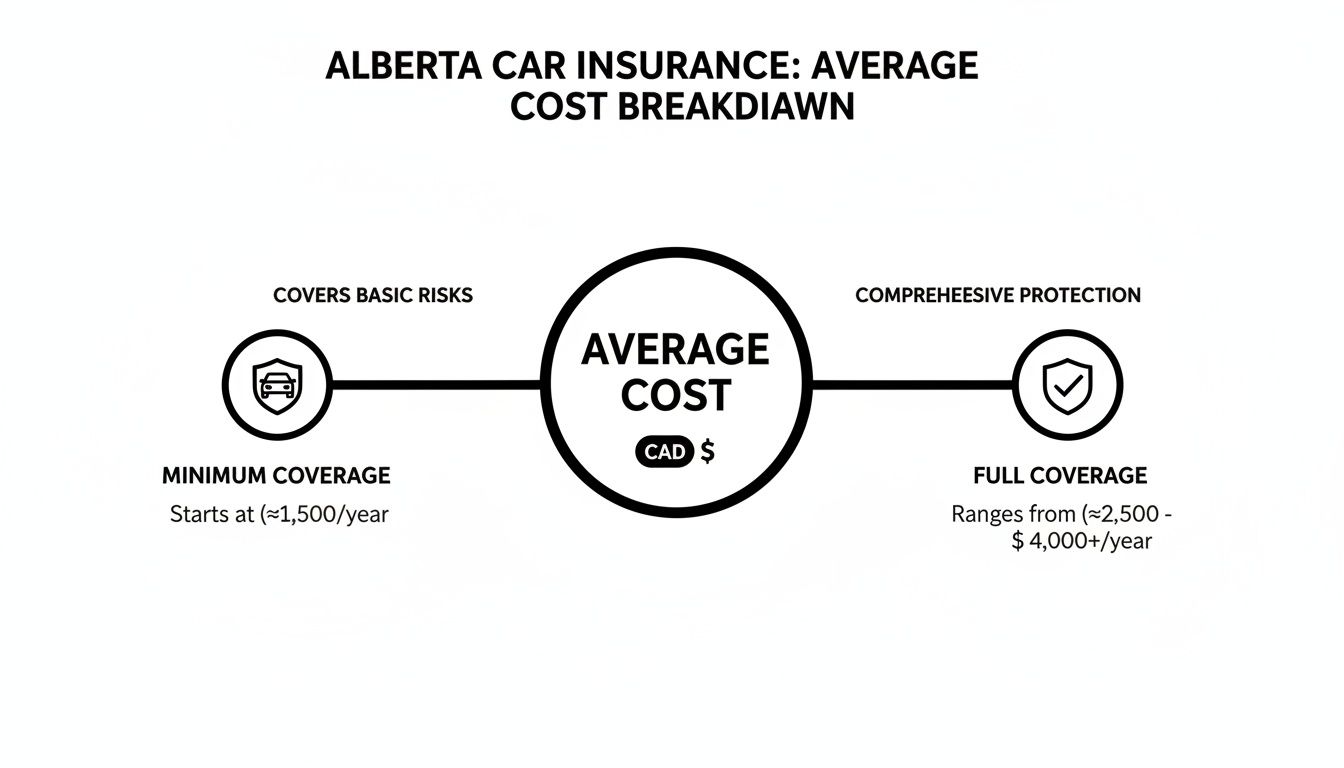
As you can see, the choice between basic and full coverage creates a significant price gap before any of your personal details are even considered.
The Vehicle You Drive
The car you want to insure has a massive impact on your final premium. Insurers evaluate everything from its sticker price and repair costs to its safety ratings and theft frequency.
It makes sense, right? A brand-new sports car will cost more to insure than a sensible family sedan because repairing or replacing it is far more expensive. Insurers also examine a car's safety track record and whether it’s a popular target for thieves.
* **Make, Model, and Year:** Luxury cars or vehicles with expensive parts will cost more to repair or replace, which increases the cost of your collision and comprehensive coverage. * **Safety Features:** Modern technologies like automatic emergency braking, lane-keep assist, and robust anti-theft systems can actually earn you discounts. * **Theft Rate:** Some cars are stolen more often than others. If your model is a popular target for thieves, your comprehensive coverage may cost slightly more.
Your Coverage and Policy Choices
Finally, the coverages you select have the most direct and immediate impact on your premium. This is where you have the most control, making it a powerful tool for managing your insurance budget. Simply put, the more protection you purchase, the higher the price.
Your choices can lead to dramatic differences in cost. For example, some analyses have found that an 18-year-old driver could pay an average of **$8,113 annually** for full coverage, while a driver in their 60s might pay closer to **$2,862**. That’s a massive gap based on just one factor, and your coverage choices will shape that number even further.
Here are the key decisions you'll make: 1. **Liability Limits:** This is the maximum amount your insurer will pay if you're at fault in an accident. Choosing higher limits than the provincial minimum offers greater protection but also increases your premium. 2. **Collision and Comprehensive Coverage:** These are the optional coverages that protect your own vehicle from damage. Adding them is crucial for newer cars, but it does add to the total cost. 3. **Deductibles:** This is the amount you agree to pay out-of-pocket for a claim before your insurance policy takes over. **Choosing a higher deductible will lower your premium**, but be certain you can comfortably cover that amount if you ever need to file a claim.
How Your Postal Code Impacts Insurance Costs
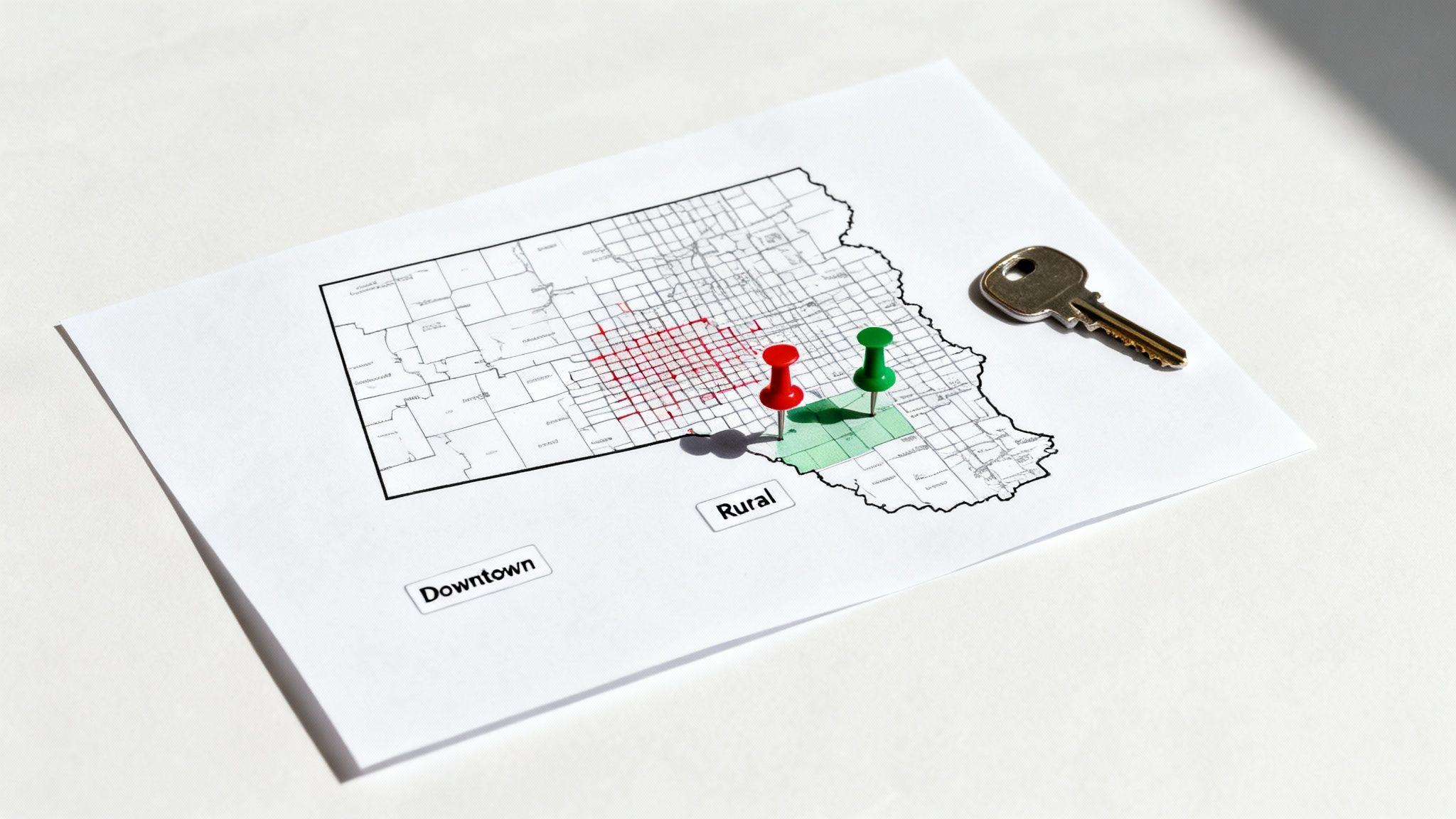
It may seem surprising, but your postal code is one of the most significant factors in determining your car insurance premium. Where you park your car overnight can sometimes matter just as much as how you drive it during the day.
This is precisely why a driver in downtown Calgary often sees a completely different rate than someone in a smaller town like Canmore, even with an identical driving record and the same vehicle.
This isn't an arbitrary decision by insurers; it’s based on extensive data. Insurance companies rely on location-based statistics to forecast the likelihood of a claim in your area. They’re not just looking at you—they’re analyzing the claims history of your entire neighbourhood to assess risk.
Put simply, some areas experience more accidents, theft, and vandalism. If your neighbourhood's data reveals a history of frequent claims, insurers see a higher risk for every vehicle parked there. This gets factored directly into the local **average car insurance cost**.
Urban vs. Rural: The Risk Divide
The most significant split in insurance costs often comes down to the classic urban versus rural divide. A bustling, densely populated city centre presents a completely different risk profile than a quiet, spread-out rural community.
Insurers have identified several key risks that are more prevalent in large cities:
* **Higher Traffic Density:** More cars on the road mean a higher probability of collisions, from frustrating fender-benders in parking lots to major accidents on busy highways. * **Increased Theft and Vandalism:** Cities, unfortunately, tend to have higher rates of vehicle-related crime, making events like break-ins and catalytic converter theft more common. * **More Complex Intersections:** Navigating a web of traffic lights, multi-lane roundabouts, and busy pedestrian crossings creates far more opportunities for incidents to occur.
Because of this, drivers in major hubs should explore all their options to find competitive **[Calgary auto insurance](https://www.insuranceshope.ca/calgary-auto-insurance)** rates that properly reflect their specific neighbourhood's risk. Conversely, those living in rural areas often benefit from lower premiums thanks to less traffic and lower crime rates.
How Neighbourhood Statistics Shape Your Premium
A good way to understand this is to think of your postal code as a risk pool. Every claim made within that area—whether for a collision, a stolen car, or hail damage—is added to the area's overall statistical profile. Your premium is then partly based on the shared experience of all your neighbours.
This is a standard practice across the insurance industry. For example, a 2025 insurer-compiled estimate from California shows huge price differences from one city to the next, driven by factors like local accident frequency, theft rates, and even regional vehicle repair costs.
> Your location provides the context for your personal driving habits. An insurer might see you as a perfectly safe driver, but if you park your car every night in an area with a high rate of break-ins, that external risk gets factored into your final premium.
This is why moving—even just a few kilometres to a different neighbourhood—can sometimes trigger a surprising change in your insurance costs. While your personal driving record is the most important factor you can control, your postal code’s statistics set the baseline for your rate.
Real-World Scenarios of Alberta Driver Premiums
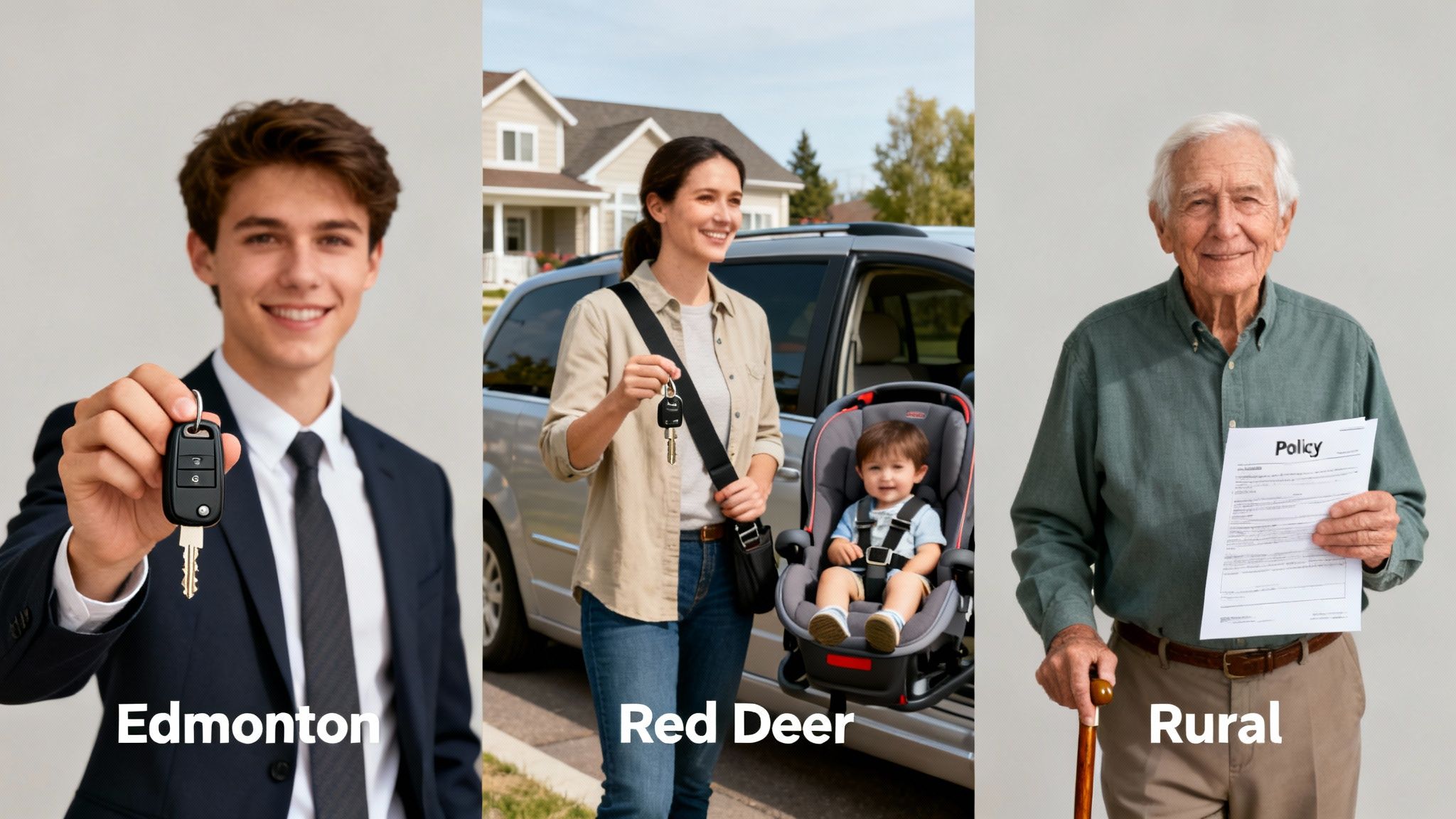
Understanding the factors that influence the **average car insurance cost** is one thing, but seeing them in real-world situations makes it all clear. Abstract concepts like "driver profile" and "location risk" become much more tangible when we connect them to actual people.
Let’s examine a few fictional driver profiles from across Alberta. These examples will show you just how different combinations of age, vehicle, driving history, and location can lead to vastly different annual premiums. By reviewing these scenarios, you can better understand which profile mirrors your own and identify the key levers affecting your rate.
To illustrate this, here’s a comparison of what our fictional drivers might expect to pay.
Sample Driver Profiles and Estimated Annual Premiums in Alberta
This table breaks down how unique situations lead to a wide range of insurance costs, demonstrating that there's no "one-size-fits-all" price for car insurance in Alberta.
| Driver Profile | Key Cost Factors | Estimated Annual Full Coverage Premium Range | | :--- | :--- | :--- | | **Liam, the Young Urban Professional** | Age (24), new vehicle (2024 Honda Civic), urban Edmonton location, limited primary insurance history. | **$3,500 - $4,800** | | **The Thompson Family, Suburban Multi-Car** | Mature drivers (42), clean records for 25+ years, two older vehicles (2018 & 2016), Red Deer location, multi-vehicle discount. | **$2,400 - $3,200** (for both vehicles) | | **Margaret, the Rural Retiree** | Senior driver (68) with a long, clean history, low annual kilometrage, rural Lethbridge-area location, home & auto bundle. | **$1,200 - $1,800** |
As you can see, the numbers vary significantly based on the details. Let's dig into why.
Scenario One: The Young Urban Professional
Meet Liam, a 24-year-old software developer living in a trendy Edmonton neighbourhood. He’s been licensed since he was 18 but has only been the primary driver on a policy for two years. Liam drives a brand-new 2024 Honda Civic for his daily commute and weekend mountain trips.
Several factors drive up Liam's costs: * **Age and Experience:** As a driver under **25**, he falls into a statistically higher-risk group. * **Location:** Living in a dense urban part of Edmonton means higher rates of traffic, theft, and accidents. * **Vehicle:** His new Civic is a popular model with relatively high repair costs, meaning full collision and comprehensive coverage are essential.
Even with a clean driving record, Liam’s combination of youth, location, and a new vehicle places him at the higher end of the premium spectrum. For an insurer, this profile has multiple risk indicators that stack up and increase his cost.
Scenario Two: The Suburban Family
Now let’s look at the Thompson family in Red Deer. Sarah and Tom are both **42**, have been driving for over **25 years**, and have spotless records. They insure two vehicles: a 2018 Honda Odyssey minivan for school runs and a 2016 Ford F-150 for everything else.
Their profile tells a completely different story: * **Experience and Record:** Decades of claims-free driving make them ideal, low-risk clients. * **Location:** Red Deer has lower traffic density and crime rates than Edmonton or Calgary, resulting in a lower baseline premium. * **Multi-Vehicle Discount:** Insuring two vehicles with the same provider almost always unlocks significant savings.
The Thompsons represent the kind of low-risk profile insurers prefer. Their experience, clean records, and location all contribute to a much more favourable premium. The **average car insurance cost** for a family like theirs is significantly lower than what a young urban driver pays.
Scenario Three: The Rural Retiree
Finally, we have Margaret, a **68-year-old** retiree living just outside of Lethbridge. She drives her trusty 2015 Toyota RAV4 but puts very few kilometres on it each year—mostly for groceries and visiting friends. Margaret also bundles her home and auto insurance with the same company.
Key factors bringing Margaret's premium down include: * **Low Kilometrage:** Driving less than **10,000 km** a year often qualifies you for a low-mileage discount. * **Multi-Policy Bundling:** Combining home and auto insurance is one of the easiest ways to get a substantial discount, often around **15-20%**. * **Experience:** Her long, clean driving history signals reliability and low risk to insurers.
Margaret's profile is a perfect storm of positive rating factors. Of course, her situation would change dramatically if she had multiple at-fault accidents, which highlights the importance of your driving record. If you're concerned about a less-than-perfect history, you can explore our detailed guide on **[car insurance for high-risk drivers](https://www.insuranceshope.ca/blog/car-insurance-for-high-risk-drivers)**.
These three scenarios prove there is no single "average" cost—only a personalized one.
Actionable Strategies to Lower Your Car Insurance Bill
Knowing what drives your premium is one thing, but taking control is what matters. While you can’t change your age or move to a different city just for cheaper insurance, there are many practical steps you can take to lower your bill. The final price you pay isn't set in stone—it's a number you can absolutely influence.
Many drivers mistakenly assume their rate is fixed. With a few strategic adjustments and good habits, you can find significant savings. It all comes down to being a savvy, informed consumer.
Let's walk through the most effective ways to cut your costs and keep more money in your wallet.
Fine-Tune Your Policy and Coverage
One of the fastest ways to see a drop in your premium is to review the details of your policy. These small adjustments can have a surprisingly large impact on the **average car insurance cost** you face each year.
* **Raise Your Deductible:** Your deductible is the amount you pay out-of-pocket on a claim before the insurance company steps in. Increasing it from **$500 to $1,000**, for example, means you're taking on more of the initial risk. Insurers reward this with a lower premium. Just ensure you can comfortably cover the higher amount if something happens. * **Review Your Coverage on Older Cars:** If you are still paying for full collision and comprehensive coverage on a car with a low market value, you might be over-insured. Over time, the cost of that premium could easily add up to more than the car is worth.
Proactively Improve Your Driver Profile
Insurance companies reward safe, responsible drivers. By demonstrating that you're a low-risk client, you'll be on the fast track to better rates.
> Think of your insurance premium as a reflection of trust. The more you do to prove you're a safe driver, the more trust you build with insurers, leading directly to lower costs.
A fantastic way to do this is to complete a government-approved defensive driving course. Many insurance providers offer a discount to drivers who voluntarily sharpen their skills behind the wheel. It’s a clear signal that you’re serious about safety.
Master the Art of Smart Shopping
This is the most powerful tool in your arsenal: always shop around and hunt for discounts. Never assume your current provider is giving you the best price. Rates and discount opportunities change constantly.
One of the easiest ways to save is by bundling your policies. When you insure your car and home with the same company, you can unlock major savings—often between **10% and 25%**. For a deeper look at how this works, check out our guide on **[multiple policy discounts in Alberta insurance](https://www.insuranceshope.ca/blog/multiple-policy-discounts-alberta-insurance)**.
Finally, make it a habit to compare quotes at least once a year, especially before your policy is up for renewal. Insurers are always tweaking their rates to stay competitive, and loyalty doesn't always pay off. Getting fresh quotes is the only way to ensure you’re getting the best deal available.
Finding Your Best Rate With an Insurance Broker
Let’s be honest: shopping for car insurance isn't a fun weekend activity. Calling multiple companies, repeating your details, and trying to decipher confusing quotes is enough to make anyone give up. It’s why so many drivers stick with their current policy, even if they suspect they’re overpaying.
But what if you had a personal expert to do all the heavy lifting for you? That’s where an insurance broker becomes your secret weapon.
The Broker Advantage Over Going Direct
When you call an insurance company directly, you’re speaking to their salesperson, whose goal is to sell you *their* product. They won't tell you that a competitor could offer the same coverage for less. This puts the entire burden of comparison shopping on you.
An independent insurance broker, on the other hand, works for *you*.
> A broker’s loyalty isn't to a single insurance company; it’s to their client. Their job is to scan the market to find the policy that hits the sweet spot between great coverage and a great price for your specific needs.
This single difference completely changes the game. It transforms a frustrating sales process into a professional consultation where your best interests are the top priority.
How a Broker Unlocks Savings
Brokers have a deep understanding of the industry and maintain relationships with a network of insurers—including some that don't sell directly to the public. This gives them a complete, bird's-eye view of the market, allowing them to find opportunities you’d likely never discover on your own.
Here’s how they find you savings:
* **Accessing Multiple Quotes Instantly:** Using specialized tools, a broker can pull quotes from numerous providers in minutes. What would take you a full day of phone calls, they can do in a single step. * **Identifying Hidden Discounts:** Are you a member of an alumni association? Does your car have top-tier safety features? A good broker knows which insurers offer niche discounts and ensures every single one is applied. * **Finding the Right Fit:** They understand the nuances of different policies and the reputations of the companies behind them. They can steer you toward an insurer known for exceptional claims service or one that offers the best rates for drivers just like you.
Ultimately, working with a broker simplifies the entire process. You get expert advice, access to the whole market, and a dedicated advocate working to get you the best deal possible. It’s the easiest path to both savings and peace of mind.
Common Questions About Alberta Car Insurance Costs
Even after you understand how insurance works, a few questions often remain. To wrap things up, let's address some of the most common things Alberta drivers ask about their premiums. Think of this as the final piece of the puzzle to help you feel completely in control of your insurance costs.
Why Did My Premium Go Up Even With a Clean Record?
This is one of the most frustrating experiences for a safe driver. You receive your renewal notice, you haven't had a single ticket or claim, and yet your price has increased. Why?
While your personal driving record is a huge piece of the puzzle, it’s not the only one. Insurers must also consider broader trends happening across the province.
Here are a few common reasons for rate increases: * **Rising Repair Costs:** Modern cars are packed with technology—sensors, cameras, and complex computer systems. This is great for safety, but it means even a minor fender bender can lead to an expensive repair bill. Factoring in inflation and supply chain issues for parts and labour, these costs are inevitably passed on to consumers. * **More Claims in Your Area:** As we discussed, your postal code matters. If your neighbourhood has seen a jump in accidents or car thefts over the past year, it can raise the baseline risk for everyone living there, even the safest drivers. * **Overall Industry Trends:** Widespread events like a massive hailstorm or major flooding can trigger a huge number of claims at once. To remain financially sound and able to pay out those claims, insurers sometimes need to adjust their rates across the board to cover these significant losses.
Is Alberta's Minimum Coverage Really Enough?
The short answer? Almost never.
While having the minimum required liability coverage keeps you legal on the road, it offers very little real financial protection. It’s designed to cover the damage you cause to *other people* and their property. It does absolutely nothing for your own vehicle.
If you were at fault in an accident with only the basic minimum, you'd be responsible for every penny to repair or replace your car. For most people, that's a massive, unexpected financial blow they cannot easily absorb. That's why full coverage, which includes collision and comprehensive protection, is almost always the right choice for any vehicle you couldn't afford to replace out-of-pocket tomorrow.
How Often Should I Shop Around for a New Insurance Quote?
A great rule of thumb is to check for new quotes **at least once a year**, ideally about **30 to 45 days** before your policy is set to renew. This gives you plenty of time to compare your options without feeling rushed.
> Think of shopping for insurance like an annual financial check-up. It's the only way to be sure you aren't leaving money on the table and that your coverage still fits your life.
Blind loyalty rarely pays off in the insurance world. Insurers are constantly updating their rate calculations, so the company that offered you the best deal last year might not be the most competitive one this year. Getting fresh quotes is a simple, proactive step to keep your **average car insurance cost** as low as possible.
--- Ready to stop guessing and discover what you should be paying? The expert broker network at **InsuranceShope** does the comparison shopping for you, finding the best coverage at the most competitive price from Alberta's top insurers. Get your free, no-obligation quote today and see how much you could save. Learn more and connect with a local expert at [https://www.insuranceshope.ca](https://www.insuranceshope.ca).