Car Insurance for High Risk Drivers: Your Guide to Finding Affordable Coverage
Being labelled a ‘high-risk’ driver can feel discouraging, but it’s not a personal judgment. Think of it as a statistical calculation. Insurers predict risk based on data, and certain events in your driving history suggest you're more likely to file a claim. Understanding this is the first step toward finding affordable **car insurance for high risk drivers** and, more importantly, working your way back to lower, standard rates.
This guide is designed to empower you with the knowledge to navigate this process, lower your premiums, and get back on the road with confidence.
What It Means to Be a High Risk Driver
When an insurance company reviews your application, they build a 'risk profile' based on your driving history. The term ‘high-risk’ simply means your profile has a few red flags that, according to industry data, point to a higher probability of a future claim. It’s a numbers game, not a permanent mark on your record.
A helpful analogy is your credit score. Just as a few late payments can lower your credit rating, certain driving events can raise your insurance risk profile. It’s not always one major incident; sometimes, a series of smaller infractions can add up. Grasping this concept helps demystify why your insurance quotes might be coming in higher than you anticipated.
Common Reasons for a High Risk Classification
Here in Alberta, insurers look for specific patterns and events when they assess your risk. While every company has a unique formula for calculating premiums, a few common factors almost always push a driver into the high-risk category.
Knowing these triggers is powerful—it helps you understand your situation and what you need to focus on to improve it.
Here’s a clear breakdown of the most common reasons drivers are classified as high-risk.
Common Reasons for a High Risk Classification
| Risk Factor | Common Examples | Impact on Insurance Premiums | | :--- | :--- | :--- | | **Serious Traffic Convictions** | DUI/DWI, reckless driving, stunt driving, fleeing the scene of an accident. | **Severe and Immediate:** This is the fastest way to see a massive rate hike or even policy cancellation. | | **Multiple Minor Violations** | A string of speeding tickets, stop sign violations, or other moving violations in a short period (e.g., **3+ tickets in 3 years**). | **Cumulative:** One ticket might not hurt much, but a pattern signals consistent risky behaviour, leading to significant increases. | | **At-Fault Accidents** | Being deemed **50% or more responsible** for one or more collisions, especially those with injuries or major property damage. | **Significant:** A single at-fault claim will raise your rates substantially. Multiple claims will solidify a high-risk status. | | **Lapses in Insurance Coverage** | Going without active **[auto insurance coverage](https://www.insuranceshope.ca/insurance/auto)**, even for a short time. | **High:** Insurers see this as a sign of instability. A coverage gap almost always results in higher premiums when you reapply. |
This table shows that a high-risk label is directly tied to specific, recorded events. By identifying which of these apply to you, you can begin to build a strategy to improve your record.
> Being classified as high-risk is a manageable situation, not a permanent identity. By understanding the specific factors affecting your record, you can create a clear and actionable plan to rebuild your driving profile and work your way back to more affordable premiums.
The good news is that for most drivers, this label is temporary. Minor violations and accidents typically fall off your insurance record after **three to six years**. While major convictions can impact your rates for much longer, the path forward is the same: maintain a clean driving record from this point on.
Proving that your past doesn't define your future driving habits is the key to lowering your premiums over time.
How Insurers Calculate Your Driving Risk
Ever wonder what happens behind the scenes when you request an insurance quote? It’s a data-driven process. Insurers act like risk analysts, using clues from your driving history to predict the likelihood of a future claim. It’s an objective calculation, not a personal one.
Think of your driving history as a resume. A clean record with years of safe driving is like a stellar CV that gets you the best offers. Conversely, at-fault accidents or multiple tickets are red flags that insurers must factor into their pricing.
The Risk Scoring System
At its core, every insurer uses a risk scoring system. The exact formulas are proprietary, but the concept is simple: certain events add "risk points" to your profile. The more points you accumulate over the last **three to six years**, the higher your perceived risk, and the more likely you are to be placed in the **high-risk driver** category.
A single speeding ticket might add a few points. But several tickets in a short period signal a pattern of risky behaviour, causing your point total to climb quickly.
This diagram breaks down the main factors that contribute to a high-risk classification.
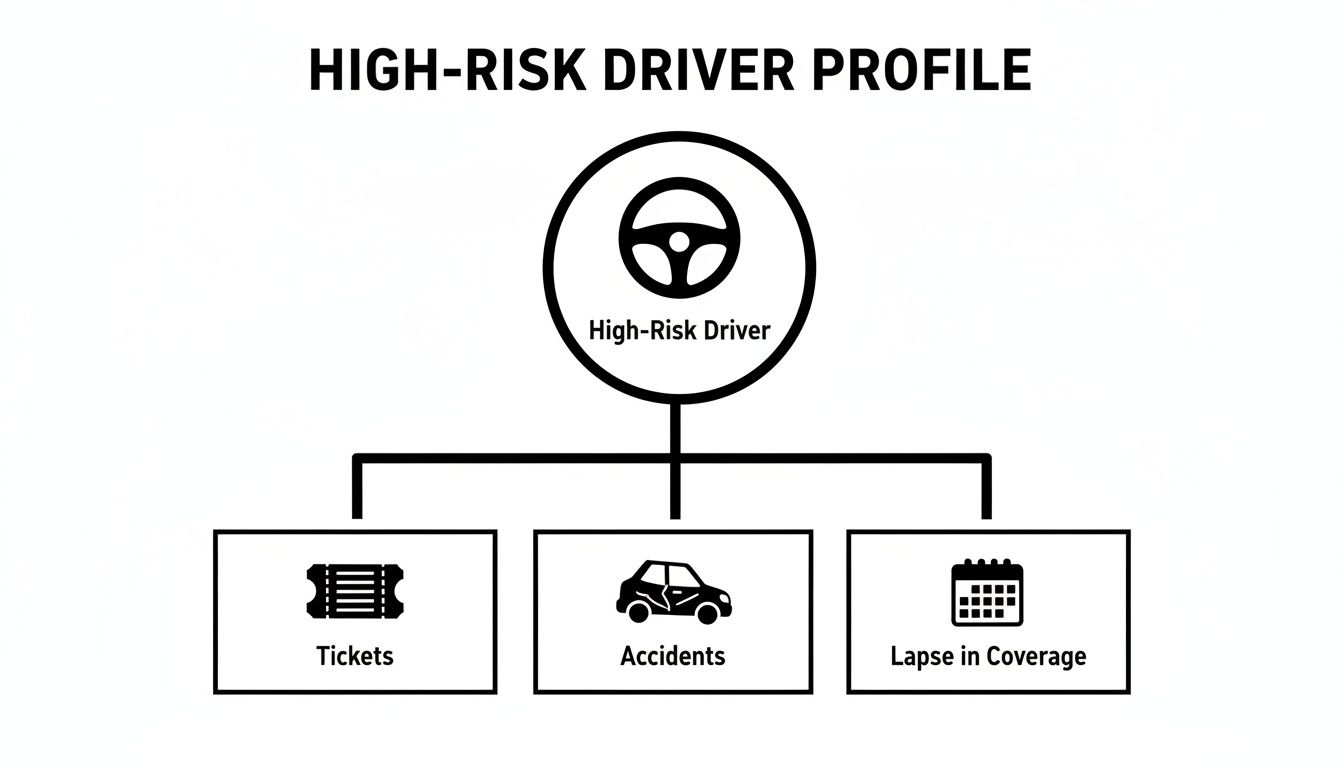
As you can see, the primary factors are tickets, at-fault accidents, and gaps in your coverage. These are the building blocks of a high-risk profile, and each one contributes to the premium you'll pay.
How Different Violations Impact Your Premiums
Not all violations are weighted equally. An at-fault accident carries much more weight than a minor ticket because it resulted in a direct financial payout from the insurance company. A major conviction, like a DUI, is the most damaging of all. It demonstrates a serious disregard for safety, which is an insurer's biggest concern.
> The single biggest factor in your insurance premium is your driving record. An insurer’s primary goal is to match the price of a policy to the risk a driver represents, and past behaviour is their most reliable predictor of future outcomes.
Let's look at a real-world example. In some regions, a single speeding ticket can push a full coverage premium to **$361** per month. An at-fault accident? That jumps to **$437**. A DUI conviction can skyrocket the monthly cost to **$643**. This gives you a clear picture of how insurers classify risk based on recent incidents. It also shows why just **three accidents or violations** can be enough to get you flagged as high-risk.
The Role of Continuous Coverage
Beyond tickets and accidents, there’s another critical factor: a lapse in coverage. Going without an active policy, even for a few weeks, creates an information gap. Insurers have no data on your driving habits during that time and often view that gap as a sign of unreliability.
Maintaining continuous coverage is one of the simplest ways to keep your risk score down. It demonstrates stability and financial responsibility—qualities insurance companies value in a client. It's a less obvious factor, but it absolutely influences your final premium.
If you want to dig deeper into what drives your costs, **[you might be interested in our guide on why insurance rates are high in Alberta](https://www.insuranceshope.ca/blog/why-insurance-rates-high-alberta)**.
By understanding how your driving "resume" is read and scored, you gain the power to take control. Each event on your record tells a story, and insurers use that story to set a price that matches the risk they’re taking on.
Finding Coverage When Standard Insurers Say No
Being declined for car insurance can feel like a major setback. For many high-risk drivers, it feels like all doors have closed. But it’s not the end of the road. In Alberta, a system is in place specifically for this situation, ensuring every licensed driver can secure coverage.
The solution isn't a secret, low-cost insurer that ignores your record. It's about understanding the framework designed to help you get the minimum legal coverage required. This provides a clear path forward, allowing you to drive legally while you work on improving your driving history.
Introducing the Market of Last Resort
When you can’t get coverage from a standard insurance company, you will be directed toward the **Facility Association**. It’s important to understand that this is not an insurance company you can call directly.
Think of it as an insurance pool—a "market of last resort"—that all private auto insurers in Alberta fund. Its purpose is to make basic car insurance available to every licensed driver, especially those who have been repeatedly declined. It’s the industry’s safety net to ensure everyone can meet their legal obligation to be insured.
This system guarantees that no matter your driving history, you have a legitimate way to get covered.
How Does Facility Association Coverage Work?
Obtaining a policy through the Facility Association may sound complex, but the process is quite straightforward. You won't have to navigate it alone; you will work with a licensed insurance broker, just like you would for any other policy.
Here’s how it works:
1. **You Contact a Broker:** Your first step is to connect with an experienced broker, like one from the InsuranceShope network. 2. **The Broker Shops for You:** They will first attempt to secure a policy for you in the standard or non-standard markets. 3. **Referral to the Facility Association:** If no standard insurer will offer you a policy due to your high-risk status, the broker will then access the Facility Association on your behalf. 4. **Policy Issuance:** A policy is issued through a designated insurance company that services Facility Association clients. You'll interact with that company for payments and claims, but the risk is shared by the entire association pool.
This means you still receive the professional advice and service of a broker, which is essential when navigating the complexities of **car insurance for high risk drivers**.
> The Facility Association acts as a bridge, not a barrier. It provides the essential, legally-required coverage you need to stay on the road, giving you the time and opportunity to rebuild a positive driving history and eventually qualify for standard rates again.
It's important to be transparent: policies from this pool are significantly more expensive. The premiums directly reflect the high risk being insured. However, view this not as a penalty, but as the necessary cost of getting back on the road legally and beginning the journey toward a cleaner record.
Comparing Standard Policies and Facility Association Coverage
This comparison clearly outlines the differences between a regular insurance policy and one from the high-risk pool, so you know what to expect.
| Feature | Standard Insurance Market | Facility Association (High-Risk Pool) | | :----------------------- | :-------------------------------------------------------------------------- | :---------------------------------------------------------------------------------- | | **Eligibility** | Based on an insurer's risk appetite; can deny coverage. | Guaranteed access for any licensed driver unable to find coverage elsewhere. | | **Cost** | Premiums are competitively priced based on a lower risk profile. | Premiums are **substantially higher** to reflect the elevated risk. | | **Coverage Options** | A wide range of options, endorsements, and discounts are available. | Typically limited to basic, legally required coverage with fewer optional add-ons. | | **Insurer Choice** | You can shop among many different companies to find the best rate. | You are assigned to a servicing carrier; there is no shopping for rates within the pool. | | **Purpose** | To provide competitive insurance protection for average-to-low-risk drivers. | To act as a **safety net** ensuring all drivers have access to mandatory insurance. |
Ultimately, a policy through the Facility Association is a temporary but crucial step. It allows you to drive legally, avoid further penalties, and start the countdown on the three-to-six-year period it takes for negative marks to clear from your record. It’s your ticket back into the game, setting you up for a return to the more affordable standard insurance market.
The Financial Impact of High Risk Car Insurance
Let's move beyond the general idea of "higher costs" and discuss the real financial implications. Being classified as a high-risk driver means a significant adjustment to your budget that can last for years. Understanding this financial impact is crucial for anyone seeking **car insurance for high risk drivers**, as it highlights the true value of a clean record.
Not every driving mistake carries the same financial weight. A single speeding ticket might cause a minor premium increase, but a serious conviction like a DUI creates a much heavier and longer-lasting financial burden. The difference between these scenarios can easily amount to thousands of dollars per year.
Breaking Down the Premium Increases
To fully grasp the consequences, let’s explore a couple of realistic scenarios. While every situation is unique, these examples illustrate how quickly insurance premiums can escalate.
**Scenario 1: The Accumulator**
Imagine a driver who started the year with a clean record but then experienced a few setbacks—a couple of minor at-fault fender benders and a speeding ticket. Individually, each incident might seem manageable, but together, they form a pattern that insurers see as consistently risky behaviour.
* **Before:** Paying a standard rate of **$1,800** per year for full coverage. * **After:** Their premium could easily jump to **$4,000** or more annually.
This is more than double the original cost, translating to an extra **$180** every month for the same coverage.
> Being labelled a high-risk driver transforms your insurance from a predictable expense into a major financial pressure point. The key is to see this period not as a permanent penalty, but as a temporary phase that you can actively work to shorten through consistent, safe driving.
**Scenario 2: The Major Conviction**
Now, consider a driver convicted of driving under the influence (DUI). This is one of the most serious infractions, and the financial consequences are immediate and severe. The premium increase is drastic because it reflects the massive liability the driver now represents.
* **Before:** Also paying a reasonable **$1,800** per year. * **After:** Their annual premium could skyrocket to between **$5,500 and $7,000**.
This driver now faces a monthly insurance bill of over **$500**—a staggering increase that can strain any household budget.
Hidden Costs Beyond the Premium
The financial impact doesn't always stop with your monthly payments. High-risk drivers often face additional expenses that standard drivers don't, and these costs can add up.
One common requirement is an **SR-22 filing**. This isn't an insurance policy but a certificate your insurer files with the province to prove you carry the minimum liability coverage. It's often mandated after serious violations like a DUI or being caught driving uninsured. While the filing fee is small (usually **$25-$50**), the requirement itself is what triggers the massive premium hikes.
Furthermore, a single at-fault accident can have a profound impact. A recent analysis found that just one at-fault incident can nearly triple a driver's annual premiums for full coverage, from **$1,498 to $3,798**. This demonstrates how heavily insurers weigh recent driving history, especially in provinces with fault-based systems. To learn more about how fault is determined in Alberta, check out our guide on the **[no-fault insurance system explained](https://www.insuranceshope.ca/blog/no-fault-insurance-explained-alberta)**.
How Long Will You Pay High Risk Rates?
This is the most pressing question for any high-risk driver: "How long will this last?" The answer provides a clear timeline for when you can expect financial relief and depends on the seriousness of the infractions.
* **Minor Violations & Accidents:** These will typically impact your insurance rates for **three to six years**. Once this period passes, they "fall off" your insurance record, and you can start qualifying for better rates. * **Major Convictions (e.g., DUI):** A serious conviction remains on your record for much longer. It can inflate your premiums for up to **10 years or more**.
Knowing this timeline gives you a tangible goal: maintain a perfect driving record until your past mistakes no longer count against you. Every year of safe driving is a step toward reclaiming standard rates and a more manageable insurance bill.
Actionable Strategies to Lower Your Premiums
While high premiums for a high-risk driver can feel unavoidable, you have more control than you think. By taking proactive steps and making smart choices, you can actively work to reduce your costs for **car insurance for high risk drivers** and pave the way back to more affordable rates.
Your past driving history may have led you here, but a disciplined approach to driving and insurance will lead you out. Every positive action sends a clear signal to insurers that you are a responsible driver committed to safety.

Proactively Improve Your Driving Profile
The most effective way to lower your insurance costs is to prove you are a safe driver. Insurers value tangible evidence that you are committed to reducing risk. Two powerful methods involve formal training and modern technology.
Enrolling in a government-approved defensive driving course is a great first step. Completing one of these programs provides a certificate that many insurers recognize with an immediate discount, often between **5-10%**. More importantly, it demonstrates your commitment to improvement, which can be a significant factor for an underwriter reviewing your profile.
Another excellent option is a telematics program. These programs use a small device or a smartphone app to track your real-world driving habits—such as braking, acceleration, and time of day you drive. Consistently demonstrating safe behaviour can earn you substantial discounts, sometimes up to **20%**. It’s your opportunity to let your current driving actions speak louder than your past record.
Make Strategic Insurance and Vehicle Choices
Beyond your driving habits, several practical decisions can have an immediate impact on your premiums. These strategies focus on adjusting your policy and carefully considering the vehicle you drive.
**1. Adjust Your Deductible** Your deductible is the amount you pay out-of-pocket on a claim before your insurance coverage applies. Raising it from **$500 to $1,000**, for example, can noticeably lower your premium. This signals to the insurer that you are willing to share more financial risk, which they reward with a lower rate.
**2. Choose Your Vehicle Wisely** The car you drive significantly influences your insurance costs. A sports car or luxury SUV is expensive to repair or replace, which increases premiums. Opting for a modest, reliable sedan with a high safety rating and readily available parts can lead to significant savings.
**3. Maintain Continuous Coverage** Never let your insurance policy lapse. A gap in coverage, even for a short period, is a major red flag for insurers and can result in much higher rates when you reapply. If you're between vehicles, a non-owner policy is an affordable way to maintain your insurance history.
> The single most powerful strategy for any high-risk driver is to consistently shop the market. Rates for the same driver can vary by hundreds or even thousands of dollars between companies, and an independent broker is your best ally in finding the insurer who views your profile most favourably.
The Power of Shopping Around with a Broker
You should never accept the first quote you receive—especially as a high-risk driver. Some insurance companies specialize in non-standard policies and are better equipped to offer you a competitive rate.
Finding these companies on your own can be challenging. This is where partnering with an independent insurance broker from the InsuranceShope network becomes a game-changer. A broker specializing in high-risk cases has deep knowledge of the Alberta market and relationships with dozens of insurance companies, including many that don't sell directly to the public.
A broker works for *you*, not for an insurance company. They can: * **Access specialized markets** that are more receptive to drivers with imperfect records. * **Negotiate on your behalf** to find the most favourable terms and pricing. * **Identify all available discounts**, including bundling your auto policy with home or renters insurance. You can **[learn more about how multiple policy discounts in Alberta insurance](https://www.insuranceshope.ca/blog/multiple-policy-discounts-alberta-insurance)** can lead to significant savings.
This expert guidance ensures you get not just *any* policy, but the *right* policy at the best possible price for your specific situation. Taking these concrete steps empowers you to change your narrative from "high-risk driver" to a smart, proactive consumer on the path to better rates.
Frequently Asked Questions About High Risk Car Insurance
Navigating high-risk auto insurance naturally brings up many questions. To provide clarity, we've compiled answers to the most common inquiries we receive from drivers in your position. Our goal is to equip you with the information you need to manage your policy with confidence.
Understanding the landscape is the first step toward making informed decisions, whether you're just beginning your search for **car insurance for high risk drivers** or actively working to improve your record.
How Long Will I Be Considered a High Risk Driver?
The timeline depends entirely on your driving record. For most minor violations or at-fault accidents, you can expect to pay higher premiums for **three to six years**. After this period, they are typically no longer considered for rating, and you should see your rates decrease.
However, major convictions have a much longer-lasting impact. A serious offense like a DUI can affect your insurance rates for up to **10 years or even longer**. The most important action you can take is to maintain a perfectly clean driving record starting *today*. This starts the clock on your return to standard, more affordable rates.
Will a High Risk Label Follow Me If I Switch Insurers?
Yes, it will. Your driving record is tied to you, not to a specific insurance company. Any insurer you apply with in Alberta can access your history of convictions, claims, and at-fault accidents. Switching providers will not erase your past.
However—and this is critical—shopping around is still one of the smartest things you can do. Different insurers have different risk appetites. One company might penalize a past coverage lapse more heavily, while another might focus more on speeding tickets. By comparing options with a broker, you can find an insurer whose pricing model is more favourable for your specific circumstances, potentially saving you a significant amount of money.
How Much More Is High Risk Insurance?
There’s no sugar-coating it: the price increase is substantial. The exact amount depends on *why* you are classified as high-risk. A driver with a couple of minor speeding tickets might see their premium double. In contrast, a driver with a major conviction like a DUI could see their rates increase by **300% or more**.
To put that into perspective, a standard driver paying **$1,800 a year** might face a **$4,000** premium after a few at-fault accidents. If that same driver gets a DUI, that annual bill could easily climb to **$7,000** or higher. The financial impact is real, which makes it crucial to use every available strategy to lower your costs.
What Is a Demerit Point System?
Provinces use demerit points to track driving offenses, and insurance companies pay close attention. Accumulating too many points in a set period—for example, from multiple speeding tickets within 12 months—can lead to government penalties like a licence suspension.
Insurers view demerit points as a clear indicator of risk. In their analysis, having just three accidents or violations within a few years is often enough to classify a driver as high-risk. This system is a formal way for both the government and insurers to identify patterns of unsafe driving.
If you have more questions about how insurance works in Alberta, you can find a wealth of information in our **[expanded FAQ section on insuranceshope.ca](https://www.insuranceshope.ca/faq/expanded)**.
--- Ready to find the most affordable coverage for your situation? The expert brokers in the **InsuranceShope** network specialize in helping high-risk drivers. They will compare options from multiple insurers to find you the best possible rate. [Request your free, no-obligation quote today!](https://www.insuranceshope.ca)