Commercial Auto Insurance Alberta: A Guide to Protecting Your Business and Saving Money
If your business relies on vehicles, **commercial auto insurance in Alberta** isn't just a regulatory box to tick—it's an essential shield for your company's finances and future. It’s a specialized policy designed to cover the unique risks and liabilities that your standard personal auto policy simply won't touch if a work vehicle is in an accident.
Choosing the right coverage protects your operations, your assets, and your employees, giving you the confidence to focus on what you do best: running your business. This guide will empower you with the knowledge to navigate your options, control your costs, and find the best possible protection.
What Is Commercial Auto Insurance and Why Does It Matter?
Think of your personal car insurance as a standard home toolkit—perfect for your daily commute and weekend errands. Commercial auto insurance, on the other hand, is the professional-grade, heavy-duty equipment you need when a vehicle becomes a tool for your business. It's built to handle the higher stakes and bigger risks that come with using vehicles for work in Alberta.
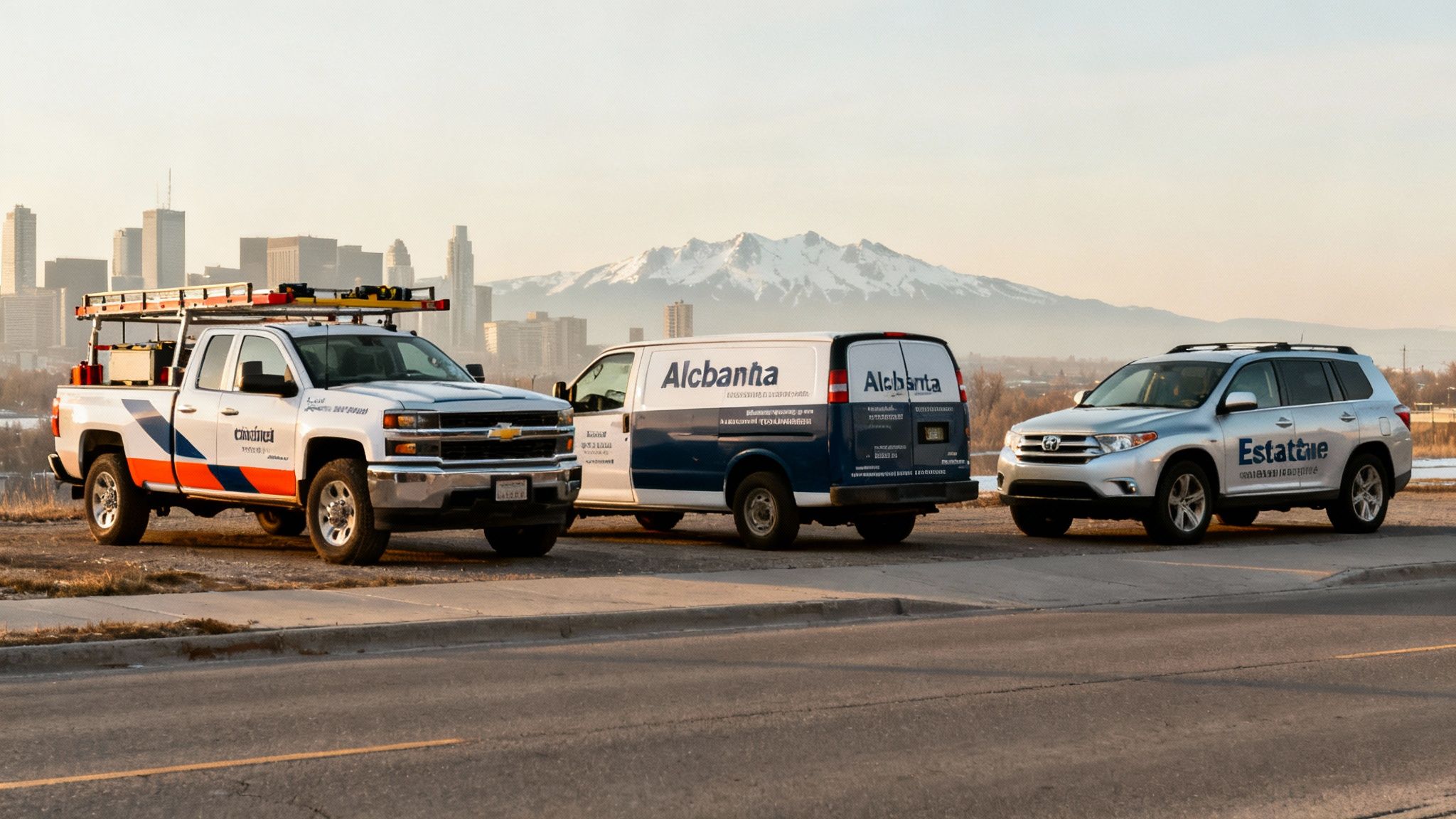
This distinction is critical. Most personal [auto insurance policies in Alberta](https://www.insuranceshope.ca/insurance/auto) have specific exclusions for business-related activities. If you get into an accident while doing something for work—like visiting a client, making a delivery, or hauling equipment—your personal insurer could outright deny the claim. That would leave you and your business on the hook for potentially devastating costs, from vehicle repairs to million-dollar lawsuits.
The Core Purpose of Commercial Coverage
At its heart, commercial auto insurance is designed to protect your business from the unique financial dangers of being on the road. When you operate a vehicle for work, the risks go far beyond a typical drive to the grocery store.
A specialized commercial policy provides a crucial safety net for:
* **Higher Liability Limits:** Accidents involving work vehicles can lead to more severe damages and injuries, demanding much higher liability coverage than personal policies offer. Smart businesses often carry $2 million or more. * **Employee Drivers:** It protects your business when an employee is driving a company vehicle or even using their own car for company business. * **Specialized Vehicles and Equipment:** It extends coverage to the work trucks, cargo vans, trailers, and even permanently attached equipment that are excluded from personal plans. * **Your Business Assets:** An at-fault accident can easily trigger a lawsuit that threatens your company's financial stability. This insurance protects your business assets from being seized to cover a legal judgment.
> In short, commercial auto insurance acts as a firewall between a road-related incident and your business's financial health. It ensures that a single bad day on the road doesn't derail your entire operation.
This coverage isn't just a smart business decision; for many operations, it's a legal requirement. It makes sure you meet provincial regulations while safeguarding your livelihood against the unpredictable nature of doing business on Alberta's roads.
Personal vs Commercial Auto Insurance: Key Differences at a Glance
To make it even clearer, here’s a quick breakdown of how these two types of policies stack up against each other. Understanding this is the first step to making an informed decision.
| Feature | Personal Auto Insurance | Commercial Auto Insurance | | :--- | :--- | :--- | | **Primary Use** | Daily commute, errands, personal travel | Transporting goods, tools, equipment, or people for business | | **Vehicle Types** | Cars, SUVs, and personal-use light trucks | Trucks, vans, trailers, specialized vehicles (e.g., dump trucks) | | **Coverage Limits** | Lower liability limits (e.g., **$200,000** minimum in AB) | Much higher liability limits (often **$1M**, **$2M**, or more) | | **Who's Covered** | Policyholder and listed family members | Business owner, employees, and anyone driving for the business | | **Cost** | Generally lower premiums | Higher premiums due to increased risk and higher limits | | **Policy Focus** | Protecting an individual and their family | Protecting business assets and operations from liability |
Ultimately, having the right commercial coverage gives you the peace of mind you need to keep your business moving forward, safely and securely.
Does Your Alberta Business Need Commercial Auto Coverage?
It can be a bit of a grey area, right? Figuring out where "personal driving" ends and "business use" begins. That quick run to the post office for your side hustle feels like any other errand, but in the eyes of an insurer, it might be a commercial trip. The key is to know the exact moment your vehicle stops being a personal convenience and becomes a tool for your business. That's the trigger for needing **commercial auto insurance in Alberta**.
Getting this wrong can have serious financial consequences. Your standard personal auto policy just isn't built to handle the higher risks that come with commercial driving. If you have an accident while on a work-related trip, you could be looking at a denied claim, leaving your business on the hook for crippling repair bills and liability lawsuits.
Identifying Commercial Vehicle Use
So, where do you draw the line? It’s often clearer than you might think. If you find yourself nodding "yes" to any of these questions, you’re almost certainly using your vehicle for business and need to get it covered properly.
* Do you haul goods, materials, or equipment as part of your service or for a fee? * Is your vehicle used to travel between different job sites, like a contractor visiting multiple projects? * Do you have employees who drive the vehicle for company-related tasks? * Do you carry specialized tools or equipment essential for your trade? * Is the vehicle officially owned by a corporation or a partnership?
This simple decision tree can help you see that dividing line between personal and business use for vehicles here in Alberta.
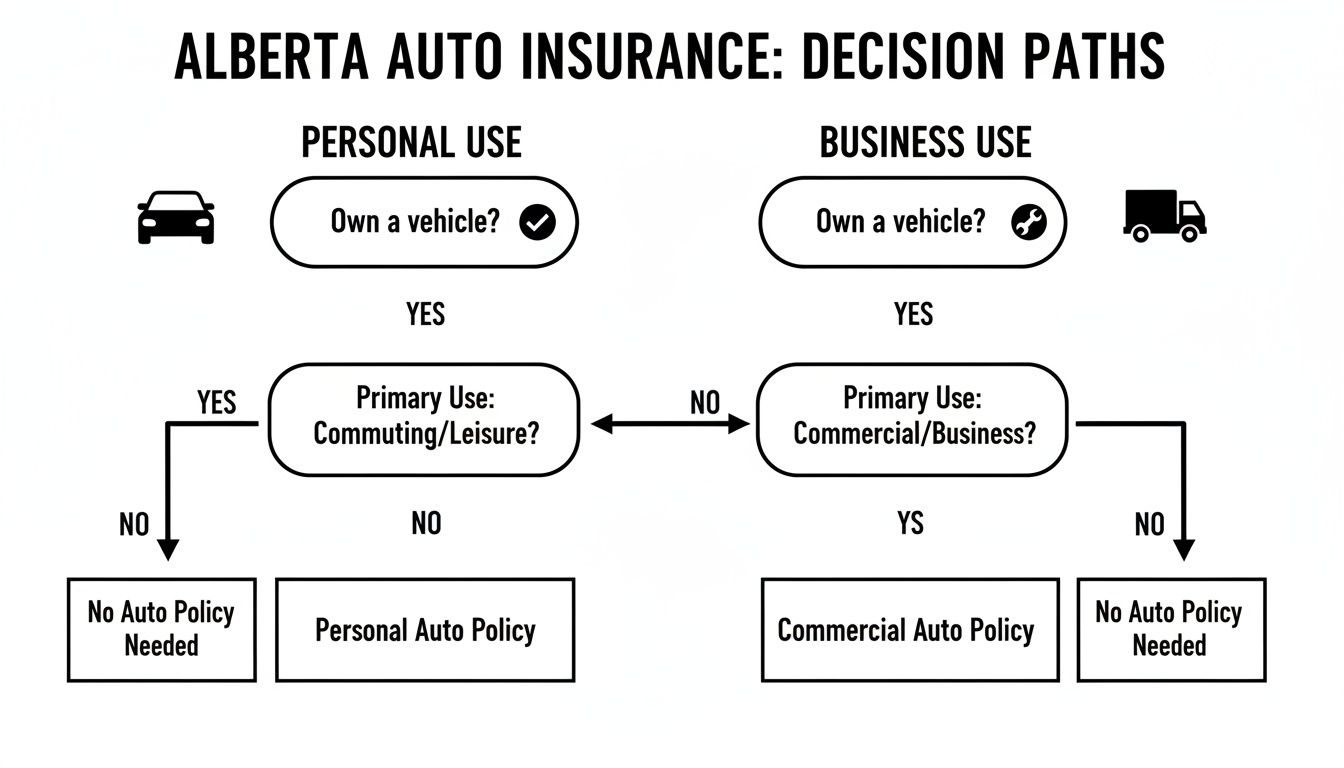
As the flowchart shows, the moment a vehicle is used to transport goods, tools, or people for your business, it crosses firmly into commercial insurance territory.
Real-World Scenarios in Alberta
Let’s move past the checklists and see how this plays out for actual Alberta businesses. These stories bring to life the specific risks that make a proper commercial policy non-negotiable.
**The Calgary Construction Company** Imagine a small construction outfit in Calgary with a few heavy-duty pickups. These trucks are always on the go, hauling everything from lumber and scaffolding to pricey power tools between job sites in Airdrie and Okotoks. One morning, an employee driving a fully loaded truck rear-ends someone on Deerfoot Trail during rush hour.
* **The Risk:** A personal policy would deny that claim in a heartbeat. The truck was being used for work, carrying tools, and driven by an employee. * **The Solution:** Proper commercial auto insurance steps in to cover the liability from the accident, the repairs to both vehicles, and can even protect the specialized tools that got smashed in the truck bed. It prevents a single accident from turning into a financial disaster.
**The Edmonton Courier Service** Think of an Edmonton-based courier who relies on a single cargo van to make dozens of time-sensitive deliveries every day. The high mileage and constant stop-and-go driving through downtown and the suburbs dramatically increase the odds of an accident. That van *is* the business.
* **The Risk:** Without commercial coverage, one at-fault collision wouldn’t just lead to a denied claim—it could shut the entire business down. * **The Solution:** A solid commercial policy provides the liability protection and collision coverage needed to get the van repaired and back on the road fast, keeping business interruption to a minimum.
**The Lethbridge Real Estate Agent** A real estate agent in Lethbridge uses her personal SUV to drive clients to property viewings a few times a week. It feels like personal driving, but she's actively conducting business and has clients in her car.
* **The Risk:** If she got into an accident with clients in the vehicle, her personal insurer would likely refuse to cover their injuries or any resulting lawsuits. This would put her personal and business assets in serious jeopardy. * **The Solution:** A commercial policy, or at the very least a specific business-use endorsement on her personal policy, ensures she’s covered for liability when clients are in her car.
> These examples drive home a critical point: it’s the *use* of the vehicle, not its make or model, that defines the need for commercial insurance. It’s a crucial distinction for protecting your operations.
The insurance industry is watching these risks closely. The upcoming **2025 AIRB Annual Review** for commercial vehicles in Alberta is set to be a major shift, as it analyzes recent loss trends to set new rate benchmarks. This follows a tough period where auto insurers saw net losses in four of the last six years through **2024**. Many major providers lost significant premium revenue, causing some to pull out of the market entirely, as detailed in a recent [Conning report on commercial auto trends](https://www.conning.com/about-us/news/ir-pr---2025-commercial-auto).
Of course, protecting your vehicles is just one piece of the puzzle. For a complete look at how to safeguard your entire company, be sure to read our guide on [business insurance essentials for Albertan entrepreneurs](https://www.insuranceshope.ca/blog/business-insurance-essentials-albertan-entrepreneurs). Understanding your unique needs is always the first step toward getting the right protection in place.
Decoding Your Commercial Auto Policy
Cracking open a commercial auto insurance policy can feel like you're trying to assemble furniture with the instructions written in another language. There are a lot of moving parts and unfamiliar terms, but getting a handle on them is the only way to make sure your business is actually protected.
Let's break down the essential building blocks of a typical policy for **commercial auto insurance in Alberta**.
Think of your policy like building a house. You start with a solid, legally required foundation, and then you add on extra layers and custom features to build a structure that perfectly fits your business.
The Mandatory Foundation of Your Coverage
In Alberta, every single vehicle on the road—commercial ones included—has to carry a basic insurance package. This isn't optional; it's the absolute legal minimum you need to operate. This foundation has three key parts that work together to protect you and everyone else on the road.
* **Third-Party Liability:** This is the absolute cornerstone of your policy. It covers the damage or injuries your driver causes to another person or their property if they're at fault in an accident. While the legal minimum in Alberta is just **$200,000**, most businesses carry much higher limits—usually **$1 million** or **$2 million**. Why? Because lawsuits and medical bills can skyrocket past that minimum in a heartbeat. You can learn more in our detailed guide on [what Third-Party Liability coverage is](https://www.insuranceshope.ca/blog/what-is-third-party-liability-coverage). * **Accident Benefits:** If you or your employees get hurt in an accident, this coverage kicks in to help with medical treatments, rehabilitation, and even income replacement. It applies regardless of who was at fault, making sure your team gets the care they need without the immediate financial stress. * **Direct Compensation for Property Damage (DCPD):** A newer addition in Alberta (since 2022), DCPD is all about streamlining the repair process. If you get into an accident and you're not at fault, your *own* insurance company pays to fix your vehicle. This gets you back on the road faster since you're only dealing with your insurer, not chasing down the other driver's company.
These three pieces form the non-negotiable core of your commercial auto insurance. They keep you legal and give you a fundamental layer of financial protection.
Building on the Foundation: Optional Coverages
That mandatory coverage takes care of your liability and basic medical needs, but what about damage to your *own* vehicles? That’s where optional coverages come in. They add crucial layers of protection for your most valuable business assets.
We've put together a quick table to show how these common options work.
Common Commercial Auto Coverage Options in Alberta
| Coverage Type | What It Covers | Example Scenario | | :--- | :--- | :--- | | **Collision or Upset** | Pays to repair or replace your vehicle after a collision with another object (like a car, guardrail, or building) or if it rolls over. | Your delivery van driver misjudges a turn and hits a light post, causing significant front-end damage. | | **Comprehensive** | Covers damage to your vehicle from non-collision events like theft, vandalism, fire, hail, floods, or hitting an animal. | A major hailstorm rolls through Calgary, leaving dozens of dents on the roof and hood of your company's pickup truck. | | **SEF 27** (Non-Owned Auto) | Extends your business liability coverage to an employee using their personal vehicle for work-related errands. | An employee driving their own car to a client meeting causes an accident. SEF 27 protects your business from the resulting lawsuit. | | **SEF 44** (Family Protection) | Protects you if you're hit by a driver who is uninsured or doesn't have enough liability coverage to pay for your injuries. | You're seriously injured by a hit-and-run driver. SEF 44 steps in to cover your medical costs up to your own policy's limits. |
These add-ons are what truly protect your investment. For businesses in Alberta, where hailstorms and wildlife on the roads are a real concern, comprehensive coverage isn't just a good idea—it's often essential.
> **Think of it this way:** Mandatory coverage is mostly about protecting *others* from the harm you might cause. Optional coverages are about protecting your *own stuff*—your trucks, vans, and equipment—from harm.
Customizing Your Policy with Endorsements
Beyond the main optional coverages, you can fine-tune your policy with **Standard Endorsement Forms (SEFs)**. Think of these as custom upgrades that plug specific gaps in your coverage. An endorsement can add a protection, remove an exclusion, or change the rules of your policy to better fit your operations.
Some of the most popular endorsements for Alberta businesses include:
* **SEF 27 Legal Liability for Damage to Non-Owned Automobiles:** This is a must-have if your employees ever use their own cars for work. It extends your company’s liability shield to cover them, protecting the business if they have an at-fault accident on the clock. * **SEF 32 Use of Non-Owned Vehicles:** If you rent or borrow vehicles for short-term use—like getting a rental truck for a big job—this endorsement provides physical damage coverage (Collision and Comprehensive) for that vehicle. * **SEF 44 Family Protection:** This is an important one. It tops up the difference if you or a family member are injured by a driver who has little or no insurance, ensuring you're not left with massive bills because someone else was irresponsible.
By carefully choosing these layers, you move beyond a one-size-fits-all policy. You're building a truly robust plan designed for how your business actually uses its vehicles on Alberta's roads.
What Drives the Cost of Your Insurance Premiums
Ever wonder why a Calgary construction company pays a wildly different premium for their truck insurance than a small floral delivery service in Red Deer? It’s not just a random number. Insurers are essentially risk analysts, and they put your business under a microscope to figure out the odds of you making a claim.
Getting a handle on these factors is the first step to controlling your costs. Once you know what’s pushing your premium up or down, you can start making smart changes that actually make a difference.
Your Fleet and How You Use It
The most obvious place an insurer starts is with the vehicles themselves and the job they do every day.
They’ll want to know the specifics, including: * **Vehicle Type, Age, and Value:** It costs a whole lot more to fix or replace a brand-new heavy-duty dump truck than a five-year-old cargo van. The higher the value, the higher the premium will be for physical damage coverages like Collision and Comprehensive. * **Vehicle Use and Radius of Operation:** A long-haul truck crossing Western Canada is on the road more and faces far more potential hazards than a local courier sticking to Edmonton’s city limits. The more kilometres you rack up, the greater the statistical chance of an accident. * **Industry and Cargo:** What you do for a living matters—a lot. A contractor hauling heavy equipment or flammable materials is a much higher risk than a real estate agent driving clients to showings. The potential for a truly catastrophic claim is just much higher in certain lines of work.
The People Behind the Wheel
Your vehicles are the assets, but your drivers are the ones in control. Their history on the road is one of the most powerful predictors of future risk, so insurers will take a very close look at the records of everyone you let drive.
> At its core, insurance is a game of prediction. An insurer's main goal is to figure out the likelihood of a future claim. A driver with a history of at-fault accidents or serious tickets is, statistically, much more likely to be involved in another incident, and that risk drives your premium up.
Key things they’ll check are: * **Driving Records (Abstracts):** Your insurer will pull the official driving record for each driver. They're looking for past accidents, traffic convictions (like speeding or distracted driving tickets), and any license suspensions. A clean abstract is your best friend when it comes to getting a lower rate. * **Years of Experience:** A seasoned trucker with decades of commercial driving under their belt is seen as a much safer bet than a brand-new hire getting behind the wheel of a big rig for the first time.
Broader Economic and Regulatory Factors
It's not all about you. Your premium is also shaped by bigger forces at play right here in Alberta. These external trends can cause rates to climb for everyone, even if you have a perfect record.
For instance, the Alberta Automobile Insurance Rate Board (AIRB) plays a huge role. The AIRB is already looking ahead to its 2025 Annual Review, which digs into industry-wide loss data. Right now, projections point to potential **7.5% premium increases** for fleet insurance in 2025. That’s a big jump from the **3.7%** hike in 2024, and it’s being driven by skyrocketing costs for vehicle parts and repairs.
Things like a spike in vehicle thefts across the province or a bad hailstorm season also push overall rates higher for everybody. Getting a sense of these bigger trends provides helpful context, and you can take a deeper dive into [how Alberta auto insurance rates are calculated](https://www.insuranceshope.ca/blog/alberta-auto-insurance-rates) in our related guide. When you know what insurers are looking for, you can start building a strategy to show them your business is as low-risk as they come.
Actionable Strategies to Lower Your Premiums
Knowing what drives your commercial auto insurance premiums is the first step. Now, it's time to take control. Lowering your insurance costs isn’t about cutting corners on coverage you need; it's about actively managing your risk and showing insurers that your business is a responsible, safe bet.
Putting a few key strategies into practice can lead to significant savings on your premiums, directly boosting your company’s bottom line. These are proven, practical methods you can start using today.
Cultivate a Strong Safety Culture
By far, the most powerful tool for cutting insurance costs is preventing claims before they even happen. Building a proactive safety culture does more than just keep your team safe—it sends a crystal-clear message to insurers that you are serious about managing risk. This goes way beyond just telling your drivers to "be careful."
A truly robust safety program includes:
* **Formal Driver Training:** Implement regular training sessions covering defensive driving, Alberta's unique road regulations, and crucial procedures for handling nasty weather like ice and snow. * **Clear Safety Policies:** Create and, more importantly, enforce written policies on hot-button issues like distracted driving, mobile phone use, and mandatory pre-trip vehicle inspections. * **Incentivize Good Driving:** Reward your drivers for keeping their records clean and staying claim-free. A small bonus, a gift card, or even just public recognition can go a long way in reinforcing safe habits.
Leverage Technology and Telematics
Modern tech gives us incredible tools for monitoring and improving how your team drives. **Telematics systems**, which use GPS and onboard diagnostics, provide real-time, unbiased data on driving habits.
This data lets you track metrics like speeding, hard braking, and sudden acceleration. By spotting these high-risk behaviours, you can offer targeted coaching to specific drivers, helping them correct unsafe habits before they cause an accident. Many insurers offer significant discounts for businesses that install and use telematics devices because it provides concrete proof of your commitment to safety.
> By actively managing driver behaviour with data, you’re no longer just telling an insurer you’re a low risk—you’re *showing* them. This tangible evidence can be one of your most effective negotiation tools for a lower premium.
Strategically Manage Your Policy and Fleet
The structure of your policy and the vehicles you put on the road also play a huge part in your final premium. Taking the time to review your coverage periodically can uncover great opportunities for savings.
Consider these tactical adjustments:
* **Review Your Deductibles:** A **deductible** is what you pay out-of-pocket on a claim before your insurance kicks in. Choosing a higher deductible can lower your premium, but just make sure you have the cash reserves to cover it if a claim happens. * **Bundle Your Policies:** This is often the easiest win. Most insurance providers offer discounts when you bundle multiple policies, like your commercial auto and commercial general liability. For a deeper dive, you can learn about the benefits of [multiple policy discounts in Alberta](https://www.insuranceshope.ca/insurance/blog/multiple-policy-discounts-alberta) in our dedicated guide. * **Choose Vehicles Wisely:** When adding new vehicles to your fleet, think about their safety ratings and typical repair costs. Vehicles that are cheaper to fix and come loaded with advanced safety features often cost less to insure from the get-go.
How to Get a Quote and What to Do in a Claim
Getting the right commercial auto policy or filing a claim can feel a bit overwhelming, but it doesn't have to be. With a little preparation and a clear roadmap, you can handle both with confidence. Think of it as replacing uncertainty with a solid plan, so you can focus on running your business, not stressing about insurance.
Getting an Accurate Quote
To find you the best coverage at the right price, an insurance broker needs a clear snapshot of your business operations. Having your information organized and ready to go not only makes the process faster but ensures the quote you get actually reflects your company's specific risks.
Before you call, it’s a good idea to have these details handy:
* **Business Info:** Your registered business name, address, and what your company actually does. * **Vehicle Details:** The year, make, model, and **Vehicle Identification Number (VIN)** for every car, truck, or van you want to insure. * **Driver Information:** A list of every employee who will be behind the wheel, including their driver's license numbers and dates of birth. * **Driver's Abstracts:** You'll need a recent driver's abstract (usually from the last **30 days**) for each driver. This gives a clear picture of their driving history. * **Operating Radius:** A realistic idea of how far your vehicles will travel from your home base—are you staying local, driving across Alberta, or heading out for long-haul trips?
With this information in hand, a broker can shop the market effectively and find a policy that truly fits your needs.
What to Do After an Accident
An accident is always stressful, but knowing what to do in the moments immediately following is key to a smooth claims process. Your actions in those first few hours can make a huge difference.
> The single most important part of any claim is documenting everything, right away. Clear, accurate records from the scene are the foundation for a fair and efficient claim, protecting your business from headaches down the road.
If one of your vehicles is involved in an incident, follow these steps:
1. **Safety First:** Check for injuries. If it's safe to do so, move the vehicles out of traffic. Call **911** immediately if anyone is hurt or the scene is dangerous. 2. **Report to Police:** In Alberta, you're legally required to report any collision to the police if the combined damage looks to be over **$5,000** or if anyone is injured. 3. **Exchange Information:** Get the names, contact info, driver's license numbers, and insurance details from everyone involved. Don't forget to grab the names and phone numbers of any witnesses, too. 4. **Document the Scene:** Use your smartphone. Take photos from every angle, capturing the damage to all vehicles, license plates, and the surrounding area, including road conditions or relevant signs. You can't have too many pictures. 5. **Call Your Broker:** Notify your insurance broker or provider as soon as you can. The sooner they know what happened, the sooner they can start the process of getting you back on the road.
Frequently Asked Questions
When it comes to **commercial auto insurance in Alberta**, a few key questions come up time and time again. Getting straightforward answers helps you make the right call for your business. Let’s tackle the most common queries we hear from local business owners.
Do I Need Commercial Insurance for My Personal Vehicle?
In almost every case where you use your personal vehicle for business, the answer is yes. Your standard personal auto policy is designed for your daily commute and running errands, not for work tasks. If you’re visiting clients, hauling tools, or making deliveries, your personal insurance likely won’t cover you if an accident happens on the job.
You’ll need either a full commercial policy or a specific “business use” endorsement on your personal one to avoid a major coverage gap. The best first step is always to chat with your broker about exactly how you use your vehicle so they can make sure you’re properly protected.
What Is the Difference Between Fleet and Non-Fleet Policies?
It really just comes down to the number of vehicles you’re insuring.
A **non-fleet policy** is what most small businesses start with. It’s designed for companies with just a handful of vehicles—usually fewer than five. Each vehicle is insured and rated individually.
A **fleet policy** kicks in when your business has **five or more vehicles**. It groups them all under a single, blanket policy. This approach is often more cost-effective per vehicle and much simpler to manage administratively as your operation grows.
How Can I Keep Premiums Low with Good Drivers?
This is a big one. Insurers love to see a business that’s serious about safety, and they’ll reward you for it with better rates. The key is to prove you’re actively managing your risk.
Here are a few practical steps you can take:
* **Pull driver’s abstracts regularly.** Make it a standard practice for every employee who gets behind the wheel of a company vehicle. This gives you a clear picture of their driving history. * **Create a formal driver safety policy.** Don't leave it to chance. Outline clear, non-negotiable rules on things like mobile phone use, pre-trip vehicle inspections, and what’s expected on the road. * **Reward safe driving.** Consider offering small incentives or bonuses for drivers who maintain a claim-free record. It’s a great way to encourage accountability.
For industries like trucking, requiring new hires to provide a comprehensive driver experience record is a must. It’s a powerful way to show insurers that you’re committed to putting only the best drivers on the road.
--- Ready to see how these strategies can impact your rates? The expert brokers at **InsuranceShope** are here to help you compare quotes from multiple top providers to find the best commercial auto coverage for your Alberta business. Get your free, no-obligation quote today and ensure your business is protected. Visit [https://www.insuranceshope.ca](https://www.insuranceshope.ca) to get started.