Understanding Direct Compensation Property Damage in Alberta
If you’re an Alberta driver, you’ve likely heard the term **Direct Compensation Property Damage (DCPD)**, especially since the insurance landscape shifted in 2022. But what does it actually mean for you when you're behind the wheel?
Simply put, DCPD is a smarter, faster system where *your own insurance company* pays to repair your vehicle after a collision you didn't cause. It was designed to replace the old, frustrating claims process, getting you back on the road quicker and with far less stress. Understanding how it works can empower you to find the best coverage and potentially save money.
Why DCPD Is a Game Changer for Alberta Drivers
Remember the old way? If someone hit you, you had to chase down *their* insurance company to get your car fixed. It was often a long, drawn-out process that felt like you were being penalized for someone else's mistake, caught between two insurers who might disagree on the details.
That all changed on **January 1, 2022**, when DCPD became standard in Alberta.
Now, instead of battling with an unfamiliar adjuster, you deal directly with the company you already chose and trust—your own. They manage your entire claim, covering repairs to your vehicle and its contents. It’s a streamlined approach that puts your needs first, making the process more efficient and consumer-friendly.
This is sometimes called a "no-fault" system, but that term can be misleading. Fault is still determined. The key difference is that you only have to deal with your own insurer for property damage repairs, regardless of who caused the crash.
What This Means for You
This shift makes a world of difference in the stressful aftermath of an accident. When you're not at fault, the DCPD system delivers significant benefits that can save you time, stress, and money:
* **Faster Claim Settlements:** By eliminating the back-and-forth between insurance companies, your claim is processed much more quickly. The goal is to get your car repaired and your life back to normal without unnecessary delays. * **Reduced Stress and Hassle:** You work with the people you chose to protect you. No more adversarial phone calls or feeling like just another claim number to a stranger's provider. * **No Deductible Payments:** This is a major financial win. In a DCPD claim where you are **0%** at fault, you do not have to pay your collision deductible to get your vehicle fixed.
> The real value of Direct Compensation Property Damage lies in its simplicity. It ensures that if you're not responsible for a collision, you won't be penalized with a complicated claims process or out-of-pocket deductible costs for repairs.
At its core, DCPD is about creating a fairer, more predictable process for responsible drivers. When you follow the rules of the road, you're rewarded with a smoother claims experience.
Understanding this coverage is the first step toward confidently navigating your [auto insurance in Alberta](https://www.insuranceshope.ca/insurance/auto). This guide will break down every aspect of DCPD, showing you how it works, what it covers, and how it can impact your ability to shop for better rates.
How A DCPD Claim Unfolds After An Accident
The moments after a collision are often stressful, but knowing what to expect can make the process much smoother. With Direct Compensation Property Damage (DCPD), the claims process in Alberta is designed to be straightforward and efficient, especially when you are not at fault.
It all starts with one simple action: you call **your own insurance company**, not the other driver's.
From that moment, your insurer takes charge. They become your single point of contact for arranging repairs, assessing damage, and getting you back on the road. This is the promise of DCPD—you deal directly with the company you trust, cutting out the delays and frustration of the old system.
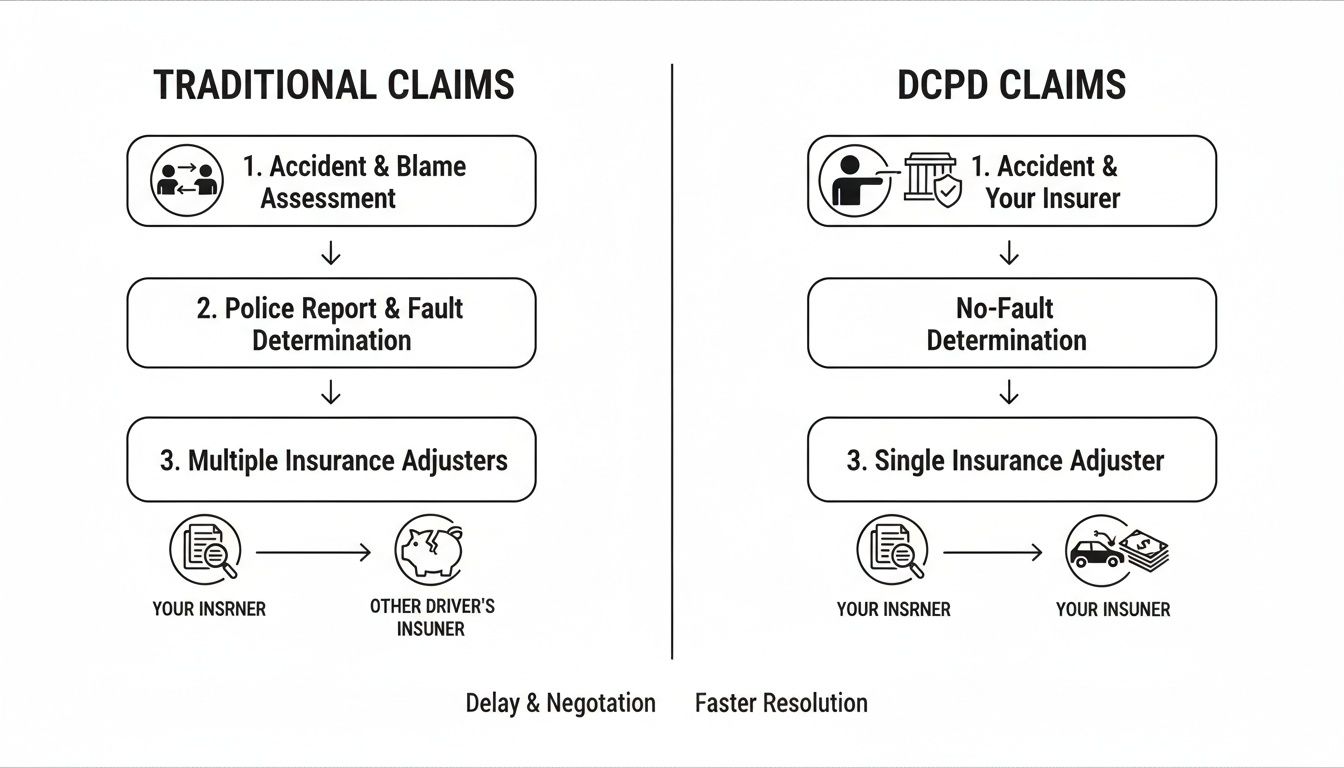
As the flowchart shows, this modern approach removes the driver-vs-driver conflict and replaces it with a partnership between you and your insurer, focused on a quick and fair resolution.
The Three Pillars Of A DCPD Claim
For your claim to qualify under DCPD—meaning your insurer handles everything and you don't pay a deductible—the accident must meet three specific criteria.
1. **The accident happened in Alberta.** DCPD is provincial legislation, so the collision must occur within Alberta's borders. 2. **Another insured vehicle was involved.** There must be at least one other vehicle in the accident, and that vehicle must also carry valid insurance. 3. **You were not at fault.** Based on Alberta’s official Fault Determination Rules, you must be found **0%** responsible for the collision.
If these three conditions are met, you're set. Your insurer will cover the repairs to your vehicle and any damaged personal belongings inside, all without you paying your collision deductible.
DCPD Claims vs. Traditional Claims: A Clear Comparison
To fully appreciate the benefits, let's compare the DCPD system to the old, fault-based approach. The table below highlights just how much simpler the process is now for the not-at-fault driver.
| Claim Process Step | DCPD System (Your Insurer Pays) | Traditional Fault-Based System | | :--- | :--- | :--- | | **Initial Contact** | You call **your own** insurance company to start the claim. | You had to file a claim with the **at-fault driver's** insurer. | | **Claim Management** | Your adjuster handles everything from start to finish. | You were stuck dealing with an unfamiliar adjuster from another company. | | **Fault Determination** | Your insurer determines fault based on provincial rules and pays you directly. | The other insurer had to investigate and formally accept liability first. | | **Repair Process** | Your insurer authorizes repairs immediately. | Delays were common while waiting for the other company to approve costs. | | **Disputes** | Any disagreements are handled between the insurance companies behind the scenes. | You might have had to pursue legal action against the other driver directly. |
The bottom line is clear: DCPD puts you in control by allowing you to work with the team you already know and trust, which can lead to significant savings in time and frustration.
Your Step-by-Step Guide To Filing a Claim
While your insurer handles the heavy lifting, the steps you take at the scene are crucial for a smooth claim.
* **Prioritize Safety:** First, check for injuries. If it's safe, move your vehicles out of traffic. Call **911** if anyone is hurt or the scene is hazardous. * **Exchange Information:** Calmly swap essential details with the other driver(s): name, contact info, driver's licence number, plate number, and insurance company name. Critically, **avoid discussing or admitting fault**. * **Document Everything:** Use your phone to take pictures of the scene. Capture the damage to both vehicles, their positions, and relevant details like traffic signs or road conditions. More photos are always better. * **File a Police Report:** In Alberta, you must report any collision with damages over **$2,000** (combined) or if there are any injuries. A police report provides an official, unbiased record. * **Call Your Insurer ASAP:** This is the most important step. Contact your broker or insurance company promptly. They will open your claim file and guide you on what to do next.
> A common misconception from the old system is waiting for the other insurer to "accept liability." With DCPD, that's no longer your concern. Your insurer has the authority to assess fault and move your claim forward immediately.
Once your claim is open, your adjuster will guide you through next steps, like finding an approved body shop and arranging a rental car if your policy includes it. For more answers, check our [expanded insurance FAQ section](https://www.insuranceshope.ca/faq/expanded).
By following these steps, you ensure your **direct compensation property damage** claim is handled as smoothly and efficiently as possible.
How Fault Is Determined Under Alberta's Rules
In the heat of the moment after a collision, drivers often disagree on who was responsible. However, in a Direct Compensation Property Damage claim, fault isn't a matter of opinion—it's determined by a standardized set of guidelines.
In Alberta, every insurer must use the **Fault Determination Rules** outlined in the province's Insurance Act. This ensures that fault is assigned consistently and fairly, no matter which company is handling the claim. Think of it as the official rulebook for accidents, removing subjectivity and ensuring a predictable outcome.
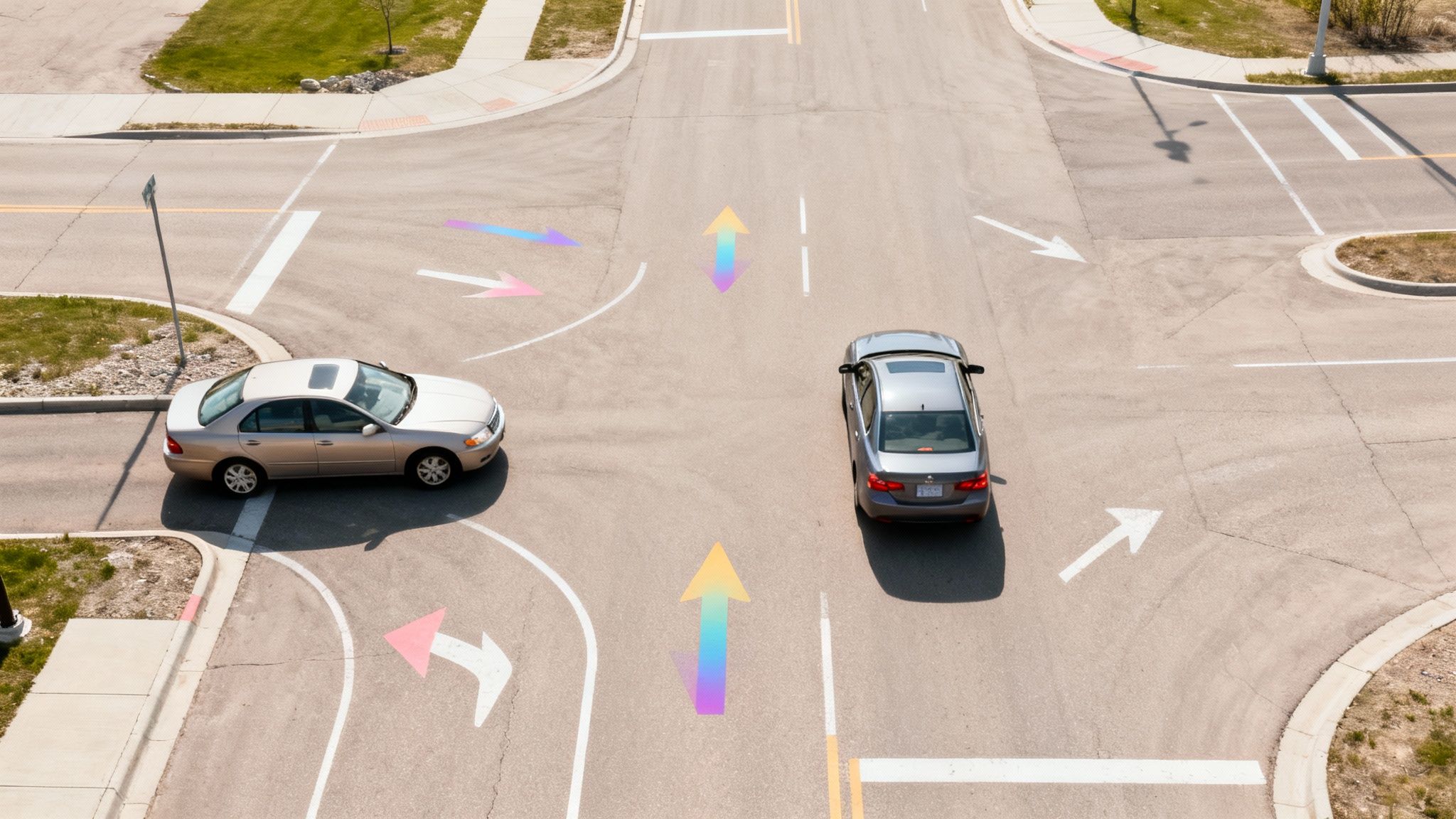
Your insurance adjuster will analyze the facts of the accident—the points of impact, traffic laws for that location, and police reports—and compare them against these established rules to assign a percentage of fault to each driver.
Common Scenarios Under The Fault Rules
Let's look at how the rules apply to some common collisions to see how they create clear, consistent outcomes.
* **Rear-End Collisions:** If you are stopped and another vehicle hits you from behind, the driver of that vehicle is almost always considered **100% at fault**. The rules presume that every driver must maintain a safe following distance. * **Left Turns at Intersections:** If you are making a left turn and collide with a car coming straight through the intersection from the opposite direction, you will typically be found **100% at fault**. The law requires the turning driver to yield the right-of-way. * **Improper Lane Changes:** A driver who changes lanes and sideswipes a vehicle already in that lane is generally found **100% at fault**. The responsibility is on the driver making the move to ensure the lane is clear.
These are just a few examples, but they highlight the clear-cut nature of many fault decisions. The rules cover dozens of specific scenarios, from parking lot fender-benders to complex intersection collisions, ensuring a consistent approach across the province.
Navigating Shared Fault Situations
Not every accident is black and white. Sometimes, the Fault Determination Rules find that both drivers contributed to the collision. In these cases, fault is split, which directly impacts your DCPD claim.
This is known as **contributory negligence** and is expressed as a percentage, like 75/25 or 50/50.
> The key takeaway is that your DCPD coverage only pays for the portion of damages for which you are **not** at fault. The amount your insurer pays is directly tied to the percentage of blame assigned to the other driver.
Let's see how this works with common fault splits:
* **75/25 Split:** If you are found **25% at fault**, your DCPD coverage will pay for **75%** of your vehicle's repair costs. To cover the remaining **25%**, you would need optional Collision coverage and would have to pay your deductible. * **50/50 Split:** If both drivers are equally responsible, you are **50% at fault**. Your DCPD will cover **50%** of your damages. Again, you would rely on Collision coverage to handle the other half, minus your deductible.
Understanding these fault rules demystifies the claims process. It’s not an arbitrary decision but a regulated, predictable system. For a deeper look, learn more about finding the right [insurance coverage in Alberta](https://www.insuranceshope.ca/alberta) with a knowledgeable broker who can help you compare options and save.
Understanding Your DCPD Coverage Limits
To get the most value from your car insurance, it's essential to know what Direct Compensation Property Damage (DCPD) covers—and just as importantly, what it *doesn’t*. Think of DCPD as a specialized tool in your policy. It excels at handling not-at-fault collision damage, but it isn't designed for every possible scenario.
Understanding these boundaries is key to ensuring you're fully protected and not overpaying for redundant coverage.
What Your DCPD Coverage Includes
When you're in a not-at-fault accident, your DCPD coverage is the first line of defense. Its primary job is to restore you and your vehicle to your pre-accident state without you having to pay your deductible.
Here’s a breakdown of what’s covered:
* **Vehicle Repairs:** DCPD pays for the parts and labor to fix your vehicle. If your car is a total loss, it covers its actual cash value. * **Damage to Contents:** The policy also covers personal items inside your vehicle that were damaged, such as a laptop, sports equipment, or groceries. * **Loss of Use:** If you have this endorsement on your policy (often called OPCF 20), DCPD will cover the cost of a rental car while yours is being repaired, up to your policy limits.
> The purpose of direct compensation property damage is to make you financially whole after an accident you didn’t cause. It’s designed to cover the direct physical and logistical costs of vehicle damage from another insured driver.
This system is a pillar of modern insurance. Property damage drives the vast majority of claims, making up about **97.3%** of homeowners insurance claims in 2023. While that statistic is for homes, the principle is the same for auto insurance—covering property loss is a core function. You can find more [insights on property claim trends](https://www.iii.org/fact-statistic/facts-statistics-homeowners-and-renters-insurance) at the Insurance Information Institute.
Common Scenarios Where DCPD Does Not Apply
Knowing what *isn't* covered is just as crucial. These scenarios are precisely why other coverages like Collision and Comprehensive are vital for a complete protection plan.
Your DCPD claim won’t apply in these situations:
* **You Are At Fault:** If you are found partially or fully responsible, DCPD won't cover your share of the damages. * **Single-Vehicle Accidents:** If you hit an object like a guardrail or a tree, there is no other insured driver involved, so DCPD doesn't apply. * **Hit-and-Run Incidents:** When an unknown driver hits your vehicle and leaves, your insurer cannot recover costs. Your own Collision coverage would be needed here. * **Collisions with Uninsured Drivers:** The DCPD system requires the other driver to have valid insurance. If they don't, your Uninsured Motorist coverage would apply instead. * **Accidents Outside Alberta:** As DCPD is an Alberta-specific system, it only applies to accidents within the province.
These exclusions highlight how different parts of your auto policy work together. DCPD is your go-to for not-at-fault collisions, but Collision and Comprehensive coverage provide the safety net for almost everything else. Having the right mix ensures you're protected from a wide range of risks, giving you true peace of mind.
How a DCPD Claim Affects Your Insurance Premiums
This is the question on every driver’s mind after an accident: "Will my insurance rates go up?" When it comes to Direct Compensation Property Damage (DCPD), the answer is a major relief for responsible drivers and a key factor in keeping your insurance affordable.
One of the greatest benefits of the DCPD system is that **a not-at-fault claim will not harm your driving record or directly cause your premiums to increase.** Your insurer will not penalize you for an accident you didn't cause. This system is designed to protect safe drivers from the financial consequences of someone else's mistake.
The Clear Line Between DCPD and Collision Claims
To understand the impact on your wallet, it’s vital to see the difference between a DCPD claim and an at-fault claim handled by your Collision coverage.
* **DCPD Claims (Not-At-Fault):** When the other driver is **100%** responsible, your DCPD coverage pays for your repairs. This does not go on your record as an at-fault incident, so it doesn't trigger a rate increase based on your driving history. * **Collision Claims (At-Fault):** If you are found responsible, you will rely on your optional Collision coverage. This type of claim almost always leads to higher premiums at renewal because it indicates a higher risk to your insurer.
This distinction creates a powerful financial incentive to drive safely. By following the rules of the road, you are shielded from the premium hikes that come with at-fault accidents.
> Think of a DCPD claim as your reward for being a good driver. It protects you from rate increases, ensuring you don't pay more for a crash you didn't cause. A clean record is your best tool for shopping around and finding lower insurance rates.
But What About Overall Rate Increases?
While your individual not-at-fault DCPD claim won't directly raise your rates, it's important to understand the bigger picture. Insurance premiums are also influenced by province-wide trends. Insurers set rates based on the total cost and frequency of claims they pay out for all drivers, not just you.
Several factors can push rates up for everyone, regardless of their driving record:
* **Skyrocketing Repair Costs:** Modern vehicles are filled with expensive sensors, cameras, and computers, making even minor repairs costly. * **More Severe Weather:** Major events like hailstorms or floods can lead to thousands of claims at once, increasing costs for all insurers in Alberta. * **Higher Claims Volume:** If the total number of accidents across the province rises, insurers may adjust rates for everyone to cover these increased costs.
So, while your personal driving record remains clean after a DCPD claim, your premiums might still be affected by these broader market forces. This is similar to how a bad wildfire season can impact home insurance rates for an entire region.
To learn more, check out our guide on [why insurance rates can be high in Alberta](https://www.insuranceshope.ca/blog/why-insurance-rates-high-alberta). Understanding the difference between your personal record and market trends empowers you to make smarter choices when shopping for insurance.
Why an Insurance Broker Is Your Best Ally
Navigating insurance after a car accident can feel overwhelming. While understanding concepts like **direct compensation property damage** is a great first step, you don't have to manage it alone. This is where a professional insurance broker becomes your most valuable partner in securing the best coverage and price.

Unlike an agent who works for a single insurance company, a broker works for *you*. Their primary role is to understand your needs, shop the market on your behalf, and find the best coverage from a variety of insurers at a competitive price, helping you save money.
Your Advocate Before and After a Claim
A broker's value extends far beyond the initial sale. They are your dedicated advocate, offering expert guidance at every stage.
Before you ever need to file a claim, a good broker ensures your policy is tailored to your needs, explaining what’s covered and where you might have gaps. This proactive advice helps prevent costly surprises later on.
When an accident happens, their support is invaluable. They can walk you through the claims process, clarify how fault is determined, and serve as your liaison with the insurance adjuster.
> An insurance broker is more than a salesperson; they are a professional advisor committed to your financial protection. If a dispute over fault or repair costs arises, they are in your corner, fighting for your interests to ensure a fair outcome.
This advocacy is critical during a complex claim. For example, after major California wildfires, agency experts directly assisted over **5,000** consumers with property damage claims, demonstrating the immense value of a knowledgeable guide. You can [read more about this powerful consumer support](https://www.insurance.ca.gov/0400-news/0100-press-releases/) on the Department of Insurance website.
Finding the Right Coverage at the Right Price
The insurance market can be complex and confusing. A broker simplifies the process, saving you time and money.
* **Expert Knowledge:** They are experts in Alberta's insurance rules, including the specifics of DCPD. * **Market Access:** Brokers work with a wide range of insurers, giving you access to more options and competitive pricing than you could find on your own. * **Unbiased Advice:** Since they don’t work for one company, their recommendations are focused solely on what's best for your needs and budget.
Partnering with a broker provides peace of mind. You get a trusted advisor who not only helps you secure the best policy but also stands by you when you need it most.
Ready to see how an expert can improve your coverage and help you save? [Connect with an Alberta insurance professional](https://www.insuranceshope.ca/contact) for a free, no-obligation review of your current policy.
Your Top DCPD Questions, Answered
Even with a good understanding of DCPD, a few common questions often arise. Let's tackle them to ensure you feel confident about your coverage.
What Happens If The At-Fault Driver Is From Outside Alberta?
This is a common concern on Alberta's busy highways. The good news is you are still covered.
As long as the collision occurred in Alberta and the other driver has valid insurance from their home province or state, your claim proceeds as a standard DCPD claim. Your own Alberta insurer will handle everything. Insurers across Canada and the U.S. have agreements to streamline this process, so you get the convenience of dealing with your own company.
Do I Still Need To Buy Collision Coverage?
Yes, absolutely. This is a critical point for ensuring you're fully protected. DCPD is excellent, but it only applies when you are **not at fault**.
Collision coverage is your safety net for all other scenarios. It pays to repair your car when *you* are at fault, or in situations where DCPD doesn't apply.
Consider these common situations where only Collision coverage can help: * You hit a patch of black ice and slide into a guardrail. * A hit-and-run driver damages your parked car and cannot be identified. * Any accident where you are found **50% or more** responsible.
> A simple way to remember the difference: DCPD protects you from other people's mistakes. Collision coverage protects you from your own mistakes and from unfortunate situations with no one else to hold accountable. An insurance broker can help you find the right balance of coverage to save you money without leaving you exposed.
What Can I Do If I Disagree With The Fault Decision?
If you believe the fault decision is incorrect, you have the right to dispute it.
Start by discussing it with your insurance adjuster. Provide any evidence that supports your case, such as dashcam footage, witness information, or a diagram of the scene.
If you cannot reach an agreement, you can escalate the issue to the insurance company's internal ombudsperson. If that fails, the General Insurance OmbudService (GIO) offers an independent, third-party resolution process for consumers.
Does DCPD Cover Injuries To Me Or My Passengers?
No. As the name implies, Direct Compensation **Property Damage** is strictly for damage to your vehicle and its contents. It does not cover medical bills, lost wages, or other injury-related costs.
For injuries, you would turn to the **Accident Benefits** section of your policy. This coverage is mandatory in Alberta and provides medical and other benefits to you and your passengers after a collision, regardless of who was at fault.
--- Understanding the details of **direct compensation property damage** highlights the importance of having an expert in your corner. At **InsuranceShope**, we connect you with experienced Alberta brokers who review your entire policy to ensure you have complete protection at the best possible price. [Get your free, no-obligation quote today and drive with confidence.](https://www.insuranceshope.ca)