Does Speed Camera Ticket Affect Insurance? Your Practical Alberta Guide
Let's get straight to the point. That dreaded photo radar ticket you found in the mail? In Alberta, a standard speed camera ticket **will not directly affect your insurance rates**.
It's a common question, and thankfully, the answer is a sigh of relief for most drivers. Because automated enforcement can't prove who was actually behind the wheel, the ticket is issued to the vehicle's owner, comes with **zero demerit points**, and doesn't get recorded on your personal driving abstract. This is a critical distinction that can save you from years of higher insurance premiums.
How Your Insurance Company Sees a Camera Ticket
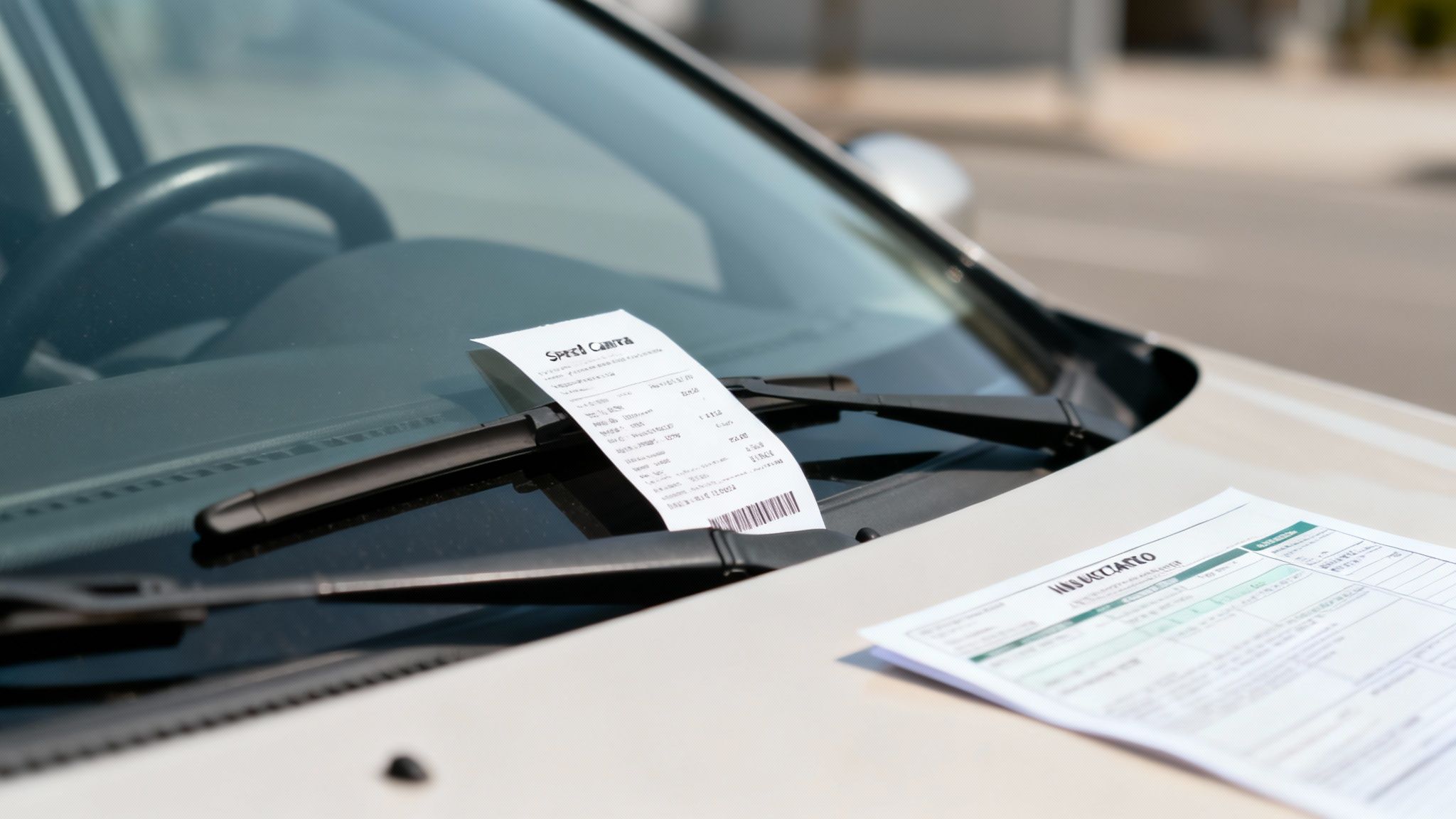
When an insurance company calculates your premium, their goal is to assess how risky you are as a driver. To do this, they pull your driving abstract—think of it as your official driving report card. It lists all the convictions for moving violations that come with demerit points.
A speed camera ticket, on the other hand, is treated more like a parking ticket.
Think about it this way: if your car is ticketed for being parked in a no-parking zone, the city has no idea who parked it there. All they know is that the vehicle violated a rule. The ticket goes to the registered owner, but it says nothing about their personal driving skills.
Automated speed enforcement works on the same principle. The camera snaps a picture of your licence plate, not a crystal-clear photo of the driver. Since they can't confirm your identity, the system can't assign blame (and more importantly, demerit points) to a specific person.
> The key takeaway is simple: No demerit points means no record on your abstract. And if it’s not on your abstract, your insurance company won't see it when they calculate your premium. It's a fine against the vehicle, not a black mark against your driving record.
Automated vs. Police-Issued Tickets: A Tale of Two Tickets
To really grasp **does speed camera ticket affect insurance**, you need to see the difference between the ticket you get in the mail and one an officer hands you at the roadside.
The distinction is critical for every Alberta driver. One costs you a one-time fine, while the other can lead to thousands in higher premiums over several years. Understanding this is fundamental to managing your overall [auto insurance costs](https://www.insuranceshope.ca/insurance/auto) and keeping your rates from creeping up.
For a quick breakdown, here's how the two stack up.
Speed Camera vs. Police-Issued Ticket Impact Summary
This table shows the core differences at a glance:
| Factor | Speed Camera Ticket (Automated) | Police-Issued Speeding Ticket | | :--- | :--- | :--- | | **Issued To** | The registered owner of the vehicle. | The specific individual driving the car. | | **Demerit Points** | **None.** This is the most critical difference. | **Yes.** Points are assigned based on speed. | | **Impact on Driving Record** | **No.** It does not appear on your abstract. | **Yes.** It is recorded as a conviction. | | **Insurance Rate Impact** | **None.** Insurers do not see this ticket. | **Yes.** Can cause significant premium increases. |
As you can see, getting pulled over by a police officer has much more serious and long-lasting consequences for your driving record and your wallet. The automated ticket is a nuisance; the police-issued one is a problem.
How Your Driving Record *Actually* Works in Alberta
To really get why a speed camera ticket won't have your insurance company breaking a sweat, you need a peek behind the curtain at how they see you as a driver. It all boils down to one critical document: your **driving abstract**.
Think of your driving abstract as your official report card for the road. It’s a summary of your driving history maintained by the Alberta government, and it’s the main playbook insurance companies use to figure out how risky you are to insure.
This document doesn't track every little thing. It zeroes in on convictions for moving violations—the kind that come with demerit points. This is the absolute key to why a speed camera ticket is different; it's a fine against your vehicle's owner, not a conviction against you personally.
The Vehicle Fine vs. The Driver Conviction
Imagine you lend your car to a friend, and they get a parking ticket. You, as the registered owner, get the bill. A speed camera ticket works on the exact same principle.
Because the camera can’t prove who was actually behind the wheel, the violation is tied to the vehicle's registration. It's treated like a civil penalty—an administrative issue, not a mark against your driving skill.
> A ticket from a police officer, on the other hand, is a whole different ball game. When an officer pulls you over, they identify *you* as the driver. If you're convicted, that violation becomes a black mark on your personal driving abstract. This one distinction changes everything for your insurance.
Nailing down this difference is crucial. One is a one-time financial headache. The other is a formal conviction that shadows you for years, flagging you as a higher risk to insurers and pushing up your premiums.
What Insurers Are *Actually* Looking For
When an insurance underwriter pulls your abstract, they're searching for patterns of risky behaviour. A photo radar ticket with no demerits attached simply doesn't show up on their radar.
They are looking for official convictions that tell a story about you as a driver, such as:
* **Speeding tickets** handed out by a police officer. * **Distracted driving** violations. * **Running a red light** or stop sign. * **Impaired driving** convictions.
These offences signal a higher chance of you being in an accident and making a claim, which is a major red flag for any insurer. The system is designed to link personal actions to financial consequences—a core concept that also powers how Alberta's no-fault insurance system operates. You can **[explore our guide on no-fault insurance in Alberta](https://www.insuranceshope.ca/blog/no-fault-insurance-explained-alberta)** to learn more.
This is exactly why a police-issued ticket can hit your wallet so hard for so long. For example, looking at jurisdictions with similar insurance systems gives us a clear picture. In California, just one speeding conviction can jack up auto insurance premiums by an average of **20% to 39%**. That translates into hundreds, or even over a thousand dollars, in extra costs every single year, often for three years straight. While the exact hike depends on the insurer, it’s a stark reminder of how a personal conviction directly inflates your rates.
Ultimately, your driving abstract tells a story. A clean one tells insurers you’re a safe, responsible driver, earning you the best rates. A record littered with convictions paints you as a higher risk, and your premiums will absolutely reflect that. A speed camera ticket, thankfully, never gets to be part of that story.
The Tickets That Will Actually Hike Your Insurance Rates
While that flash from a speed camera is a hit to your wallet, it’s a sigh of relief for your insurance premium. But don't get too comfortable—not all tickets are created equal. To really get why this matters, we need to talk about the violations that insurers absolutely notice and that will send your rates climbing.
These are the tickets handed to you directly by a police officer. They’re the ones that lead to a **conviction** on your personal driving abstract. Unlike an automated ticket tied to your vehicle's license plate, these violations are a direct mark against *you* as a driver.
Moving Violations and Your Driving Abstract
When a police officer pulls you over for a moving violation, a totally different chain of events kicks off. If you pay that fine or are found guilty in court, the offence gets logged as a conviction on your driving abstract. This abstract is the official report card that insurers pull to see what kind of risk you represent.
This conviction doesn't just come with demerit points; it flags you in the insurance company's system as a higher-risk driver. Insurers live and breathe statistics, and the data clearly shows that a history of moving violations is linked to a higher chance of future claims.
Common convictions that will push your premiums up include:
* **Speeding tickets** from an officer, especially for going well over the limit. * **Distracted driving** tickets, like being caught on your phone. * **Failing to obey a traffic sign**, such as blowing through a stop sign or red light. * **Improper lane changes** or tailgating another vehicle. * **Careless driving**, a serious charge with a major impact on your rates.
Each of these convictions tells an insurer a story about your habits behind the wheel. And more often than not, that story ends with a higher premium come renewal time.
> To an insurer, a conviction isn't just a fine you paid. It's a data point that proves you've taken risks on the road. This prompts them to adjust your rates—often with a surcharge that can stick to your policy for **up to three years**—to balance out the higher odds of a future accident.
How Insurers See the Risk
Insurance companies use a process called **underwriting** to figure out how much you should pay. While they look at a few things, your driving record is one of the heaviest factors. A recent conviction on your abstract is a big red flag for an underwriter.
Think of it as a credit score, but for driving. A clean record shows you’re a safe bet, and you’ll be rewarded with the best rates. A record dotted with convictions, however, lowers your "driving score," and you’ll pay more because of it.
A single conviction for speeding can bump your premium by **20% or more**, depending on how fast you were going and the insurer’s specific rules. More serious offences, like distracted or careless driving, can trigger even bigger hikes. Collect a few convictions, and you can quickly find yourself in a high-risk category, scrambling for affordable coverage. If you're in that boat, it’s important to know your options; our guide on **[car insurance for high-risk drivers in Alberta](https://www.insuranceshope.ca/blog/car-insurance-for-high-risk-drivers)** can help you navigate that challenge.
The message here is crystal clear. A speed camera ticket is a one-time financial sting. A police-issued moving violation, on the other hand, creates a long-term financial headache. It's not just the cost of the fine itself, but the compounding effect of higher insurance premiums for the next three years. That direct link between a conviction and your wallet is a powerful reminder to drive safely and attentively every single time you start the car.
A Tale of Two Tickets: The Real Financial Impact
To really get to the bottom of whether a speed camera ticket affects your insurance, let's step away from the abstract and look at a real-world comparison. The financial gap between a ticket from a camera and one from a police officer isn't just a few bucks—it's a chasm that gets wider and wider over several years.
Imagine two Alberta drivers, both caught doing the same speed over the limit. Their stories take wildly different turns based entirely on *how* they got their ticket. This tale of two tickets proves why a clean driving record is one of your most valuable financial assets.
Driver A: The Simple Fine
Our first driver, let's call her Driver A, gets flashed by a speed camera. A week or so later, a **$150** ticket shows up in the mail. She pays it online, and that's it. Story over. Her total out-of-pocket cost is exactly **$150**.
Because it's an automated ticket with no demerit points, it's a non-event for her insurance. The ticket never hits her driving abstract, so her insurance company never even knows it happened. Her premiums stay exactly the same. For Driver A, it's a minor, one-time inconvenience.
Driver B: The Compounding Cost
Driver B isn’t so lucky. Instead of a camera, a police officer pulls him over for the very same speeding offence. He gets a similar **$150** fine, but this one comes with a nasty surprise: two demerit points. That single difference kicks off a financial chain reaction that will sting for the next three years.
As soon as Driver B pays the fine, it becomes a conviction on his driving abstract. At his next insurance renewal, his provider sees the new conviction and immediately flags him as a higher-risk driver. The result? His premium goes up.
Let's break down the real financial damage. We'll assume Driver B pays a modest **$1,500 per year** for insurance before the ticket. A single speeding conviction can easily trigger a **20-25% surcharge** on the policy.
Using a conservative **20%** increase, his annual premium jumps by **$300**. And that surcharge isn't a one-and-done deal; it typically stays on a policy for three full years—the same length of time a conviction remains on an Alberta driving abstract.
> The initial $150 fine is just the tip of the iceberg for Driver B. The real cost is buried in the compounding insurance hikes that follow him for years, turning a simple mistake into a significant financial burden.
This chart shows just how much common tickets can drive up your premiums. It’s a clear illustration of why convictions from police for things like speeding, distracted driving, or running a stop sign carry such a heavy financial penalty.
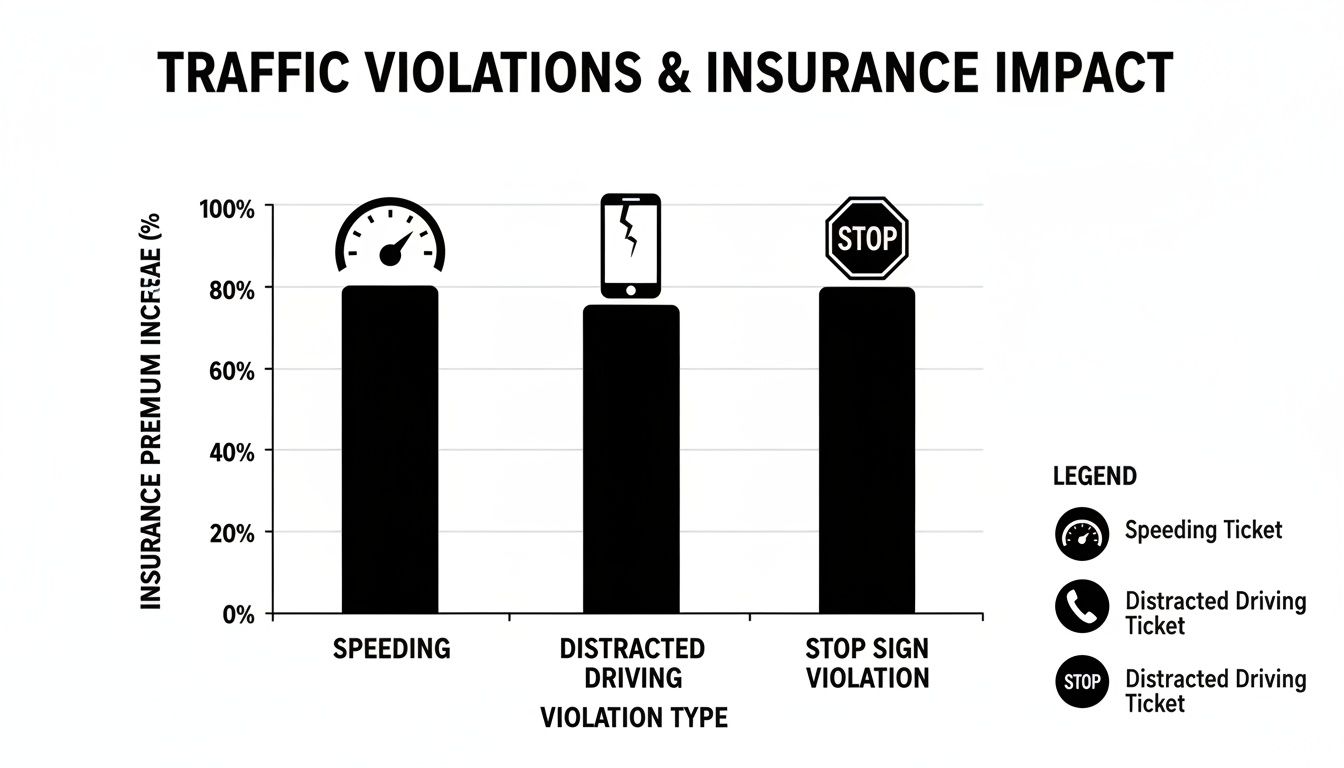
As you can see, these are precisely the kinds of violations insurers are looking for when they set your rates.
To really drive the point home, let's compare the total financial damage for our two drivers over three years. The numbers don't lie.
Three-Year Cost Comparison of Ticket Types
| Cost Factor | Speed Camera Ticket Scenario | Police-Issued Ticket Scenario | | :--- | :--- | :--- | | **Initial Fine** | $150 | $150 | | **Year 1 Premium Increase** | $0 | $300 | | **Year 2 Premium Increase** | $0 | $300 | | **Year 3 Premium Increase** | $0 | $300 | | **Total 3-Year Cost** | **$150** | **$1,050** |
The grand total for Driver B's single police-issued ticket is **$1,050**.
That’s a staggering **$900 more** than what Driver A paid for the exact same mistake. This powerful example makes the distinction crystal clear: a speed camera ticket costs you once, but a police-issued ticket with demerits costs you again and again for years to come. Protecting your driving record from convictions is the single most effective thing you can do to keep your insurance rates low and predictable.
Your Action Plan for Handling a Camera Ticket

Finding a speed camera ticket in your mailbox is never a pleasant surprise. But before your mind starts racing about insurance hikes, take a deep breath. This isn't a five-alarm fire for your driving record, and with a clear plan, you can handle it calmly and correctly.
The very first step is simple: don't panic. Read the entire notice carefully, from top to bottom. Make sure everything is accurate—your licence plate, the location, and the date and time. While rare, clerical errors can happen.
Next, find the deadlines. The notice will clearly state the due date for payment or for contesting the ticket. Missing these dates can cause a real headache, leading to extra fees or even preventing you from renewing your vehicle registration down the road. It's best to act promptly.
Verifying and Paying Your Ticket
Once you've confirmed the ticket's details are correct, you've got a decision to make. For most people, the simplest path forward is just to pay the fine. The ticket will give you several ways to do this, usually including online portals, mail-in cheques, or in-person payments at a registry agent.
Paying the fine is an admission of liability for the vehicle, but it's crucial to understand what it is *not*. It is **not** a conviction against your personal driving record. Your insurance company won't be notified, and it will have zero impact on your rates.
When You Weren't the Driver
What happens if you weren't the one behind the wheel? This is a common situation, especially in households where a car is shared. The law holds the registered vehicle owner responsible for the fine, but you do have options.
In Alberta, you can "nominate another driver" if someone else was driving your car. This involves filling out a form to officially declare who was operating the vehicle at the time. Keep in mind this may transfer responsibility for the fine to that individual.
> The most important thing to remember is that the ticket is tied to the **vehicle**, not the person. As the owner, you're the first point of contact and ultimately responsible for making sure the fine is handled, whether you pay it yourself or formally nominate the person who was actually driving.
Disputing an Error or Inaccuracy
Sometimes, you might have legitimate grounds to dispute a ticket. If you genuinely believe there's been a clear error, you have every right to challenge it in court.
Common reasons for a successful dispute include:
* **You had already sold the vehicle:** If you can provide a bill of sale dated before the infraction, the ticket can be dismissed. * **Your vehicle was reported stolen:** A police report showing the car was stolen before the ticket was issued is essential evidence. * **The vehicle information is incorrect:** A ticket listing the wrong make, model, or licence plate number may be invalid.
Handling a ticket correctly is just one piece of the puzzle. Being proactive about your auto insurance policy is just as important, especially when it's time to **[learn about the process to renew auto insurance](https://www.insuranceshope.ca/blog/renew-auto-insurance)**. Understanding both sides of the coin—dealing with infractions and managing your policy—empowers you to keep your costs down and stay protected on the road.
How to Protect Your Driving Record and Lower Your Insurance Rates
It’s definitely a relief to know a speed camera ticket won’t mess with your insurance rates, but let's be honest—the real goal is to keep your driving record spotless and your premiums as low as humanly possible. This isn’t about just avoiding the flash of a camera; it’s about taking a proactive approach to both your driving and your insurance policy.
At the end of the day, a clean driving record is your single best tool for long-term savings. That means practicing defensive driving, keeping an eye out for changing speed limits, and putting distractions away every single time you’re behind the wheel. A perfect record is the best leverage you have when it comes to getting the lowest rates.
Take Control of Your Insurance Profile
One of the smartest moves you can make is to see exactly what your insurer sees. In Alberta, you can easily order a copy of your own driving abstract from any registry agent. Think of this as your official driving report card—it lists all the convictions and demerit points that insurers use to figure out your premiums.
Grabbing a copy of your abstract lets you: * **Verify Accuracy:** Make sure there are no mistakes or old convictions that should have been removed by now. * **See Your Standing:** Get a clear picture of how an insurance underwriter views your history. * **Prepare for Renewals:** You’ll know what’s coming when your policy is up for renewal, so you can have an informed conversation about your record.
This one simple step changes you from a passive policyholder into an informed consumer who can make smart decisions.
> Knowledge is power when it comes to insurance. By regularly checking your driving abstract, you eliminate surprises and can address any inaccuracies before they have a chance to impact your rates, ensuring you're only paying for the risk you actually represent.
The Most Effective Way to Save Money
Even with a perfect record, the most powerful tool for slashing your insurance bill is **comparison shopping**. Insurance isn't a one-size-fits-all product. Every company uses a slightly different formula to calculate risk, which means the price for the exact same coverage can be wildly different from one insurer to the next.
This is especially true if you do have a conviction on your record. One company might jack up your premium by **25%** for a minor speeding ticket, while another might only add a **15%** surcharge. If you don't compare, you could be leaving hundreds of dollars on the table every year. The absolute best way to find these savings is to work with an independent insurance broker who can pull multiple quotes for you.
On top of that, bundling your policies is a tried-and-true savings strategy. To see how this works, **[learn more about bundling your policies to save on Alberta insurance](https://www.insuranceshope.ca/blog/multiple-policy-discounts-alberta-insurance)**. An expert can help you pinpoint every discount you qualify for to really maximize your savings.
Ultimately, protecting your driving record and actively shopping for the best rate are two sides of the same coin. A clean record gets you access to the best prices, and shopping around ensures you actually *find* them. Don’t just assume your current provider is giving you the best deal—put the market to the test and get the coverage you need at a price you deserve.
Common Questions About Alberta Tickets and Insurance
Even when you know the rules, real-world situations always bring up more questions. Let's tackle some of the most common things Alberta drivers ask about traffic tickets and how they can, or can't, mess with their insurance.
Will an Unpaid Speed Camera Ticket Affect My Insurance?
Directly? No. An unpaid photo radar ticket won’t show up on the driving record your insurance company pulls.
But ignoring it is a bad idea. If you don't pay the fine, the government will stop you from renewing your vehicle registration. You can't legally drive the car until that fine is settled.
Driving with an expired registration is a whole different level of trouble. Get pulled over by an officer for that, and you're looking at a serious ticket that *absolutely* comes with demerits and a conviction. That new ticket will definitely have a major impact on your insurance.
What About Red Light Camera Tickets in Alberta?
Red light camera tickets in Alberta are handled exactly like the speed-on-green ones. They're both forms of automated enforcement, which means the ticket goes to the vehicle, not the person driving it.
Because the camera can't prove who was actually behind the wheel, a red light ticket: * Is sent to the registered owner of the vehicle. * Carries a fine but has **no demerit points**. * Does not get recorded on your personal driving abstract.
Bottom line: a red light camera ticket **will not affect your insurance rates** in Alberta.
If I Get a Ticket Outside Alberta Will It Affect My Insurance?
Yes, you can pretty much count on it. Alberta has agreements with every other Canadian province and most U.S. states to share driver information.
So, if a police officer hands you a ticket for a moving violation while you're in B.C. or Montana, that infraction is going to be reported back to Alberta. The conviction will be added to your driving record here—often with demerits—and it will impact your insurance rates just as if it happened down the street from your house.
> A ticket doesn't stay where it happens. Thanks to these agreements, a conviction from a police officer will follow you back to Alberta and onto your driving abstract, affecting your premiums for years to come.
How Long Does a Conviction Stay on My Record for Insurance?
In Alberta, a conviction for a moving violation will typically haunt your driving abstract for **three years**. This three-year clock starts on the conviction date—that’s the day you either pay the fine or are found guilty in court.
Most insurance companies will look at that conviction and factor it into your premium for the entire three-year period. Once it drops off your abstract, it can no longer be used to calculate your rates.
--- Trying to figure out the ins and outs of Alberta's insurance rules can be tricky, but you don't have to do it alone. At **InsuranceShope**, our network of licensed brokers knows the local market inside and out. We'll shop around to find you the best coverage at a competitive price, making sure your policy is the right fit. [Connect with a local Alberta broker today](https://www.insuranceshope.ca) for a free, no-obligation quote.