How Much Does Insurance Go Up After an Accident in Canada?
Let's cut to the chase and answer the question every driver asks after a collision: how much will my insurance go up after an at-fault accident?
The straightforward answer is that you can expect your car insurance premium to increase anywhere from **25% to over 100%**. This rate hike isn’t a penalty; it’s your insurer recalibrating your risk level based on your new driving record. Where your premium ultimately lands depends on several key factors, but understanding them gives you the power to manage the financial impact.
What to Expect for Your Car Insurance After an Accident
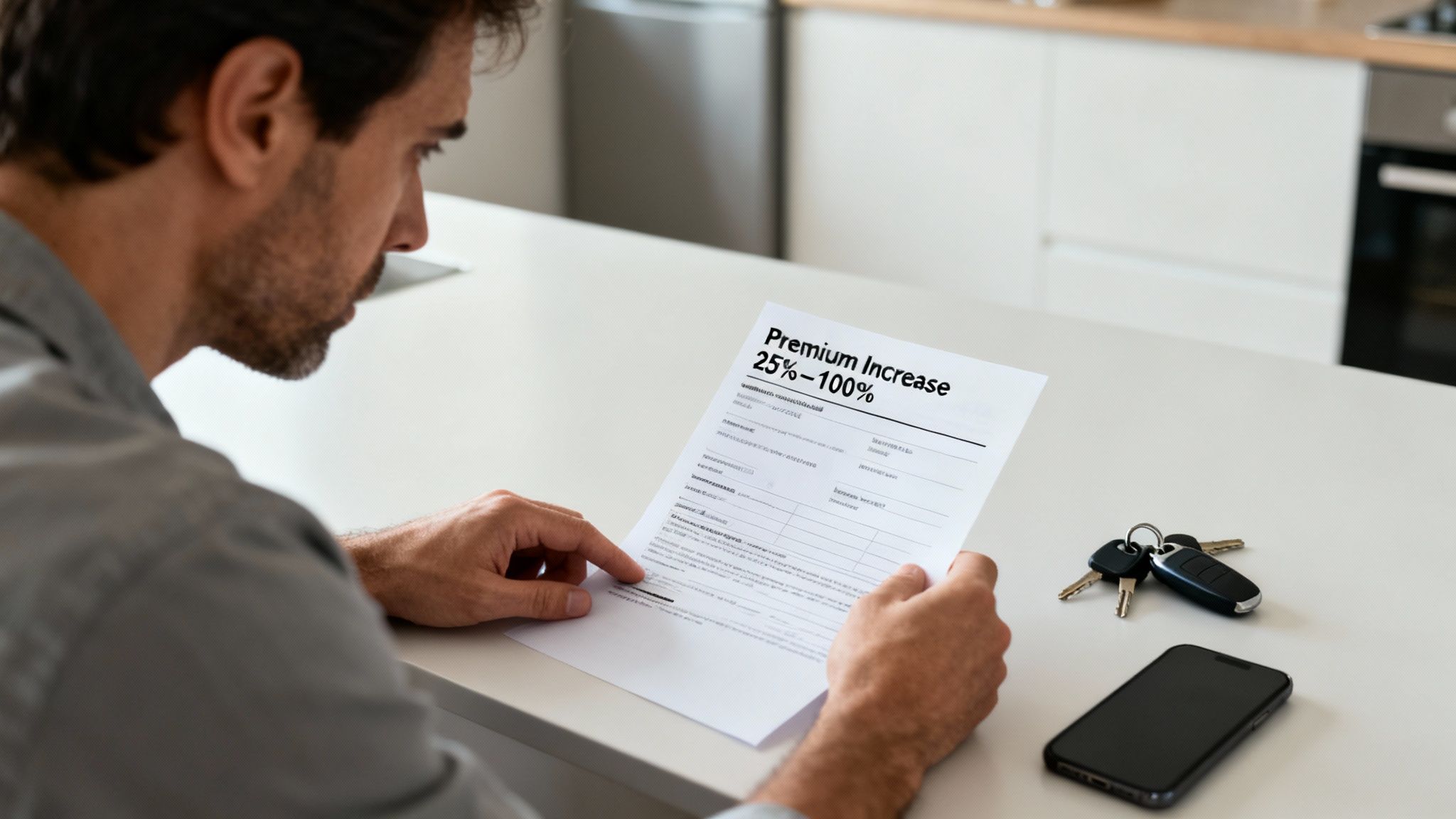
The aftermath of a car accident is stressful. The last thing you need is a financial shock when your insurance renewal arrives. By understanding the potential increase, you can set a realistic budget and plan your next steps with confidence.
To your insurance company, an at-fault accident signals a change in your risk profile. In their view, you've moved from a lower-risk driver to a higher-risk one. This isn't personal; it's based on statistics. A driver with one at-fault accident is statistically more likely to have another in the future. This reclassification is what drives your rate up.
Estimating the Financial Impact
While every insurer and situation is unique, the severity of the accident is a major factor. A minor fender-bender with a small repair bill will have a much smaller impact on your premium than a major collision involving serious damage or injuries.
To give you a clearer picture, here’s a general breakdown of what you might expect:
This table provides a general estimate of potential car insurance premium increases following an at-fault accident. Your actual increase will vary based on your insurer, province, and driving history.
Estimated Premium Increase After an At-Fault Accident
| Accident Severity | Typical Premium Increase Range | Impact on Your Driving Record | | :--- | :--- | :--- | | **Minor At-Fault Accident** | **20-35%** | Considered a minor conviction, stays on record for several years. | | **Moderate At-Fault Accident** | **40-60%** | A more significant blemish that clearly increases your risk profile. | | **Major At-Fault Accident** | **70-100%+** | A serious event that can make it difficult to find affordable coverage. |
Remember, these percentages are just a guide. The actual dollar amount will depend entirely on your unique circumstances and insurance provider.
> It's crucial to remember that these percentages are applied to your existing premium. A 50% increase on a $1,500 annual premium is a $750 jump, whereas the same percentage on a $3,000 premium adds $1,500 to your yearly cost.
Your Baseline Premium Matters
The starting point for any rate increase is what you’re paying *before* the accident. That figure is calculated based on dozens of factors—your age, location, driving experience, and vehicle type all contribute to the [average car insurance cost](https://www.insuranceshope.ca/blog/average-car-insurance-cost) in Canada.
Knowing your baseline premium is the first step in preparing for the financial impact of an at-fault claim. This knowledge empowers you to make smarter decisions, whether that means filing the claim in the first place or preparing to shop around for a better rate at renewal time.
Why Your Insurance Rates Rise After a Collision
It can feel personal when your insurance rates jump after an accident, but for insurers, it’s a business decision based on risk. Think of your clean driving record as a valuable asset, much like a good credit score.
For years, you've demonstrated that you are a safe, low-risk driver, and your insurance company has rewarded you with lower premiums. An at-fault accident, unfortunately, changes that calculation. It signals to the provider that you've shifted into a higher-risk category—similar to how a missed payment can lower your credit score.
The Logic of Risk Pools
Insurance companies operate by grouping thousands of drivers into **risk pools**. These are large statistical categories of people with similar traits—age, location, driving history, and vehicle type. The premiums collected from everyone in a pool are used to pay for the claims made by those who have accidents.
When you have a clean record, you're in a pool with other safe drivers, keeping the collective risk low. After an at-fault accident, your insurer must reclassify you.
> You are statistically moved into a different pool with other drivers who have also had accidents. Because this new group has a higher demonstrated likelihood of future claims, the cost to insure everyone in it is higher. Your new premium reflects the increased risk of this new group.
How a Claim Impacts Your Record
Your claims history is one of the most significant factors insurers use to predict future behaviour. From their perspective, an at-fault accident on your record is a powerful predictor of future risk. They aren't penalizing you for a past mistake; they are adjusting your rate based on new data that suggests you're more likely to be involved in another incident.
This adjustment isn't permanent, but it has a real impact for several years. In Alberta, for instance, a single at-fault accident can stay on your insurance record and affect your premiums for up to **six years**. You can learn more about how these calculations work by checking out our guide on [Alberta auto insurance rates](https://www.insuranceshope.ca/blog/alberta-auto-insurance-rates).
This is why it's so important to understand how much your insurance might go up after an accident. By understanding the risk-based model insurers use, you can better anticipate the financial impact and start planning a strategy to manage your costs. The key takeaway is that your new rate reflects a statistical probability, not a personal judgment.
The Key Factors That Decide Your Premium Increase
When your insurance premium increases after an accident, the new figure isn't arbitrary. It’s the result of a careful calculation your insurer makes based on several key factors, all designed to reassess your risk profile.
Understanding what drives these numbers is the first step in estimating how much your insurance might go up. A minor fender-bender with a spotless record is treated very differently from a major collision for a driver with previous claims. Let's break down exactly what your insurer is looking at.
Who Was at Fault
The single most important factor is **fault determination**. If you are found **100% at fault** for the crash, you should expect a significant premium increase. The accident now acts as a clear indicator on your record, telling the insurer you represent a higher risk.
If you’re found partially at fault, the increase will likely be smaller but still noticeable. On the other hand, if you are deemed **not at fault**, your rates should not increase because of the accident itself. This is true in Alberta and most other Canadian provinces.
The Severity of the Claim
Not all claims carry the same weight. The total financial cost of the accident plays a huge role in how much your premium will climb. Your insurer looks at the total cost of the claim, which includes two main components:
* **Property Damage:** This covers the repair bills for all vehicles involved. A claim for a small dent will have a much lighter impact on your rate than one for a car that's been completely written off. * **Injury Claims:** If anyone was injured in the accident, the claim becomes much more serious. Medical expenses, rehabilitation costs, and liability payouts can be substantial, leading to a much steeper rate hike. This is where your policy’s liability coverage is critical. You can get a deeper understanding by reading about [what is third party liability coverage](https://www.insuranceshope.ca/blog/what-is-third-party-liability-coverage) and how it protects you.
> As a simple rule of thumb: the higher the dollar amount your insurer has to pay out, the more of a statistical risk you become. A **$2,000** claim for a scratched bumper is viewed very differently from a **$50,000** claim involving injuries.
Your Driving History
Your past driving behaviour is one of the best predictors of your future actions. Insurers rely on this data heavily. A driver with a long, clean record is often treated with more leniency than someone who already has a history of tickets or claims.
If this is your first at-fault accident after a decade of perfect driving, the increase might not be as harsh. In fact, many insurance companies offer **accident forgiveness** as a reward for loyal customers with excellent records.
However, if you already have a couple of speeding tickets or another recent claim on your file, this new accident confirms a pattern of risky behaviour in the insurer's eyes. That almost always leads to a much sharper, more significant premium increase. Your history sets the stage for how a new claim is handled.
Deciding When to Claim or Pay Out of Pocket
After the stress of a minor fender-bender, your first instinct might be to call your insurance company. However, it’s wise to pause and think strategically. You’re at a crossroads: file a claim and risk a premium hike, or handle the repairs yourself?
This is a financial decision that comes down to simple math. The goal is to determine your 'break-even point.' You need to compare the immediate, one-time cost of repairs against the long-term financial pain of a higher insurance premium. A single claim for minor damage can increase your rates for up to six years, often costing you far more in the long run than the initial repair bill.
This flowchart breaks down the key factors—fault, severity, and your driving history—that insurers analyze when determining your premium increase after an accident.
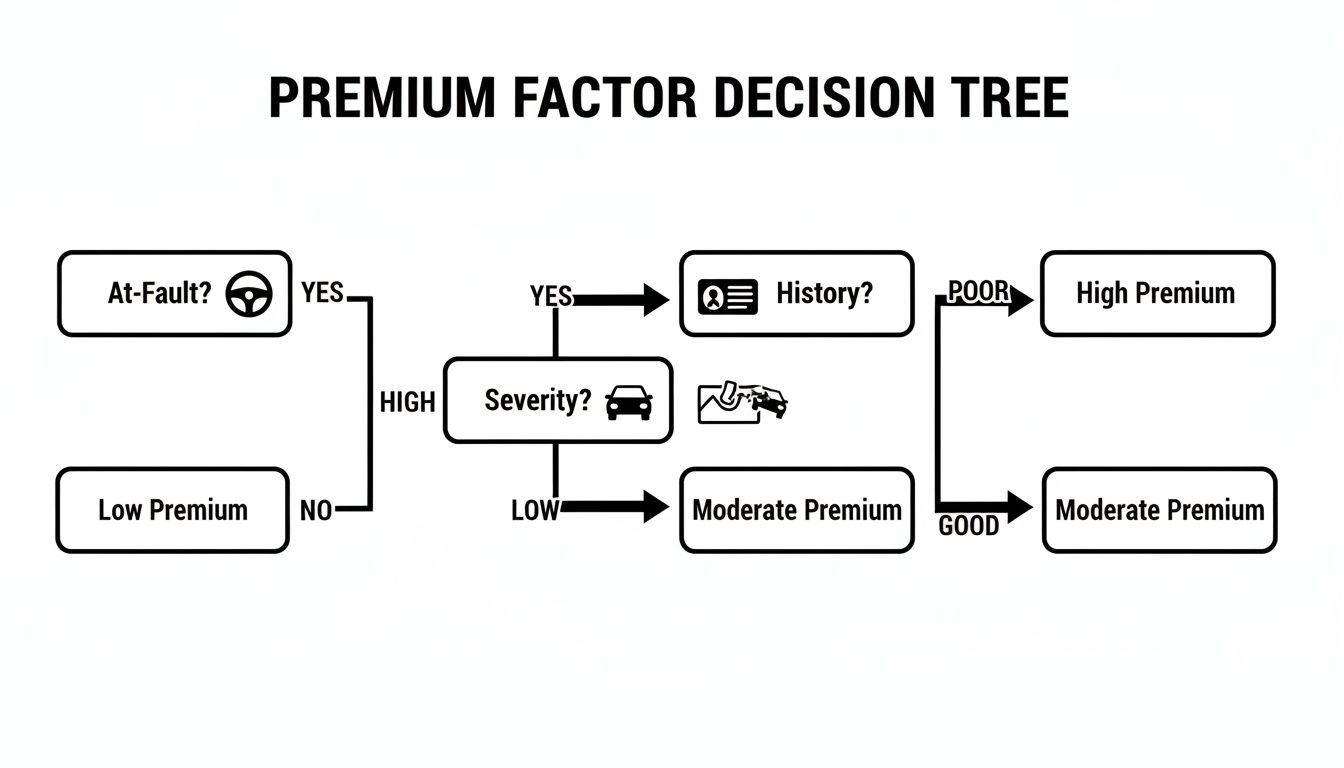
As you can see, being at fault for a serious accident when you already have a poor driving record is the worst-case scenario for your insurance rates.
Calculating Your Break-Even Point
So, how do you figure this out? First, get a firm repair estimate from a trusted mechanic. Let's say fixing a dented bumper will cost **$1,800**.
Next, estimate the potential premium increase. If your current annual premium is **$2,000** and you anticipate a **30%** hike after an at-fault claim, your new premium would jump to **$2,600**. That's an extra **$600** out of your pocket every year.
> The real cost isn't just one year's increase. In Alberta, an at-fault accident can impact your rates for up to six years. That means the total long-term cost of that single claim could be **$3,600** ($600 x 6 years).
In this example, paying the **$1,800** repair bill yourself saves you **$1,800** over that six-year period. Making a calculated choice instead of a reactive one keeps your driving record clean and your premiums under control.
Sample Calculation: Claim vs Pay Out of Pocket
Let's put those numbers into a table to make the choice crystal clear. Here’s a hypothetical comparison of the long-term cost of a premium increase versus the one-time cost of paying for repairs yourself.
| Financial Factor | Cost if You File a Claim | Cost if You Pay Out of Pocket | | :--- | :--- | :--- | | **Upfront Repair Cost** | **$0** (after deductible) | **$1,800** | | **Annual Premium Increase** | **$600** | **$0** | | **Total Premium Increase (Over 6 Years)** | **$3,600** | **$0** | | **Total Long-Term Cost** | **$3,600** | **$1,800** |
As the table shows, while filing a claim avoids an immediate out-of-pocket expense, paying for the repairs yourself can save you a significant amount of money in the long run.
When You Should Always Report an Accident
While paying cash for minor cosmetic damage often makes financial sense, some situations are non-negotiable. You **must** report the incident to your insurer and the police in these cases:
* **Injuries are involved:** If anyone—a driver, passenger, or pedestrian—is hurt, your first call should be to emergency services, followed by a report. * **Significant property damage:** In Alberta, you are legally required to report any accident where the total damage to all vehicles and property appears to be over **$2,000**. * **Fault is unclear or disputed:** When it's not obvious who caused the crash, you need to let the insurance companies determine fault. This is especially important under systems like Alberta’s. You can learn more about how fault is determined in our guide to [Direct Compensation Property Damage](https://www.insuranceshope.ca/blog/direct-compensation-property-damage).
Deciding whether to file a claim is a balancing act. By weighing the immediate repair bill against the potential for a long-term premium spike, you can protect your wallet and make the smartest financial choice.
How to Lower Your Insurance Costs After an Accident

Seeing your insurance rate climb after an at-fault accident can feel like a long-term penalty. But you have more control than you might think. With a few proactive steps, you can take charge of your insurance costs and find significant savings.
The single most powerful move you can make is to **shop around for new quotes**. Loyalty doesn't always pay in the insurance world, especially after a claim. While your current insurer has re-categorized you as a higher risk, a different company might weigh that same accident less heavily and offer a much more competitive rate.
Become a Savvy Insurance Shopper
Don't just accept your renewal notice at face value. Think of it as an opening offer, not the final price.
The key is to compare quotes from multiple providers to see what the market can offer someone with your new driving record. This is where working with an insurance broker is invaluable—they do the comparison shopping for you, sourcing options from various insurers to find you the best possible deal.
Once you have a better offer, you can even go back to your current insurer and ask them to match it. Faced with losing your business, they might be willing to reconsider. Understanding this process is crucial when it's time to [renew your auto insurance](https://www.insuranceshope.ca/blog/renew-auto-insurance) after a claim.
Practical Steps to Reduce Your Premium
Beyond shopping the market, there are several adjustments you can make to your existing policy to help lower the cost. Consider these actionable strategies:
* **Increase Your Deductible:** Your deductible is the amount you pay out-of-pocket before insurance covers the rest. By raising it from **$500** to **$1,000**, you agree to take on more of the initial risk, and insurers will often reward you with a lower premium. * **Bundle Your Policies:** If you have home or tenant insurance with another company, ask about bundling. Most insurers offer a significant discount—often **10-20%**—for combining your home and auto policies. It’s one of the easiest ways to save. * **Inquire About Discounts:** Don't be afraid to ask your broker or insurer for a full discount review. You might qualify for savings by using winter tires, having an anti-theft device, being a member of a certain association, or driving fewer kilometres annually.
> Even after a claim, you are not powerless. Think of your insurance policy as a flexible plan, not a fixed contract. A quick conversation with your broker can uncover savings opportunities you didn't know existed.
Long-Term Strategies for Lower Rates
Finally, focus on the long game. The ultimate way to get your rates back down is to rebuild a clean driving history. One of the best ways to demonstrate your commitment to safety is by taking a government-approved defensive driving course.
Completing one of these courses shows insurers you’re serious about being a safer driver. Many companies offer a rate reduction for it, which can help offset the surcharge from the accident. This proactive step, combined with a period of accident-free driving, will gradually improve your risk profile and lead to much better premiums down the road.
Your Top Questions After an Accident
After an accident, your mind is likely racing with questions about what comes next for your insurance. Here are clear, straightforward answers to the most common concerns.
How Long Will an At-Fault Accident Affect My Insurance Rate?
An at-fault accident will typically impact your insurance premiums for **six years** in Canada. The exact timeline can vary slightly by province and insurer, but six years is the industry standard.
The good news is that this increase isn't permanent. After that six-year period, provided you maintain a clean driving record, the accident will no longer be used to calculate your rate. Your patience and commitment to safe driving will pay off financially.
Will My Insurance Go Up if the Accident Wasn't My Fault?
This is a common worry, but the answer is generally no. If you are found **100% not at fault** for a collision, your premium should not increase as a direct result. Your good driving record remains intact from a rating perspective.
This can be confusing in provinces like Alberta that use a "no-fault" system, also known as Direct Compensation for Property Damage (DCPD). This system simply means you deal directly with *your own* insurance company for repairs, regardless of who caused the accident. Even in this system, if you are not the cause of the accident, your rates are protected.
> A not-at-fault claim is recorded on your insurance history, but it is coded differently. While a single one won't affect your rates, insurers may become concerned if they see a pattern of multiple claims of *any* kind in a short period, as it could suggest a higher overall risk.
Is Accident Forgiveness Worth the Extra Cost?
In most cases, absolutely. Think of accident forgiveness as an insurance policy for your insurance policy. This optional coverage does exactly what it says: it "forgives" your first at-fault accident, preventing the associated rate increase.
Insurers typically offer this endorsement to drivers with a long, proven history of safe driving for a small additional fee. When you compare that minor cost to the thousands of dollars you could save in premium hikes over six years, the value becomes clear. It provides peace of mind and protects you financially from a single mistake.
--- Navigating the insurance landscape after an accident can feel complex, but you don't have to do it alone. The expert brokers in the **InsuranceShope** network specialize in finding solutions for every driver. They can help you understand your options, shop the market, and find the most competitive rate available, even with a claim on your record. [Get your free, no-obligation quotes today!](https://www.insuranceshope.ca)