How to Get Travel Insurance in Alberta: A Practical Guide
Before you even think about what to pack, let’s talk about the one thing that should be at the very top of every Albertan's travel checklist: securing the right travel insurance. This isn’t just about buying a policy; it’s about taking a moment to *understand your trip*, assess potential risks, and find smart, affordable protection.
This simple process is your financial safety net, ensuring a surprise event doesn’t turn your dream vacation into a financial nightmare. Let's explore how you can shop effectively and save on the right coverage.
Why Travel Insurance Is a Must-Have for Albertans
This is a critical point. Many Albertans assume their provincial health card has them covered when they leave the province. The hard truth is that the Alberta Health Care Insurance Plan (AHCIP) covers very little outside Alberta and next to nothing internationally.
Imagine a simple slip-and-fall while sightseeing in the U.S. That minor accident could easily rack up a five-figure medical bill. Without the right insurance, that bill is yours to pay out-of-pocket.
And it's not just about medical emergencies. What if a sudden family crisis forces you to cancel that big trip you’ve been planning for years? Without trip cancellation coverage, all the money you spent on non-refundable flights and hotels is simply gone. Travel insurance isn’t about expecting the worst; it's about smart financial planning that protects your hard-earned savings.
Protecting Your Travel Investment
Travel is a major priority again, and the financial stakes are higher than ever. Canadians are planning to spend a massive **$25.5 billion** on their vacations.
Even with inflation worries, a solid **90%** of these travellers are making sure they have travel insurance, whether it’s through a direct purchase, work benefits, or a credit card. With financial stress being the biggest travel hurdle for **60%** of people, protecting that vacation fund is just common sense. You can learn more about how Canadians are prioritizing travel protection.
> Travel insurance is your financial backstop. It ensures a travel mishap—whether a medical issue or a cancelled flight—doesn't spiral into a long-term financial catastrophe.
The Role of an Insurance Broker
Trying to navigate the world of travel insurance on your own can be confusing. With so many options and complex fine print, it's easy to feel overwhelmed. This is where a good insurance broker becomes your most valuable asset.
Instead of you spending hours sifting through websites, a broker does the heavy lifting. They are licensed experts who can:
* **Shop the Market:** They have access to policies from a wide range of insurance companies, allowing them to find you the best coverage at a competitive price, helping you save money. * **Offer Tailored Advice:** A broker will listen to your specific plans, ask about your health, and recommend a policy that actually fits your trip, not a one-size-fits-all solution. * **Advocate for You:** They’ll help you understand the confusing jargon and, if you ever need to make a claim, they’ll be in your corner to help you through the process.
Working with a broker takes the guesswork out of getting insured. It gives you the confidence that you’re properly protected, so you can stop worrying and start looking forward to your trip.
Matching Your Trip with the Right Policy
Not all travel is the same, so your insurance shouldn't be a one-size-fits-all product. The key to getting the right coverage is taking an honest look at your travel style and the specific risks of your trip. This ensures you’re protected where it counts without overpaying for extras you'll never use.
Think about it: a weekend ski trip from Calgary down to Montana has a completely different risk profile than a multi-country backpacking adventure through Europe. Your policy needs to reflect that reality.
This decision-making flowchart helps visualize the simple logic behind whether you need coverage when travelling.
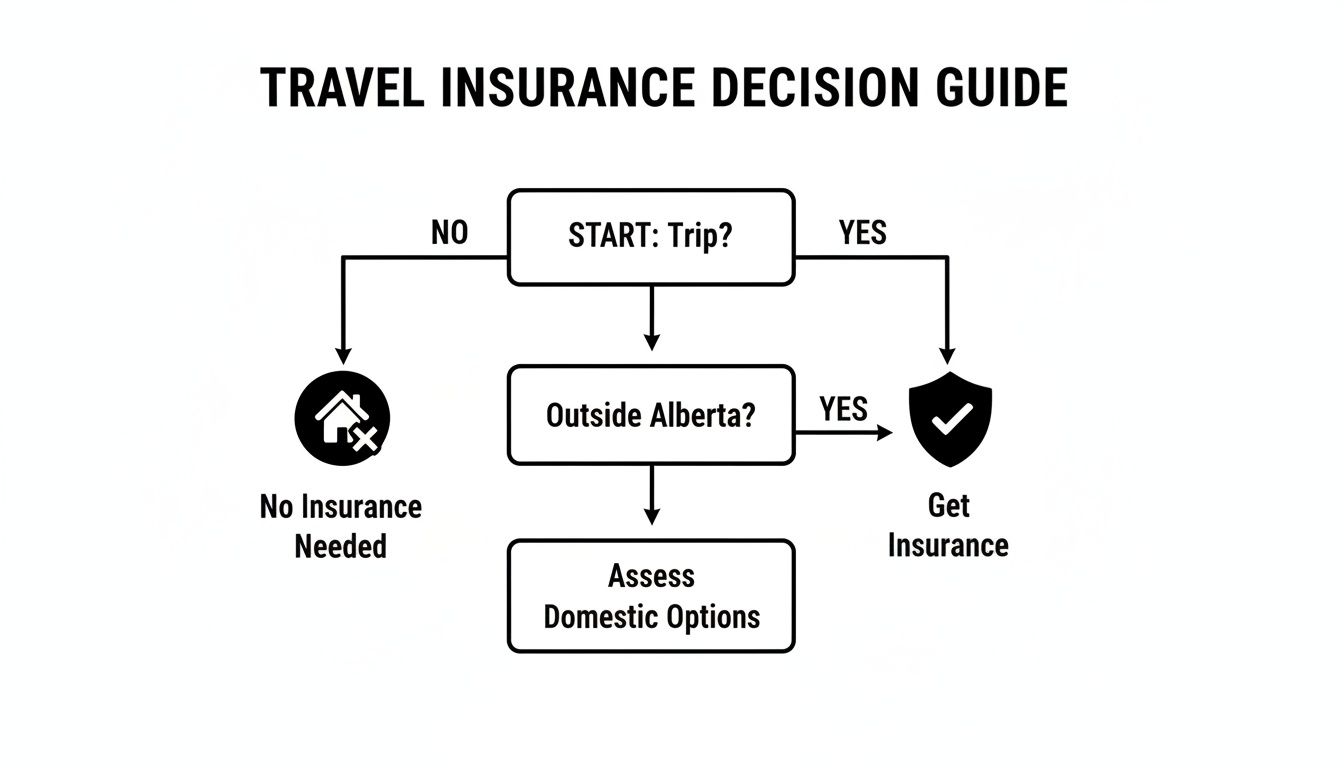
As the chart shows, the moment you plan to leave Alberta—even if it's just to another province—getting a travel insurance policy becomes a critical part of your trip planning.
Core Policy Types Explained
Let's break down the main types of coverage you'll encounter. Each one serves a distinct purpose, and understanding the differences is the first step toward building a policy that fits your trip and budget perfectly.
* **Emergency Medical Insurance:** This is the absolute foundation of any good travel policy. It’s non-negotiable. It covers unexpected medical and hospital bills if you get sick or injured on your trip. From a sudden illness in Mexico to a hiking accident in B.C., this coverage is what stops a medical emergency from turning into a financial catastrophe.
* **Trip Cancellation & Interruption:** This is all about protecting the money you've already invested in your trip. If a covered reason, like a family emergency or sudden illness, forces you to cancel *before* you leave, it reimburses your non-refundable costs. Trip interruption helps if you have to cut your trip short for a similar reason. To get into the nitty-gritty, check out our complete [trip cancellation and interruption insurance guide](https://www.insuranceshope.ca/blog/trip-cancellation-interruption-insurance-guide).
* **All-Inclusive Plans:** These are the package deals of the insurance world, bundling several coverages into one convenient policy. They almost always include emergency medical, trip cancellation/interruption, baggage loss or delay, and flight accident insurance. For a lot of travellers, this offers the best value and the most comprehensive peace of mind.
To make things a bit clearer, here's a quick comparison to help you match a policy to your travel plans.
Choosing the Right Travel Insurance Policy for Your Trip
| Policy Type | Best For | Key Coverage | Example Scenario | | :--- | :--- | :--- | :--- | | **Emergency Medical** | Budget-conscious travellers with flexible, low-cost trip plans. | Hospital stays, doctor visits, ambulance, prescriptions. | A road trip to visit friends in Saskatchewan where your primary concern is an unexpected health issue. | | **Trip Cancellation & Interruption** | Travellers who have pre-paid significant, non-refundable trip costs. | Reimbursement for flights, hotels, tours if you must cancel or cut the trip short for a covered reason. | A pre-booked, all-inclusive resort vacation in the Caribbean. | | **All-Inclusive Plan** | Most vacationers and families looking for comprehensive, hassle-free protection and good value. | Bundles medical, cancellation, interruption, baggage loss/delay, and more. | A family vacation to Disneyland with flights, park passes, and hotels booked months in advance. | | **Multi-Trip Annual Plan** | Frequent travellers, cross-border shoppers, and business professionals looking to save time and money. | Covers all trips taken within a year (up to a specified duration per trip, e.g., 15 or 30 days). | An Edmontonian who drives to the U.S. for business several times a year and takes a few weekend trips to B.C. | | **Super Visa Insurance** | Sponsoring parents or grandparents for an extended visit to Canada. | Long-term emergency medical coverage meeting IRCC requirements. | Your parents are coming from abroad to stay with you in Calgary for a year. |
Ultimately, choosing the right policy means aligning the coverage with your specific travel frequency, financial investment, and planned activities.
Finding a Match for Your Travel Style
The right policy often comes down to *how* you travel. Let’s look at a couple of common scenarios for Albertans to see how different plans are a better fit for different needs.
A business traveller from Edmonton who takes multiple short trips to the U.S. each year would save a lot of time and money with a **Multi-Trip Annual Plan**. This kind of policy covers every trip taken within a year up to a set number of days (say, 30 days per trip), which means no more buying a new policy every time you cross the border.
> For the frequent flyer or the spontaneous weekend adventurer, an annual plan is almost always the most cost-effective and convenient way to stay protected year-round. It's a true set-it-and-forget-it approach to travel safety.
Now, consider a completely different situation. If you’re sponsoring your parents to visit you in Calgary for several months, you'll need **Super Visa Insurance**. This is a specific medical policy designed to meet the strict requirements of Immigration, Refugees and Citizenship Canada. It must provide at least **$100,000** in emergency medical coverage and be valid for at least one year from their date of entry into Canada.
Matching the Policy to the Adventure
Let's walk through a couple of real-world examples to see how the right policy choice plays out.
**Scenario 1: The Family Ski Trip** A family from Lethbridge is driving to Montana for a week-long ski vacation. An **All-Inclusive policy** is their best bet. * **Emergency Medical** is absolutely crucial in case of a skiing injury. * **Trip Cancellation** protects their pre-paid ski passes and accommodation if a child gets sick right before they leave. * **Baggage Coverage** helps if their expensive ski gear is delayed or lost.
**Scenario 2: The Solo Backpacker** A recent university grad from Red Deer is planning a three-month backpacking trip across Southeast Asia. Their needs are totally different. * **Long-Stay Emergency Medical** is the top priority, ensuring they're covered for the entire extended trip. * **Trip Interruption** is more valuable than cancellation, since their plans are flexible but an emergency at home could mean an expensive, last-minute flight back. * **Adventure Sports Coverage** might be a necessary add-on if they plan on doing things like scuba diving or rock climbing, which often aren't covered by standard policies.
By thinking through your trip's duration, destination, activities, and what you’ve already paid for, you can confidently pick a policy that gives you solid protection right where you need it most.
Understanding Pre-Existing Conditions and Stability
This is the part of travel insurance that trips people up the most. It’s also where a simple oversight can lead to a denied claim, but it doesn’t have to be intimidating. Understanding what insurers consider a **pre-existing medical condition** is the key to buying a policy that actually has your back when you need it.
Simply put, a pre-existing condition is any medical ailment, injury, or disease you've had symptoms of—or received medical advice, diagnosis, or treatment for—before your trip begins. This covers everything from chronic conditions like diabetes or high blood pressure to a nagging old injury you still see a physiotherapist for.
The All-Important Stability Period
Okay, here’s the most crucial detail: for a pre-existing condition to be covered, it must be considered **stable** for a specific length of time before you travel. This is called the **stability period**, and it’s one of the most important definitions you'll find in your policy documents.
Think of the stability period as a look-back window, which can range from **90 to 365 days** before your departure date. During this window, your condition cannot have worsened, and you cannot have had any changes to your treatment or medication.
Let’s walk through a common scenario for an Albertan snowbird.
Imagine you have high blood pressure that’s well-managed with medication. Three months before your planned trip to Arizona, your doctor slightly increases your dosage during a routine check-up. That tiny adjustment "resets the clock" on your stability. If your policy requires 180 days of stability, that recent change means your high blood pressure wouldn't be covered if it flared up on your trip.
> Full and honest disclosure is your best policy. Hiding a condition or a recent medication change might save you a few dollars on your premium, but it could invalidate your entire policy, leaving you with a massive bill.
Navigating Medical Questionnaires with Confidence
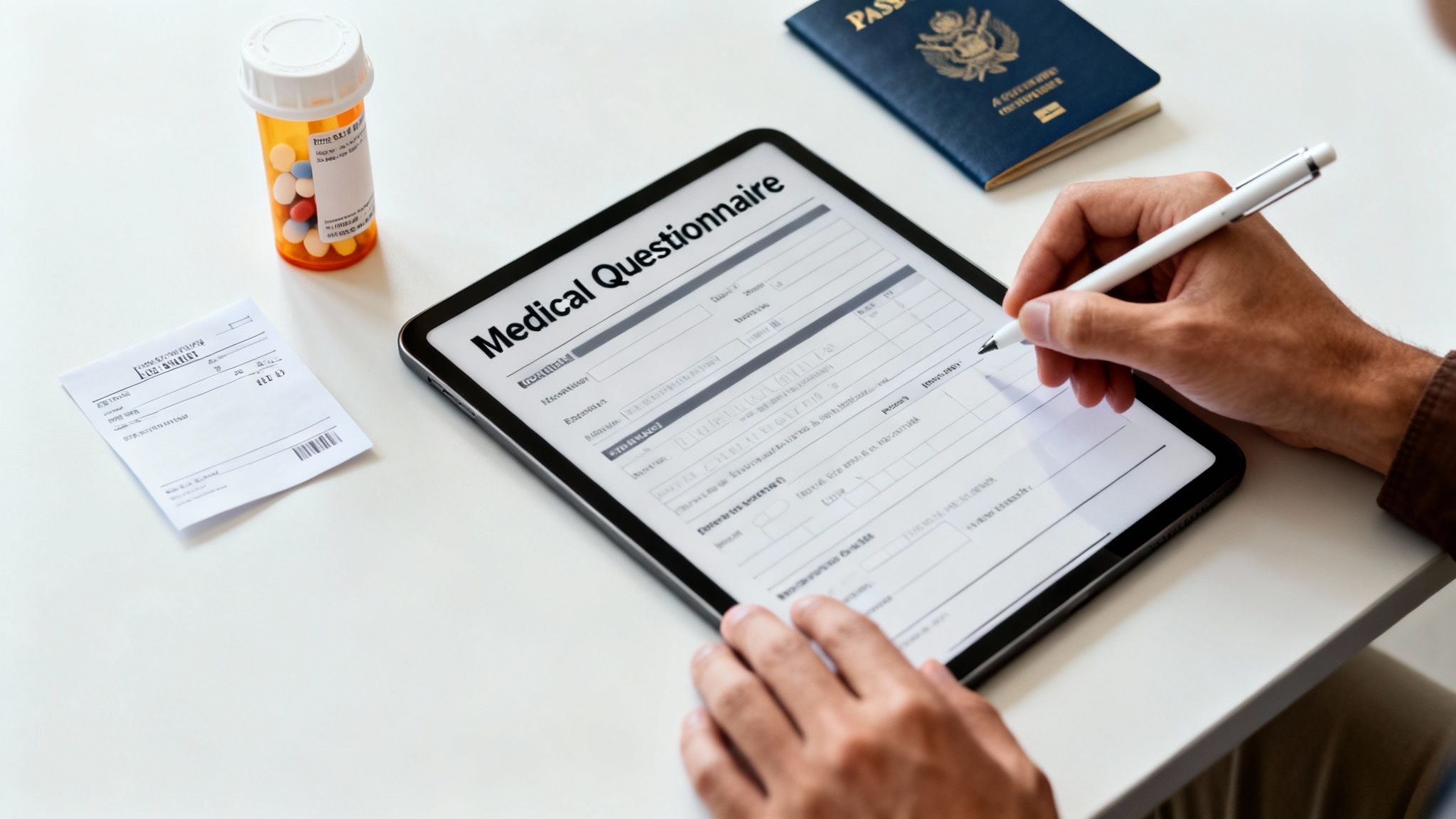
When you apply for travel insurance—especially if you're over a certain age or have known health issues—you'll need to fill out a medical questionnaire. It is absolutely vital to answer every single question with complete honesty.
* **Review Your Medical History:** Before you even start the application, think back over the stability period required by the policy you're considering. Have you seen a doctor for anything new? Have any of your prescriptions changed? * **Don't Guess:** If you’re unsure about a date or a diagnosis, check your medical records or call your doctor's office. An innocent mistake can be flagged as misrepresentation, which is grounds for a claim denial. * **Disclose Everything:** Even if a condition seems minor or is perfectly under control, if the questionnaire asks about it, you need to mention it.
The good news is that the travel insurance market is growing. The Canada travel insurance market was valued at **$784.3 million** in 2024 and is projected to hit **$2,166.4 million** by 2030. This expansion means more options are becoming available, even for travellers with tricky medical histories.
Specialized Options for Less-Stable Conditions
So, what happens if your condition isn't "stable"? Don't just assume you can't get coverage. You have options, and this is where an expert can really help you find the right fit.
Some insurers offer policies specifically designed for individuals with less stable pre-existing conditions. These plans work a bit differently:
* **Shorter Stability Periods:** Some policies may only look back **30 or 60 days**, making it much easier to qualify if you've had a recent, minor medication adjustment. * **"No Medical Questionnaire" Plans:** You'll often see these for younger travellers or for short trips. While they're convenient, they usually come with very strict stability clauses and lower coverage limits, so you must read the fine print carefully. * **Individual Underwriting:** For complex cases, a broker can work directly with an insurer to have your specific situation reviewed by an underwriter. This can lead to a personalized policy that covers your condition, often for a higher premium.
The key takeaway is that having a pre-existing condition doesn’t automatically mean you can't get solid protection. By understanding the rules of stability and being upfront about your health, you can find a policy that gives you genuine peace of mind. For a deeper dive into the specifics, our [guide to travel medical insurance in Alberta](https://www.insuranceshope.ca/blog/travel-medical-insurance-alberta-guide) is an excellent resource.
Broker vs. Direct Insurer: Where Should You Buy Your Policy?
Once you have a handle on the type of coverage you need, the next big question is where to get it. You really have two main paths: go straight to an insurance company or work with an independent insurance broker. Each approach has its pros and cons, but one offers a clear advantage for finding the best value.
Going Direct to an Insurance Company
When you buy direct, you’re dealing with a single company. You visit their website or call their agent, and they’ll sell you one of *their* products. If you're a young, healthy traveller taking a short trip, this can be quick and painless.
The catch? Your choices are completely limited to what that one insurer offers. You have no way of knowing if a better policy—one with more suitable coverage or a lower price—is available from another company unless you go through the entire quoting process again and again with different insurers.
The Broker Advantage: Choice and Expertise on Your Side
This is where a good insurance broker changes the game. A broker doesn’t work for an insurance company; they work for **you**. They have access to a wide range of policies from many different insurers across the market.
Think of a broker as your personal insurance shopper. Their job is to understand your trip, your health, and your budget, then hunt down the best possible match from a huge selection of providers. This alone saves you a ton of time and legwork.
Here’s what a broker brings to the table:
* **Personalized Advice:** Their expertise is invaluable when your situation isn’t straightforward. They know which policies cover pre-existing conditions, include adventure sports, or meet the specific requirements for a Super Visa. * **Market Comparison:** A broker can run the numbers and compare coverage details from multiple companies in minutes, often finding better value and helping you save on your premium. Our guide on [travel insurance comparison in Canada](https://www.insuranceshope.ca/blog/travel-insurance-comparison-canada) dives deeper into how this works. * **Claim Advocacy:** If you ever have to make a claim, having a broker in your corner is a massive relief. They can help you with the paperwork and act as your advocate with the insurance company to ensure everything goes smoothly.
> A broker doesn't try to fit you into a pre-made insurance product. They find an insurance product that fits you, often at a better price.
Real-World Scenario: A Calgary Family's Vacation
Let’s look at how this plays out with a real example. Picture a Calgary family of four heading to Costa Rica for two weeks. Their needs are a little complex:
* **The Parents:** Early 50s, both in good health. * **The Grandfather:** 72 years old and joining them. He has high blood pressure that is well-managed, but his doctor adjusted his medication five months ago. * **The Teenager:** A 16-year-old who is definitely going to be ziplining and surfing.
If this family went directly to a single insurer, they’d likely hit a few snags. The standard family plan probably wouldn't cover the grandfather because of his age and the recent medication change. That "stability period" is a common sticking point. The policy might also exclude "hazardous activities," leaving their teenager completely unprotected while surfing. They'd be forced to piece together different policies, likely overpaying and still ending up with dangerous coverage gaps.
Now, let's rewind and have them call a broker.
The broker looks at the whole picture at once. They know exactly which insurers have more forgiving stability period rules that can accommodate the grandfather's condition. They can also pinpoint policies that either include adventure sports automatically or offer an affordable add-on for the teenager.
The result? The broker finds a single, all-in-one policy from an insurer who specializes in family and senior travel. It covers everyone properly, including the grandfather's medical history and the teenager's activities. By shopping the market, the broker secures a solution that's not just more comprehensive but also more affordable than what the family could have cobbled together themselves. This is the core value of a broker: expert guidance that navigates complexity to give you a true safety net.
Getting Your Travel Insurance Policy in Hand
You've done the research and figured out what you need. Now it’s time for the final, most important part: turning that knowledge into a real, active policy. Securing your travel insurance should be a satisfying final step in your trip planning, not another hurdle.
Let's walk through the actual process of getting covered, from gathering your documents to the final policy review.
Step 1: Gather Your Information
Before getting quotes, have all your details ready. This makes the process much smoother and ensures the quotes you receive are accurate right from the start.
For each person travelling, you’ll want this info handy:
* **Full Legal Names and Birthdates:** Double-check that these match passports *exactly*. No nicknames. * **Exact Travel Dates:** Your departure and return dates define the policy period. * **Destinations:** List every single country you plan to visit, even for a layover. * **Total Non-Refundable Trip Cost:** This is a big one for trip cancellation coverage. Tally up your flights, non-refundable hotel deposits, tour payments, and any other pre-paid expenses. * **Medical History:** Be ready to answer questions about pre-existing conditions, any recent changes in your health, or new medications. Honesty is critical here.
> **Pro Tip:** Buy your insurance the moment you start booking your trip. Trip cancellation benefits only protect you *after* you’ve bought the policy. Purchasing early gives you the longest window of protection against unexpected events that could derail your plans.
Step 2: Get and Compare Your Quotes
With your info at the ready, it's time to shop around. Whether you're working with a broker or going straight to an insurer, the mission is the same: find the best *value*, not just the lowest price. A cheap policy might look good at first glance, but it could come with a sky-high deductible or low benefit limits that make it nearly useless in a real emergency.
When comparing quotes, you need to look past the premium. Focus on these key details:
* **Emergency Medical Limit:** Does it offer at least **$1 million**? For any travel to the U.S., a limit of **$5 million** or more is highly recommended. * **Deductible:** How much are you on the hook for before the insurance company pays a dime? * **Pre-existing Condition Clause:** What is the required stability period for your conditions? **60, 90, 180 days**? This matters. * **Trip Cancellation Limit:** Does the amount cover the full non-refundable cost you calculated earlier? * **Exclusions:** What specific activities or situations are *not* covered? Think adventure sports, alcohol-related incidents, etc.
This approach ensures you're not just buying a policy, but the *right* policy. For a straightforward way to find and compare options designed for Albertans, check out our [travel insurance page](https://www.insuranceshope.ca/insurance/travel).
Step 3: The Final Policy Review
Before you pull out your credit card, hit pause. Take a few minutes for one last, critical review. This is your chance to catch any mistakes and confirm the policy does exactly what you think it does.
Don't just read the brochure or the summary page. Open the actual policy document—that long, boring-looking PDF—and use the "find" function (Ctrl+F on a PC or Cmd+F on a Mac) to search for key terms. It’s a shortcut to the sections that matter most.
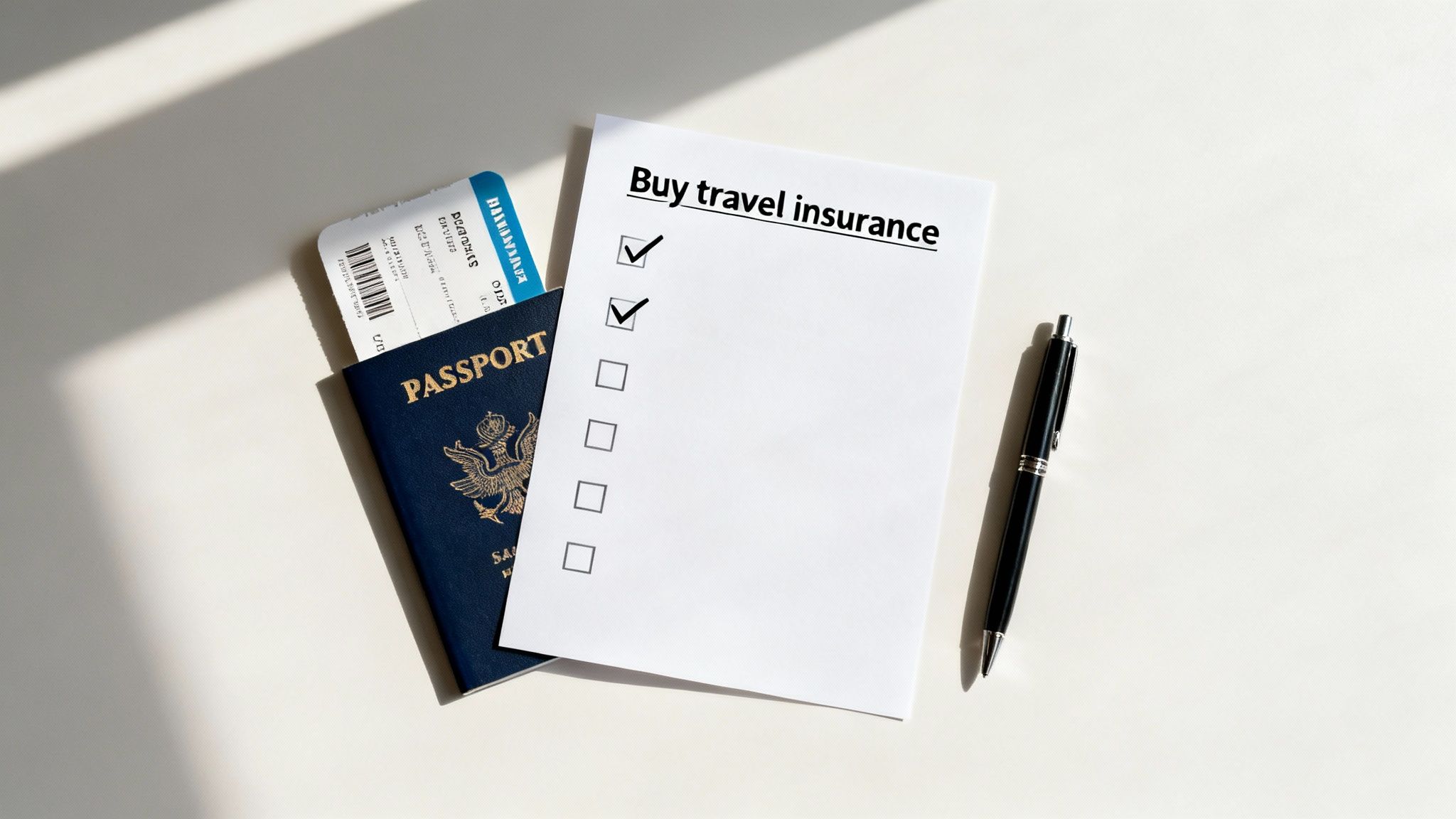
Your Final Pre-Purchase Checklist:
1. **Check Personal Details:** Are all names spelled correctly? Are the birthdates right? A simple typo here can create a massive headache during a claim. 2. **Confirm Coverage Dates:** Do the policy start and end dates perfectly match your travel itinerary? 3. **Read Key Definitions:** See how the policy defines words like "emergency," "stable," and "pre-existing condition." These definitions are the rulebook for your coverage. 4. **Understand Benefit Limits:** Re-confirm the maximum dollar amount the policy will pay for medical care, cancellation, lost baggage, and so on. 5. **Review Exclusions Again:** Scan for anything related to your plans, like high-risk sports, alcohol use, or travel to specific regions. 6. **Find the Claims Process:** How do you contact the 24/7 assistance line? What documents would they need if you had to file a claim? Save that number in your phone *now*.
Taking these final steps shifts you from being just a buyer to being an informed policyholder. You'll be able to relax and enjoy your trip, knowing exactly what protection you have in your back pocket.
Common Questions About Alberta Travel Insurance
Even after you've done all your homework on travel insurance, a few questions might still be nagging you. That’s perfectly normal. To help clear things up, here are answers to the most common questions Albertans ask.
Does My AHCIP Cover Me Outside Alberta?
This is a big one, and the answer is a hard **no, not in any meaningful way.** Your Alberta Health Care Insurance Plan (AHCIP) provides very little coverage the second you leave the province.
Sure, if you're travelling to another province in Canada, a reciprocal agreement covers some basic, medically necessary hospital and doctor services. But that’s where it stops. It won't touch things like ambulance rides, prescription drugs, or emergency dental work.
Go international, and the coverage becomes practically non-existent. AHCIP might reimburse you for a tiny fraction of your costs—often just a few hundred dollars per day for in-patient hospital care. Meanwhile, a single night in a U.S. hospital can run into the thousands. Relying solely on your provincial health card outside Alberta is a huge financial gamble.
When Is the Best Time to Buy Travel Insurance?
The answer couldn't be simpler: **buy it as soon as you book your trip.**
So many people put this off until the last minute, and it’s a classic mistake. The moment you buy a policy that includes Trip Cancellation, that benefit is active. This means all your non-refundable costs—flights, hotels, tours—are protected from day one.
> Imagine an unexpected illness or family emergency pops up a month before you're set to leave. You'll only be covered if you've already bought your insurance. Buying early maximizes your protection and safeguards your travel investment for the longest possible time.
If you wait until the week before you fly, you're completely unprotected against anything that could go wrong between the day you booked and that point.
Trip Cancellation vs. Trip Interruption
It's easy to get these two mixed up, but they cover completely different parts of your journey. Let's walk through a quick scenario to make it clear.
Picture this: you've booked a fantastic two-week trip to Italy.
* **Trip Cancellation:** This protects you *before* you leave Alberta. A week before your flight, you have a bad fall and your doctor says you absolutely cannot travel. Trip Cancellation coverage would step in to reimburse you for those non-refundable flights and hotel bookings. * **Trip Interruption:** This protects you *after* your trip has already started. You're five days into your Italian adventure when you get an urgent call about a family emergency back home. Trip Interruption would help cover the steep cost of a last-minute flight back to Calgary and reimburse you for the unused portion of your trip you had to forfeit.
In short, cancellation is for when you can't go, and interruption is for when you have to come home early.
Can I Get Insurance if I’ve Already Left for My Trip?
This is a common "what if" moment, but the reality is that your options are extremely limited once you're on the road. A handful of specialized companies might offer "after-departure" policies, but they are almost always more expensive and come loaded with restrictions.
Most mainstream insurers simply will not sell you a new policy once your trip is underway. There's also usually a waiting period before coverage kicks in, meaning any incident that happens right after you buy it won't be covered anyway. This is to stop people from only buying insurance after they've already had an accident or fallen ill. For a more detailed look at this and other specific situations, you can explore a broader list of [travel insurance frequently asked questions](https://www.insuranceshope.ca/faq/expanded).
The only truly reliable approach is to lock in your coverage before you leave Alberta. It's the simplest and surest way to guarantee you have full, uninterrupted protection from the moment your journey begins.