How to Switch Insurance Companies & Save: A Step-by-Step Guide
If you've noticed your insurance premiums creeping up, you're not imagining things. For many Albertans, shopping around for a new insurance provider is one of the most effective ways to control your budget and ensure you’re getting the best value for your hard-earned money.
The process is simpler than you might think. It really comes down to reviewing what you have now, comparing quotes from other companies, and timing the switch perfectly so you don't have any gaps in your coverage. This is your chance to take control and potentially save hundreds of dollars a year.
Why Smart Albertans Are Shopping for New Insurance
More and more, Albertans are taking a closer look at their insurance policies and discovering they can often find a better deal—or better coverage—somewhere else. What used to be a "set it and forget it" task has become a key financial check-up, especially with the rising cost of living.
Instead of seeing it as another chore on your to-do list, think of it as a powerful opportunity. You get to make sure your coverage actually fits your life *right now*, not what it was a few years ago.

This guide is your roadmap to confidently making that switch. We’ll walk through the real reasons to make a change, from big life events to simply wanting to deal with a company that offers better customer service.
The Triggers for Making a Change
It’s incredibly easy to let your policy auto-renew without giving it a second thought. But certain moments in life should be a clear signal to start shopping around. Ignoring these triggers could mean you're overpaying or, even worse, finding out you're underinsured when you need it most.
Think about it: a major home renovation can significantly increase your property's value, but your old policy won't automatically know that. This could leave you seriously exposed if something happens.
Here are a few common reasons to start comparing your options: * **Significant Life Events:** Getting married, buying a new home, or adding a teen driver to your car insurance are game-changers for your coverage needs. * **Poor Customer Service:** A frustrating claims experience or just struggling to get a real person on the phone is a huge red flag. It’s a sign that it’s time to find an insurer who actually values your business. * **Rising Premiums:** Did your rate jump at renewal for no obvious reason? That's your cue to see if another insurer can offer a more competitive price. Many factors are at play here, and you can learn more about **[why insurance rates are high in Alberta](https://www.insuranceshope.ca/blog/why-insurance-rates-high-alberta)** in our detailed breakdown.
> The biggest mistake you can make is assuming your current insurer is still the best fit. Loyalty doesn't always translate to the best price or coverage; regular reviews are essential to your financial health.
We'll introduce the core steps for switching insurance companies the right way. That means evaluating your current policy, knowing the best times to compare quotes, and understanding how an insurance broker can make the whole journey a lot simpler. By being proactive, you put yourself in the driver's seat to make a smarter, more informed switch that saves you money and provides some much-needed peace of mind.
Knowing When It Is the Right Time to Switch
Figuring out the perfect moment to switch insurance companies is more of an art than a science. It's about a lot more than just waiting for that annual renewal notice to land in your mailbox.
While that notice is a fantastic reminder, the real chances to save money often pop up all year long. These opportunities are usually triggered by big changes in your life or even just shifts in the Alberta insurance market itself. The key is to be proactive. Instead of just accepting whatever renewal your current insurer offers, you need to think of your policy as something that requires a regular check-up, just like your car or your health. This simple shift in mindset can unlock some serious savings.
Life Changes That Signal a Time for a Review
Your insurance needs aren't set in stone—they change right alongside your life. When a major event happens, your current policy might suddenly be a poor fit, either in coverage or in cost. These are the moments that should immediately get you thinking about shopping around.
For instance, I recently worked with a Calgary family who finished a major basement development. They added a bedroom, a bathroom, and a big family room, which bumped up their home's replacement value by nearly **$80,000**. Sure, their existing insurer could have just updated the policy. But a quick comparison showed that a different provider offered them better coverage for that newly added value at a lower premium. They ended up saving over **$300** a year.
Other common triggers I see all the time include: * **A Change in Your Commute:** Did you just switch to a remote or hybrid work setup? If you're driving way less than you used to, your risk profile has dropped. This is a perfect reason to see if another insurer will give you a better rate. * **Adding a New Driver:** Putting a newly licensed teen on your auto policy is always going to make your rates jump. But different insurers calculate that risk very differently. Some offer much better discounts for young drivers who have good grades, so it pays to compare. * **Major Purchases or Sales:** Buying a newer, safer vehicle loaded with driver-assist features can often lead to new discounts. On the flip side, if you sell a second car and become a one-car household, you should immediately be on the phone comparing rates.
Market Shifts and Proactive Savings
Sometimes, the best reason to switch has nothing to do with you and everything to do with what’s happening in the Alberta insurance industry. Insurers are constantly tweaking their rates and rolling out new products or discounts to win your business. If you’re not paying attention, you’re leaving money on the table.
A few years back, for example, several companies started offering telematics discounts for safe driving, tracked with a simple smartphone app. An Edmonton driver who was a careful, by-the-book driver switched to a provider with this program. Just by driving like he normally did—obeying speed limits and avoiding hard braking—he saw his premium drop by **15%** in the first six months. He never would have known that was even an option if he hadn't actively looked.
> Waiting for your renewal is a reactive strategy. Proactively shopping after a life event or when you hear about new industry discounts puts you in control and maximizes your potential for savings.
Understanding the renewal process itself is also critical. While you can technically switch at any time, lining it up with your renewal date is usually the cleanest way to avoid potential cancellation fees. By recognizing these key moments—whether they’re personal or market-driven—you stop treating insurance as a passive expense and start seeing it as an active opportunity to benefit your bottom line.
How to Compare Insurance Quotes Like a Pro
Switching insurance companies to lock in a better rate isn't just about the final click. The prep work you do beforehand is what really makes the difference. Think of it like getting your ingredients measured and ready before you start cooking—it makes the whole process smoother and guarantees a better result.
When you have all your details handy, you’re not just getting quotes; you’re getting *accurate* quotes. That’s the only way to do a true apples-to-apples comparison and avoid nasty surprises down the road.
Gather Your Essential Documents
Before you even think about calling a broker or filling out an online form, spend a few minutes pulling together some key documents. This one simple step can save you hours of back-and-forth later.
You’ll want to have the following info from your current policies ready to go:
* **Declarations Page:** This is your golden ticket. It’s a one-page summary of your current coverage, including liability limits, deductibles, and any special add-ons (called endorsements) for both your car and home. * **Driver Information:** Get the driver's licence numbers and a quick history (any tickets or accidents in the last few years) for everyone in your household who will be on the policy. * **Vehicle Details:** For each car, you'll need the Vehicle Identification Number (VIN), year, make, and model. Having a rough idea of your annual kilometres driven is also a big help. * **Home Information:** Know the basics of your property, like the year it was built, the square footage, and any major upgrades you’ve done recently (think roof, plumbing, or electrical work).
With this information at your fingertips, you're set up to get the most precise quotes possible.
> A quote is only as good as the information you provide. Inaccurate or incomplete details lead to inaccurate pricing, which can completely derail your decision-making process.
Look Beyond the Premium Price
The lowest price isn't always the best deal. While your monthly or annual premium is a huge factor, it’s just one piece of the puzzle. To really compare insurance quotes like a pro, you need to dive into the policy details to make sure you aren't accidentally underinsuring yourself.
This is more critical now than ever. With the rising cost of vehicle repairs, more frequent claims from wildfires and floods, and a surge in car thefts, insurance rates are on the move across Alberta. We've seen that drivers who shop around at renewal can often save **20-30%** simply by letting insurers compete for their business.
Pay close attention to these three areas:
* **Coverage Limits:** Does the new quote offer the same liability limits as your current policy? Dropping your third-party liability from **$2 million** down to **$1 million** might save you a few bucks now, but it could be financially devastating if you cause a major accident. * **Deductibles:** How do the deductible amounts stack up for collision, comprehensive, and home insurance? A policy with a lower premium might have a much higher deductible, meaning you’ll have to pay a lot more out of pocket before your insurance kicks in. * **Endorsements and Exclusions:** Look for the extras, often called endorsements or riders. Does the new quote include important things like sewer backup protection for your home or accident forgiveness for your car? Just as important, read the exclusions to understand what the policy *doesn't* cover.
To help you stay organized, here's a checklist for comparing the crucial details between two policies.
Key Policy Comparison Checklist
Looking past the price tag is what separates a savvy shopper from someone who might get caught with a surprise bill. Use this table to make sure you're comparing the features that truly matter.
| Feature to Compare | Policy A | Policy B | Why It Matters | | :--- | :--- | :--- | :--- | | **Third-Party Liability (Auto)** | e.g., $2 Million | e.g., $1 Million | This is your financial shield in a major at-fault accident. The standard recommendation is **$2 million**. | | **Collision Deductible (Auto)** | e.g., $500 | e.g., $1,000 | This is what you pay out-of-pocket for at-fault accident repairs. A higher deductible lowers your premium but increases your immediate cost after a claim. | | **Comprehensive Deductible (Auto)** | e.g., $500 | e.g., $500 | This covers theft, vandalism, fire, and hail. Ensure it's an amount you can comfortably afford to pay. | | **Accident Forgiveness (Auto)** | Yes/No | Yes/No | Prevents your rates from increasing after your first at-fault accident. Invaluable for maintaining good rates. | | **Replacement Cost on Dwelling (Home)** | Guaranteed | Stated Amount | Guaranteed Replacement Cost protects you if rebuilding costs more than your policy limit. Essential in today's market. | | **Sewer Backup Limit (Home)** | e.g., $25,000 | e.g., $10,000 | A common and costly claim. A lower limit could leave you with a massive cleanup bill. | | **Overland Water/Flood (Home)** | Yes/No | Yes/No | Standard policies often exclude this. In Alberta, with our unpredictable weather, this coverage is a must-have for many homeowners. | | **Personal Property Coverage** | Replacement Cost | Actual Cash Value | Replacement Cost buys you a new item. Actual Cash Value pays you what your used item was worth, which is always less. |
This checklist forces you to look at the whole picture, ensuring the policy you choose will actually be there for you when you need it most.
The Broker Advantage in Comparison Shopping
Trying to compare quotes from half a dozen insurance companies on your own can feel like a part-time job. Every provider uses different jargon and structures their policies in unique ways, making a direct, fair comparison a real headache.
This is where a good insurance broker becomes your secret weapon.
An independent broker works for *you*, not a specific insurance company. Their job is to take your information and shop it around to multiple insurers to find the best blend of coverage and price for your situation. They translate the industry jargon, lay out your options in a way that makes sense, and can point out the small but crucial differences between policies that you might otherwise miss. If you're new to this, you can [**learn more about how Alberta auto insurance brokers work**](https://www.insuranceshope.ca/blog/alberta-auto-insurance-brokers) and see why they're such an important part of the process.
A broker can give you a side-by-side comparison that clearly shows the premiums, limits, deductibles, and endorsements. It’s the easiest way to make a truly informed choice without all the hassle.
Making the Switch Without Gaps or Penalties
You've done the legwork, compared the quotes, and picked a new insurer. Fantastic. Now comes the most critical part: making it official without creating a risky gap in your coverage or getting dinged with surprise fees.
The transition itself is pretty simple, but **timing is everything**. Even a single day without coverage can lead to massive legal and financial headaches, especially with auto insurance. This stage is all about clear communication and careful coordination.
Activate Your New Policy First
Before you even think about calling your old provider, your new policy has to be live. This is the golden rule of switching insurance. **Never cancel your current coverage until you have official confirmation and documents from your new company.**
This means you’ve paid the first premium, signed on the dotted line, and have a new policy number and proof of insurance in your hands. For car insurance, that's your new pink card. For home insurance, it's a certificate of insurance. Only when your new protection is locked in should you take the next step.
Getting to this point is the result of a straightforward comparison process.
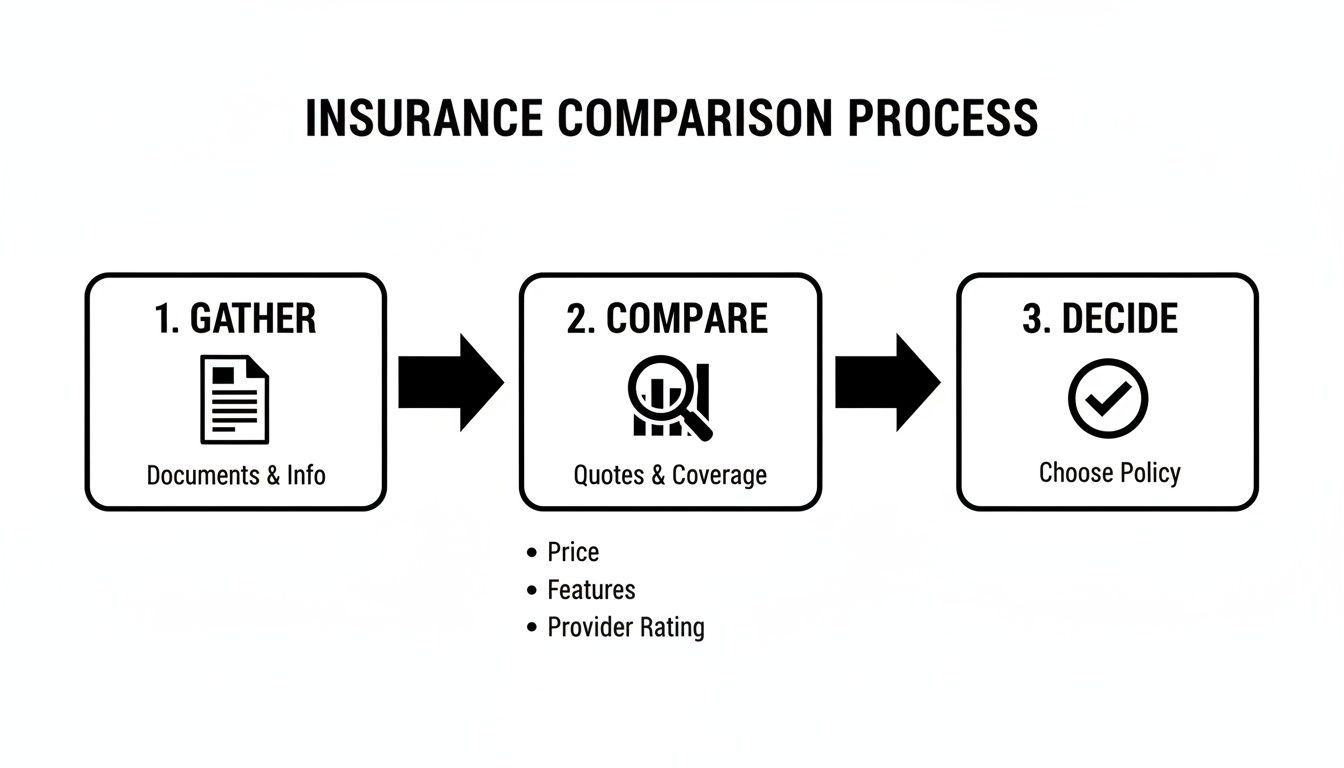
This flowchart breaks down the journey into three key actions: gathering your documents, comparing quotes feature-by-feature, and making an informed decision. Following this path is what sets you up for a seamless transition.
How to Properly Cancel Your Old Policy
Don't just stop paying and assume your old policy will fade away. To do it right, you need to notify your previous insurer or broker **in writing**. A phone call is rarely enough; you want a paper trail to cover yourself.
Your cancellation request doesn't need to be complicated, but it does need to be clear. Think of it as a formal note to avoid any mix-ups.
Here’s what your written request must include: * Your **full name and address** * Your **old policy number** * The **specific date** you want the cancellation to take effect * Your **signature**
> **Pro Tip:** Always set your cancellation date to be the *same day* your new policy begins. If your new coverage starts at **12:01 AM** on August 1st, your old policy should end at **11:59 PM** on July 31st. This creates a perfect, gap-free handover.
An insurance broker can handle all of this for you, coordinating with both companies to guarantee a smooth switch. If you're doing it yourself and feel unsure, don't hesitate to [**reach out for professional guidance**](https://www.insuranceshope.ca/contact) to make sure it's done right.
Understanding Fees and Refunds
One of the biggest questions we get from Albertans is about the money. Will you be penalized for leaving mid-term? And will you get a refund?
If you switch on your renewal date, it's a clean break. No fees, no fuss—you just start fresh with the new company. But if you switch in the middle of your policy term, a couple of things can happen.
**Cancellation Fees** Some insurers charge what's called a **"short-rate" cancellation fee**. It's a small administrative penalty for ending the contract early, usually calculated as a small percentage of your remaining premium. Your broker can tell you if your current insurer has this fee and help you do the math to see if the savings on your new policy still make it a smart move.
**Pro-Rated Refunds** If you paid your annual premium in full, you're owed a refund for the unused portion. The insurance company will calculate how many days of coverage you didn't use and send you a cheque for that amount, minus any cancellation fees. If you pay monthly, they’ll simply stop the automatic withdrawals.
The Importance of a Smooth Handover
Ensuring a clean break from your old insurer and a solid start with your new one is vital. The modern insurance market is more competitive than ever, rewarding consumers who take the time to shop around. Knowing how to switch seamlessly is a valuable skill for protecting your finances and making the most of the options available to you.
Your Post-Switch Administrative Checklist
Making the switch is a huge win for your wallet, but the work isn’t quite done once your new policy is live. There are a few final administrative tasks you need to tick off to make sure the transition is smooth and you don’t run into any headaches down the road. This checklist covers the crucial follow-up items that really lock in the benefits of your decision.
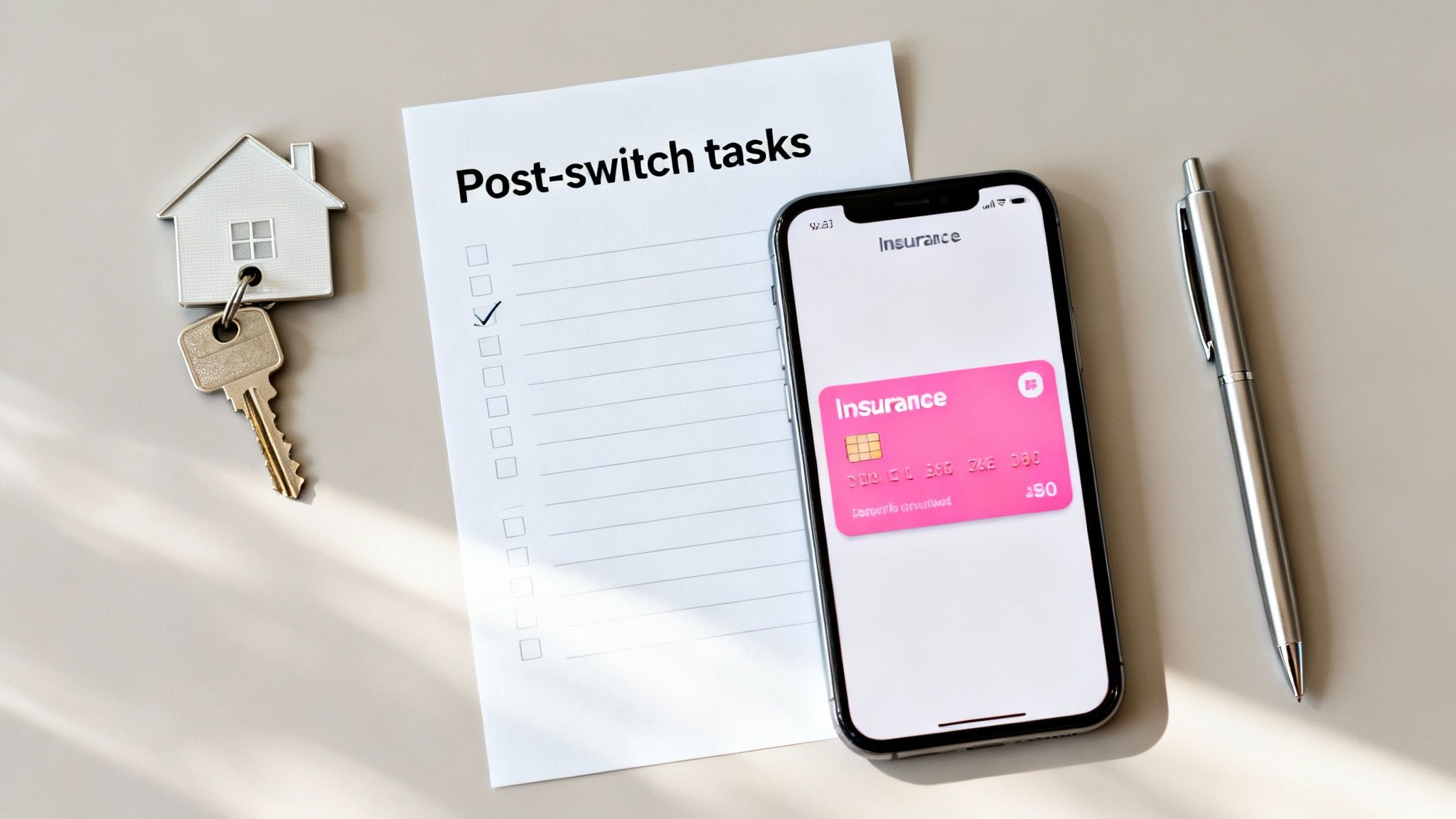
Think of this as the final lap. You’ve already done the heavy lifting—comparing quotes and timing the change perfectly. Now it’s just a matter of tying up the loose ends. Skipping these small but important details can lead to compliance issues with your lender or accidental missed payments, so it’s well worth a few extra minutes to get them sorted.
Update Key Third Parties
Your insurance doesn't exist in a vacuum. The companies that hold your car loan and mortgage have a financial stake in making sure your property is protected. They need to be in the loop right away when you change insurers.
Here’s who to contact first:
* **Your Auto Leasing or Financing Company:** The dealership or bank that financed your vehicle needs proof that it's covered against damage or theft. As soon as you get your new **proof of insurance (your pink card)**, send them a copy. * **Your Mortgage Lender:** It’s the same deal for your home. Your mortgage provider requires your property to be insured, so you need to provide them with the new policy details. Your broker can usually handle this for you by sending a "notice of replacement" directly to the lender's insurance department, which saves you a step.
If you don't notify them, you risk having them buy expensive "force-placed" insurance on your behalf and tacking the cost onto your loan payments. It's a costly mistake that's easy to avoid.
Manage Your Payments and Documents
Next up, let’s get the financial and organizational details squared away. This is all about making sure money is going to the right place and you can find your new policy info when you need it. A little organization now saves a ton of stress later.
Confirm your payment schedule with the new insurer so there are no surprises.
* **Set Up New Automatic Payments:** If you're paying monthly, double-check that your banking information is set up correctly with the new insurance company and that you know the exact withdrawal date. * **Cancel Old Automatic Payments:** This is critical. Don't just assume your old provider will stop taking your money. Confirm with them in writing that they have cancelled your pre-authorized payment plan. Verifying this prevents any frustrating double payments. * **Organize Your New Documents:** Whether you prefer a physical folder or a digital one, create a dedicated space for your new policy documents. This includes the declarations page, your pink card, and important contact numbers. It makes life much easier if you ever need to file a claim.
> Tying up administrative loose ends is just as important as finding the right policy. It ensures your hard-earned savings and improved coverage are not undermined by simple clerical errors or miscommunications with your lenders.
Prepare for the Future
Finally, let’s set you up for continued success. Switching insurance isn’t a one-and-done fix; it’s part of an ongoing strategy to manage your finances smartly. Taking an active role in your insurance choices empowers you to consistently find the best value in a changing market.
To keep yourself ahead of the curve, take these two simple actions:
1. **Set an Annual Review Reminder:** Pop a recurring reminder in your calendar for about **45 days before** your new policy is set to renew. This gives you plenty of time to review your coverage and shop around again if you need to, without any last-minute pressure. 2. **Keep Your Broker in the Loop:** Let your insurance broker know about any big life changes during the year. Things like a major home renovation, adding a new driver to your household, or a change in your daily commute can all impact your needs. They can advise if a mid-term policy tweak is in order.
By running through this checklist, you can be confident your switch is truly complete and that you're well-positioned to keep saving money for years to come.
Answering Your Questions About Switching Insurers
Even with a solid plan, it's natural to have a few questions rattling around. Changing something as important as your insurance is a big deal, and you want to be absolutely sure you’ve got all the details right.
To help you feel confident about making the move, we’ve put together answers to the most common questions we hear from Albertans. A little clarity can go a long way.
Will Shopping Around Affect My Record or Score?
This is a big one, and the answer is a straightforward **no**. Getting insurance quotes and switching providers will not negatively impact your insurance score, your driving record, or your credit score.
Unlike a hard credit check for a loan, insurance inquiries are considered a responsible part of managing your finances. Insurers expect you to shop for the best value—in fact, they encourage it. It's the only real way to know you’re getting a fair price in the current market.
Can I Switch Insurance Companies Before My Renewal Date?
Absolutely. You have the right to switch your insurance provider at any point during your policy term. You don't have to wait for the renewal notice to arrive.
If you stumble upon a much better rate or find coverage that’s a better fit for you mid-term, you can make the change. The main thing to keep in mind is a potential short-rate cancellation fee, which we touched on earlier. Your broker can calculate this for you in minutes. More often than not, the annual savings from the new policy will easily dwarf that small, one-time fee.
> You are never locked into a policy for the full year. The power to shop and switch is always in your hands, giving you the flexibility to adapt to new rates or life changes whenever they happen.
For more detailed answers on a variety of insurance topics, you can always check out our complete [**Alberta insurance FAQ page**](https://www.insuranceshope.ca/faq), which covers everything from policy specifics to claims processes.
What Happens to My Old Policy After I Switch?
This is a critical detail: your old policy doesn't just disappear when your new one starts. You have to take action. It's a common myth that one cancels the other, and it can lead to paying for two policies at once. You must formally notify your previous insurer or broker to terminate the coverage, ideally in writing with a specific end date.
Once that cancellation is processed, here’s what to expect:
* **If you paid in full:** You’ll get a pro-rated refund for the unused portion of your premium, minus any cancellation fees that apply. * **If you pay monthly:** The automatic withdrawals from your bank account will stop. It’s always smart to keep an eye on your account for a month or so just to confirm everything has been processed correctly.
How Quickly Can I Switch My Insurance Policy?
The switch itself can happen surprisingly fast—often within a day or two. The most time-consuming part is usually on your end, just gathering the documents you need, like your current policy declarations page and the VINs for your vehicles.
Once you hand that information over to a broker, they can usually get competitive quotes back to you within a few hours. Finalizing the paperwork is now almost entirely done with e-signatures, which makes the process incredibly efficient. Your new, better-priced coverage can start on whatever date works for you, ensuring a seamless transition without any gaps.