A Guide to Professional Liability Insurance Alberta
If you’re a professional in Alberta providing advice or a skilled service for a living, clients depend on your expertise. But what happens if a client claims your expertise caused them financial harm? That’s where **Professional Liability Insurance** comes in. It’s not just a policy; it’s a critical business tool that protects you, your reputation, and your finances from claims of negligence, errors, or omissions.
Often called **Errors and Omissions (E&O) insurance**, this coverage is designed to handle the high costs of legal defence and potential settlements. For any Alberta business, these expenses can be financially devastating. A solid professional liability policy isn't an option—it's a core part of a smart risk management strategy that lets you focus on your clients, not on "what ifs."
The Financial Shield for Your Expertise

Imagine a skilled tightrope walker performing high above the ground. They are a master of their craft, but the safety net below is non-negotiable. Professional liability insurance is that safety net for your business. You deliver your services with diligence and care, but in a world of high client expectations and complex projects, even the most meticulous professional can face an allegation of making a mistake.
This specialized insurance is designed to protect you from shouldering the full cost of defending yourself against a negligence claim from a client. It also covers damages awarded if a civil lawsuit doesn't go your way. The focus is specifically on the *financial losses* a client suffers because of your professional services, advice, or failure to perform your duties as expected.
Who Needs This Protection in Alberta?
Not long ago, this type of coverage was mostly associated with traditional professions like doctors, lawyers, and accountants. That’s no longer the case. Alberta’s modern economy is driven by a diverse range of service professionals, and every one of them carries a unique set of risks.
If your business provides advice, offers a specialized service, or handles client data, professional liability insurance should be considered essential. This includes fields like:
* **Technology and IT Consultants:** A single software bug or a missed security patch can lead to devastating financial losses for a client. * **Marketing and Advertising Agencies:** If a campaign doesn't hit its promised metrics, a client could sue for undelivered services. * **Architects and Engineers:** A small miscalculation or design flaw can result in millions of dollars in construction delays and rework. * **Wellness Practitioners:** A nutritionist or therapist could face a serious claim if their advice is alleged to have caused a client harm.
> Professional liability insurance isn't about admitting you might make a mistake. It’s about acknowledging that in the professional world, the *perception* of an error can be just as financially damaging as an actual one. Defending your good name costs money, no matter the outcome.
A Deeper Look at Professional Risks
The specific risks you face are tied directly to your industry. A client's definition of a "professional error" can be incredibly broad, covering everything from a missed deadline to a breach of contract. Without the right coverage, your business and even your personal assets are on the line.
Navigating these risks is a fundamental part of running a sustainable business. For a closer look at solutions tailored to different fields, you can learn more about [specialized coverage for professionals in Alberta](https://www.insuranceshope.ca/business/professionals) to ensure your unique needs are met.
The table below breaks down some common claim scenarios across different Alberta sectors, showing exactly why this coverage is so vital. It’s a clear illustration of how a single client dispute can quickly escalate into a legal battle that threatens your company's entire future.
Who Needs Professional Liability Insurance in Alberta? A Sector Breakdown
Here’s a snapshot of various Alberta professions, the common risks they encounter, and how Professional Liability Insurance offers crucial protection.
| Profession/Industry | Common Claim Examples in Alberta | Why PLI is Essential | | :--- | :--- | :--- | | **IT Consultants** | An Edmonton tech firm is sued after a system migration they managed results in a client losing critical sales data. | Covers the financial fallout from technical errors, data loss, and failure to provide adequate cybersecurity advice. | | **Marketing Agencies** | A Calgary marketing company faces a lawsuit when a major campaign underperforms, and the client alleges misleading projections. | Protects against claims of negligence, misrepresentation, and failure to deliver promised results or ROI. | | **Architects/Engineers** | A Red Deer engineering firm is held liable for a design flaw that causes costly structural issues in a new commercial building. | Essential for covering errors, omissions, or negligence in design plans that lead to construction defects or safety hazards. | | **Accountants** | A Lethbridge accounting firm gives incorrect tax advice, leading to a significant CRA penalty for their client. | Shields the firm from claims related to financial misstatements, incorrect advice, and professional negligence. | | **Wellness Practitioners** | A Fort McMurray-based wellness coach is sued after a client claims their recommended diet plan caused health problems. | Provides a crucial safety net for claims of malpractice or professional advice that allegedly resulted in client harm. |
As you can see, the potential for a claim exists in any field where your expertise is the product. Protecting that expertise is one of the smartest investments you can make in your business's future.
Understanding Your Business Insurance Toolkit

Trying to figure out business insurance can feel like assembling furniture without instructions. With so many policies available, it's easy for Alberta business owners to feel overwhelmed and unsure of what they truly need. The best approach is to think of your coverage as a toolkit, where each policy is a specific tool for a specific job.
You wouldn't use a hammer to drive a screw, and you can't expect one insurance policy to cover every single risk your business faces. **Professional Liability Insurance (PLI)** is a critical tool in this kit, but it serves a very different purpose from other essential policies like Commercial General Liability (CGL) or Cyber Liability.
Knowing the difference is the first step to building a comprehensive protection plan that doesn't leave you exposed to costly surprises.
CGL vs. PLI: The Physical vs. The Financial
The most common point of confusion for business owners is distinguishing between Commercial General Liability and Professional Liability insurance. Both are vital, but they protect against entirely different kinds of trouble.
**Commercial General Liability (CGL)** is your protection against tangible, physical risks. It covers claims of bodily injury or property damage that your business operations cause to a third party. Think of it as your "slip and fall" insurance. If a client trips over a cord in your Calgary office and breaks their arm, your CGL policy is designed to handle the medical and legal costs.
**Professional Liability Insurance (PLI)**, on the other hand, is your tool for intangible, financial risks. It covers the economic losses a client suffers because of a mistake, oversight, or alleged negligence in the professional services or advice you delivered. It protects your expertise, not your office space.
> Think of it this way: CGL covers what you *do* that causes physical harm, while PLI covers what you *say* or *advise* that causes financial harm. A single business can easily face risks in both categories, making both policies necessary for complete protection.
Let's look at an Edmonton-based interior designer to see this in action:
* **CGL Claim Scenario:** While visiting a client's home, the designer accidentally knocks over and shatters an expensive vase. The CGL policy would cover the cost of replacing the damaged property. * **PLI Claim Scenario:** The designer specifies materials for a kitchen renovation that don't meet building codes, forcing the client to pay for expensive tear-out and rework. The PLI policy would cover the client’s financial losses and the designer's legal defence costs.
Adding Cyber Liability to the Mix
In today's digital world, another specialized tool has become essential for nearly every Alberta business: **Cyber Liability Insurance**. This policy is built to manage the specific risks that come from data breaches, system hacks, and other cyber threats.
While a PLI policy for an IT consultant might cover a client's financial losses from bad software advice, it generally won't cover the fallout from a data breach. That's where Cyber Liability steps in. It handles expenses like:
* Notifying customers that their data was compromised. * Providing credit monitoring services to affected individuals. * Managing PR to restore your company's reputation. * Covering regulatory fines and legal defence costs.
For a complete picture of how these coverages work together, check out our guide to [business insurance essentials for Albertan entrepreneurs](https://www.insuranceshope.ca/blog/business-insurance-essentials-albertan-entrepreneurs). Getting this framework right helps you build a resilient business that can handle whatever comes its way.
At the end of the day, a strong insurance toolkit isn't about having one "best" policy. It's about having a coordinated set of policies that work together, ensuring that whether a risk is physical, financial, or digital, you have the right tool for the job.
Navigating the Alberta Insurance Market
Getting professional liability insurance in Alberta isn't as simple as picking a product off a shelf. Our province has a unique economic pulse and its own set of rules, both of which directly shape your business's risks, the coverage you need, and what you’ll pay for it.
Think of it this way: a generic, one-size-fits-all policy is like a tourist's map. An Alberta-specific policy is like getting directions from a local—it understands the backroads, the trouble spots, and the most efficient way to get you where you need to go, safely. It's built for Alberta’s economy.
Provincial Rules and Professional Associations
For many professionals here, having liability insurance isn't just a good idea—it’s a mandatory condition of doing business. Several professional associations and regulatory bodies require their members to carry a minimum amount of coverage just to maintain their license.
Why? These rules exist to protect the public. They guarantee that if a professional’s mistake costs a client money, there's a financial safety net to make things right. Key groups with these mandates include:
* **Engineers and Geoscientists:** The Association of Professional Engineers and Geoscientists of Alberta (APEGA) sets specific liability insurance standards for its members. * **Accountants:** If you’re a Chartered Professional Accountant (CPA) in Alberta, you’re required to maintain proper professional liability coverage. * **Real Estate Agents:** The Real Estate Council of Alberta (RECA) mandates that all licensed agents and brokers carry Errors and Omissions insurance. * **Lawyers:** The Law Society of Alberta has a mandatory group liability insurance program that all practicing lawyers must be part of.
> Let’s be clear: your professional designation and your insurance policy are tied at the hip. Falling short of these requirements doesn’t just expose you to a lawsuit; it can put your entire career on the line. An Alberta broker who understands these regulations is your best partner to ensure your policy ticks every single box.
How Alberta's Key Industries Shape Your Risk
Beyond official regulations, Alberta’s distinct economy creates specific risks that a generic policy might overlook. Our major industries each come with their own set of challenges that directly impact your insurance needs.
**Energy Sector:** If you're a consultant or engineer in oil and gas, you’re playing in the big leagues. A tiny error in a drilling calculation or an oversight in an environmental report can spiral into a multi-million-dollar claim. Insurers will look closely at the types of projects you handle and the contractual obligations you have.
**Technology Sector:** Alberta's tech scene, especially in hubs like Calgary and Edmonton, is booming—and so are the risks. An IT consultant handling a client’s cloud migration or a developer building custom software is on the hook for things like data breaches, system crashes, and IP disputes. Your insurance has to match the high-speed, high-stakes nature of tech work.
**Agriculture:** Agrologists and farm consultants give advice that directly impacts a farm's bottom line. A mistake in soil analysis or a bad recommendation for pest control can wipe out a significant chunk of a farm’s annual revenue. Specialized PLI isn't a luxury here; it's essential.
The insurance market here is tuned into these realities. Alberta's robust professional services sector is a major driver of market trends, with analysts forecasting continued growth into **2025**. We're currently seeing rate adjustments for architects and engineers fluctuate between **-5% and +5%**, showing that insurers reward businesses that take risk management seriously. At the same time, social inflation is pushing claim costs higher, making rock-solid documentation more critical than ever to lock in good rates. You can dig deeper into these shifts with these [2025 commercial insurance rate predictions](https://theaim.ca/commercial-insurance-rate-trends-a-2025-sector-by-sector-analysis/).
This is why partnering with a local broker is so powerful. They can translate the specific risks of your Alberta-based industry into a policy that actually protects you, helping you find the right price without cutting corners on coverage.
Real-Life Claim Scenarios in Alberta

Insurance policies can feel abstract, filled with technical jargon and what-if situations. To truly grasp why professional liability insurance is a must-have in Alberta, it helps to look at tangible, real-world examples where expertise is called into question.
These aren't just far-fetched "worst-case scenarios"—they are realistic situations that Alberta professionals face every day. A simple oversight, a miscommunication, or a client's unmet expectations can quickly escalate into a legal nightmare. Let’s dive into a few claim examples to see what’s really at stake.
The Marketing Campaign That Missed the Mark
A Calgary-based digital marketing agency is hired by a local e-commerce brand to drive sales. The agency projects a significant return on a new ad campaign, backing it up with their expertise and initial data. The client signs off, committing **$50,000** to the ad spend.
Unfortunately, the campaign flops. The results fall drastically short of projections, and sales actually dip. The client is furious and sues the marketing agency for negligence and misrepresentation, demanding their **$50,000** back plus damages for lost revenue.
Even if the agency’s projections were just good-faith estimates, they’re now staring down a costly legal fight. This is exactly where professional liability insurance kicks in to cover:
* **Legal Defence Costs:** Hiring a lawyer to handle the claim and represent the agency. * **Settlements or Judgments:** Paying the amount agreed upon in a settlement or awarded by a court.
Without this coverage, the agency would be responsible for every dollar, putting its financial stability and hard-earned reputation on the line.
The Architectural Error With a Ripple Effect
An Edmonton architectural firm designs a new mid-rise commercial building. Everything is going smoothly until construction is well underway. A contractor discovers a major error in the structural plans related to the HVAC system, making one floor’s layout unworkable.
The mistake forces a complete rework of that floor, causing a three-month delay and huge cost overruns for the developer. The developer promptly sues the architectural firm for negligence, seeking **$250,000** to cover demolition, reconstruction, and losses from the delayed opening.
> A professional liability policy is designed for precisely this situation. It acts as a financial backstop, covering the legal defence bills and the settlement costs stemming from the design error. It allows the firm to manage the crisis without facing potential bankruptcy.
The IT Consultant and the Security Oversight
A Red Deer-based IT consultant is hired to upgrade a small accounting practice’s data security. The consultant recommends and installs new software but misses a key configuration setting, accidentally leaving a vulnerability exposed. Months later, the accounting firm suffers a data breach, and sensitive client financial data is compromised.
The accounting firm holds the IT consultant responsible for the breach, suing for financial losses, client notification costs, and reputational damage. While some of these damages might sound like they overlap with other policies, understanding the fine print—like how [direct compensation for property damage](https://www.insuranceshope.ca/blog/direct-compensation-property-damage) works in different contexts—highlights why specialized coverage is non-negotiable.
A professional liability policy specifically addresses the financial fallout from negligent advice. It provides the critical funds needed to mount a defence and cover any resulting settlement, turning a potential business-ending event into a manageable problem.
How Your Insurance Premiums Are Calculated
Trying to figure out how insurers arrive at the price for your professional liability insurance can feel like a mystery. But it’s actually quite logical. The entire process boils down to one simple idea: your premium is a direct reflection of your risk.
Insurers analyze several key factors to build a risk profile for your business, and then they set a price to match. It's not just about *what* you do, but *how* you do it. Once you understand these factors, you can take practical steps to present your business as a lower risk, which can directly lead to better rates and help you shop smarter for coverage.
Your Profession and Industry Risk
The starting point for any premium calculation is your specific line of work. Insurers have vast amounts of data on which industries tend to generate the most claims. A healthcare professional or an architect, for instance, works in a field where a single mistake can lead to massive financial damages. That places them in a higher-risk category than, say, a business consultant.
Similarly, an IT firm handling sensitive client data faces a completely different set of risks than a graphic designer. Your industry's built-in liability exposure is the foundation your premium is built on.
Coverage Limits and Deductibles
Next, insurers look at how much protection you decide to buy. Your **coverage limit** is the absolute maximum your insurer will pay for a single claim or over the policy year. A policy with a **$2 million** limit will naturally cost more than one with a **$1 million** limit because the insurer is taking on more potential liability.
Your **deductible**—the amount you pay out-of-pocket before the insurance kicks in—also plays a huge part in the final price.
* **Higher Deductible:** If you agree to cover more of the initial cost of a claim yourself, your premium will be lower. * **Lower Deductible:** If you want the insurer to start paying from the first dollar, they take on more risk, which increases your premium.
Choosing the right combination is a strategic decision that balances your budget with your need for robust protection.
Your Business Operations and History
Finally, insurers zoom in on your individual business to fine-tune the price. They'll look at a few key things:
* **Annual Revenue:** Higher revenue often means bigger projects and more clients, which naturally increases the potential for claims. * **Number of Employees:** More people on your team means more potential points of human error. * **Claims History:** This is a big one. A clean record with no previous claims is one of the strongest signals that you're a low-risk business.
That spotless claims history is incredibly valuable. Data from across Canada shows that professional service firms with clean records often get favourable premium adjustments at renewal. While you're thinking about what drives your costs, it's also worth understanding the broader trends explaining [why insurance rates are high in Alberta](https://www.insuranceshope.ca/blog/why-insurance-rates-high-alberta).
> For Alberta professionals, proving a commitment to risk management is the single most effective way to secure better rates. Strong client contracts, clear documentation, and a clean claims record directly translate into savings.
Recent market analysis backs this up. A [professional services risk report](https://www.aon.com/getmedia/6d6e4d97-a9d3-47f1-95cc-27cadae94012/professional-service-firm-risk-and-human-capital-environment-and-indications-for-2025.pdf) showed that firms with clean histories enjoyed flat to **-5%** premium adjustments in **2024**, even as defence costs for complex claims kept climbing. By actively managing your risk, you put yourself in the driver's seat to shop smarter and save on this essential coverage.
Finding the Right Coverage for Your Business
Now, let's turn knowledge into action. Securing the right professional liability insurance in Alberta isn't just about ticking a box or finding the cheapest premium. It’s about investing in a policy that provides genuine peace of mind, knowing your business is protected when it matters most. This means taking an honest look at your operations and doing some smart comparison shopping.
First, you need to understand your unique risk profile. Think through the services you provide and identify worst-case scenarios. If you made a mistake, what kind of financial fallout could it cause for a client? Consider the value of your projects, your industry's specific pitfalls, and any insurance requirements your clients write into contracts. This initial self-assessment is crucial for determining how much coverage you actually need.
Preparing Your Application
Once you have a handle on your risks, it’s time to gather your information. A detailed and accurate application is the key to getting a quote that truly fits your business. Insurers need a clear picture of what you do.
Be ready to provide:
* **Detailed Business Description:** A clear, straightforward explanation of the professional services you offer. * **Annual Revenue Figures:** This gives insurers a sense of the scale and scope of your operations. * **Employee Information:** The number of staff on your team, including any principals and partners. * **Claims History:** A record of any professional liability claims made against your business in the past.
This flowchart shows how insurers take these key pieces of information—your professional profile, the coverage limits you need, and your claims history—to calculate your premium.
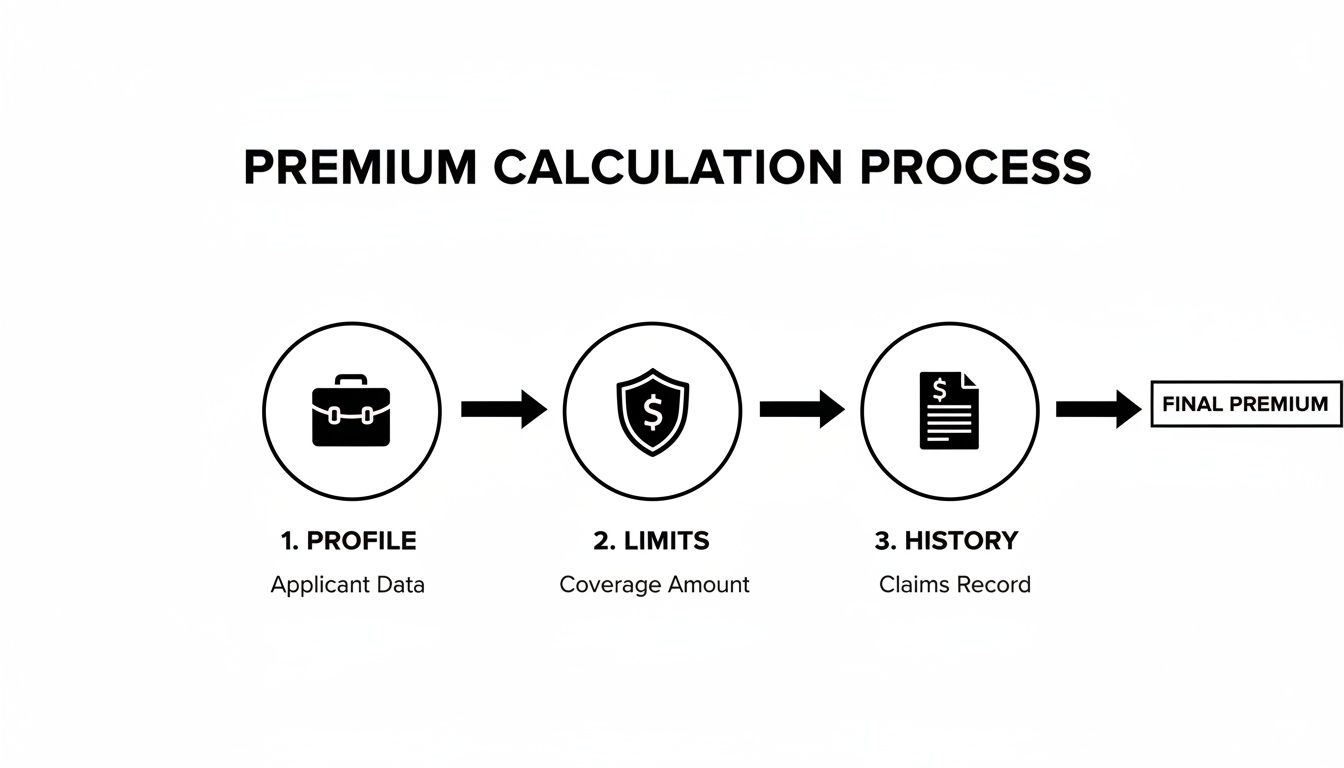
Each element helps the insurer build a complete risk profile for your business, which directly influences the price you'll pay.
Comparing Your Quotes Intelligently
Getting multiple quotes is a great start, but the real work is in the comparison. You have to look beyond the price tag. The true value of a policy is in the details, and those details determine how well it will actually protect you.
When reviewing a policy, zoom in on these critical elements to make a smart decision.
> A lower premium might look tempting, but it could come at the cost of essential protection. You're looking for the sweet spot: a policy that balances affordability with solid coverage, leaving no dangerous gaps that could expose your business.
Focus on these key details:
* **Policy Exclusions:** What specific situations or types of claims are *not* covered? It's common to see exclusions for fraudulent acts or claims related to services you aren't qualified to provide. Make sure you know what's left out. * **Retroactive Date:** This is crucial. Does the policy cover advice or work you did *before* the policy started? If you’ve been operating without prior coverage, this is vital for protecting yourself from claims that might pop up from old projects.
By carefully assessing what you need and taking the time to scrutinize your quotes, you can confidently choose the right **professional liability insurance in Alberta**. For more insights on protecting your company, check out our resources on comprehensive [business insurance solutions](https://www.insuranceshope.ca/insurance/business) designed for local entrepreneurs like you.
Frequently Asked Questions
Even after covering the basics, you probably still have a few questions. That's completely normal. Here are some of the most common things Alberta professionals ask us, with straightforward answers to help you gain the clarity you need.
Does My Policy Cover Work I Did in the Past?
Excellent question. The answer lies in your policy's **retroactive date**. Think of this as the official start date for your coverage. Any professional service you provided on or after this date is eligible for coverage, as long as the claim is filed while your policy is currently active.
When you get professional liability insurance for the first time or switch providers, setting this date correctly is critical. An experienced broker will ensure you don't have dangerous gaps in your history, protecting projects you completed months or even years ago.
> A policy with no retroactive date is a huge gamble. It leaves all your past work completely exposed to future claims. This single date is one of the most important details for protecting your business long-term.
What Is a Claims-Made Policy?
This is a critical concept to understand. Nearly all professional liability policies are sold on a **claims-made basis**, which works differently from your car or home insurance.
In simple terms, it means your policy must be active *at the time a claim is filed against you*, not just when the work was originally done. This is why it’s so important to maintain continuous coverage without any lapses. If you cancel your policy and a former client sues you six months later for a past project, you would be left without coverage.
How Much Coverage Do I Really Need?
There's no single magic number—the right amount of coverage is completely unique to your business. It comes down to a few key factors:
* **Your Profession:** High-stakes fields like engineering, medicine, or financial advising naturally need higher limits than lower-risk professions. * **Client Contracts:** It's common for contracts in Alberta to require a minimum of **$1 million** or **$2 million** in coverage before you can even start work. * **Business Size:** The more revenue you generate and the more people you employ, the bigger your potential exposure becomes. * **Risk Tolerance:** What's at stake? Think about the value of your business and personal assets you need to shield from a potential lawsuit.
This is where a good Alberta insurance broker becomes an invaluable partner. They can walk you through a proper risk assessment and recommend a coverage limit that gives you robust protection without making you overpay for coverage you don't need.
--- Ready to ensure your professional services are properly protected? The licensed Alberta brokers in the **InsuranceShope** network are here to help. They do the shopping for you, bringing you competitive quotes and expert advice to find a policy that is a perfect fit for your business. Get your free, no-obligation quote today at [https://www.insuranceshope.ca](https://www.insuranceshope.ca).