How to Master Travel Insurance Comparison in Canada and Save
Planning a trip is exciting, but a smart traveller knows that true peace of mind comes from having the right protection. When you're looking at [travel insurance in Canada](https://www.insuranceshope.ca/insurance/travel), a thorough comparison isn't just about checking a box—it's a crucial step to ensure you're properly covered without overpaying. The goal is to move beyond the price and find a policy that genuinely protects your health and your wallet, perfectly matched to your specific travel plans.
Why Comparing Travel Insurance Is a Financial Lifesaver
Venturing abroad without adequate protection is a massive financial gamble. A common misconception among Canadians is that their provincial health plan, like the Alberta Health Care Insurance Plan (AHCIP), will cover them fully if they get sick or injured outside their home province. This is a dangerously false assumption.
In reality, provincial plans cover only a tiny fraction of out-of-province medical expenses. We're talking less than **$400 per day** for a U.S. hospital stay, where the actual bill can easily skyrocket past **$10,000 per day**.
This staggering coverage gap is precisely why a careful travel insurance comparison is essential. We're not talking about minor expenses; we're talking about safeguarding yourself from medical bills that could lead to financial ruin. A well-chosen policy acts as your financial safety net, giving you the freedom to truly enjoy your travels.
Understanding the Market to Find the Best Value
More Canadians than ever recognize the importance of travel protection. The Canadian travel insurance market reached **USD 784.3 million in 2024** and is projected to grow to **USD 2,166.4 million by 2030**. Single-trip policies dominate, making up over **60%** of the market, which highlights their importance for everything from a weekend getaway to a two-week family vacation.
A proper comparison helps you find a policy that fits your trip perfectly. Are you a snowbird travelling for several months, or do you take a few short trips each year? Are you packing expensive electronics or planning to hit the ski slopes? Answering these questions helps you pinpoint what you truly need. Getting several **quotes for travel insurance coverage** is the most effective way to see how different providers balance cost against real-world benefits, empowering you to shop smart and save.
> A classic mistake is choosing the cheapest plan without reading the policy details. That "bargain" could have a sky-high deductible or exclude the very activities you're planning, rendering it useless when you actually need to file a claim.
By investing a little time in a **travel insurance comparison in Canada**, you ensure the plan you select offers genuine security. You want comprehensive protection that covers everything from a lost suitcase to a serious medical emergency. Here’s a quick breakdown of what to focus on.
| Comparison Aspect | Why It Matters | What to Look For | | :--- | :--- | :--- | | **Emergency Medical** | This is the absolute core of any policy, covering hospital stays, doctor visits, and treatments. | A minimum of **$5 million CAD** in coverage, especially if you're travelling to the United States. | | **Trip Cancellation** | Reimburses you for non-refundable expenses if you have to cancel your trip for a covered reason. | A clear list of covered reasons like illness, a family emergency, or unexpected job loss. | | **Baggage Protection** | Covers the cost if your luggage or personal items are lost, stolen, or delayed. | Check the per-item limits and overall maximums to ensure your valuables are actually covered. |
Deconstructing Policies: What to Actually Compare to Get the Best Deal
When you're comparing travel insurance in Canada, it's tempting to focus solely on the price. But the quote is just the tip of the iceberg—the real value is hidden in the policy details. If you don't look closer, you won't know what you're really paying for.
Think of it this way: buying a policy based on price alone is like buying a car without checking under the hood. It might look good on the sticker, but it could fail you when you need it most. Let's pop the hood and examine the key components of a solid travel insurance plan so you can make an informed, apples-to-apples comparison and find the best value.
The infographic below gives you a quick snapshot of the Canadian travel insurance landscape.
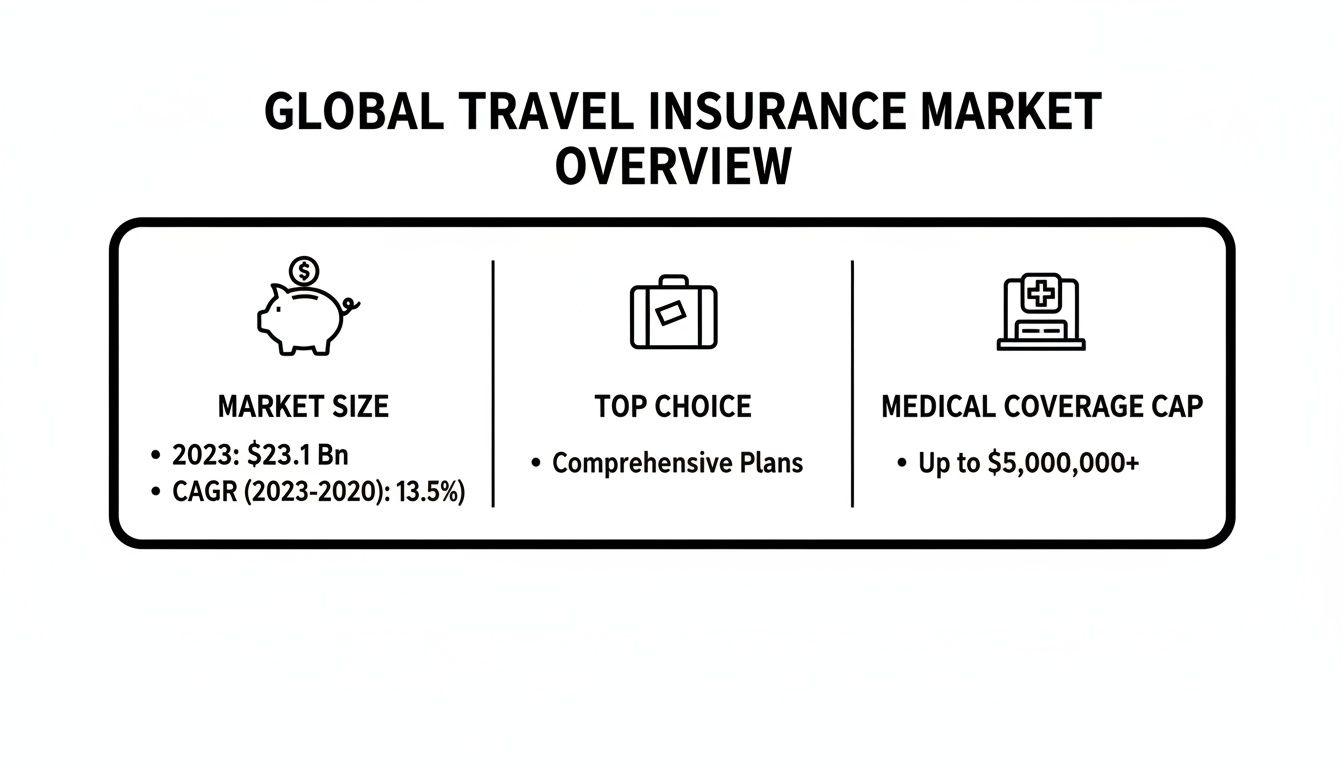
As you can see, single-trip plans are the most common choice for Canadians. The high medical coverage limits also prove just how critical this protection is.
Emergency Medical: The Non-Negotiable Core
This is the heart and soul of any travel insurance policy. It covers the big-ticket items like hospital stays, doctor visits, ambulance rides, and prescription drugs if you have a medical emergency abroad. Without it, you’re on the hook for costs that can spiral into hundreds of thousands of dollars.
When comparing this crucial coverage, zero in on these three things: * **Coverage Limit:** Don't settle for less than **$5 million CAD**. It sounds like a lot, but a serious medical event in a country like the United States can burn through a smaller limit in no time. * **Exclusions:** Read the fine print. Many standard policies won't cover injuries from what they deem "high-risk" activities—think rock climbing or scuba diving—unless you've added an adventure sports rider. * **Deductible:** This is what you pay out-of-pocket before your insurance kicks in. A higher deductible can lower your premium, but make sure it’s an amount you can comfortably afford in an emergency. Choosing the right deductible is a key way to save money on your premium.
Trip Cancellation and Interruption
Life is unpredictable. Sometimes, trips get cancelled before they even begin, or you have to cut them short. This coverage is your financial safety net, protecting the money you've already spent on non-refundable flights, hotels, and tours.
**Trip Cancellation** pays you back if you have to scrap your plans *before* you leave for a covered reason—like a sudden illness, a family emergency, or losing your job. **Trip Interruption** kicks in *after* you’ve already left, covering the costs to get you home if you need to end your trip unexpectedly. For a deeper look, check out our [**complete guide to trip cancellation and interruption insurance**](https://www.insuranceshope.ca/blog/trip-cancellation-interruption-insurance-guide).
> Here's a real-world example: trip interruption claims in Canada shot up by **28%** in 2024, thanks in large part to wildfire disruptions. The average claim hit **$4,500 CAD**. That really drives home how essential this coverage has become.
To help you get a clearer picture of what to focus on, here's a quick summary of the key features to compare across different policies.
Key Travel Insurance Coverage Comparison Points
| Coverage Type | What It Covers | What to Look For (Key Comparison Point) | Typical Coverage Limit | | :--- | :--- | :--- | :--- | | **Emergency Medical** | Hospital stays, doctor visits, ambulance, prescriptions. | The overall limit, exclusions for activities, and the deductible amount. | $5 Million+ CAD | | **Trip Cancellation** | Non-refundable costs if you cancel *before* departure. | The list of covered reasons (e.g., illness, job loss). | Up to your total trip cost | | **Trip Interruption** | Costs to return home early if your trip is cut short. | Covered reasons and what's reimbursed (e.g., flights, unused hotels). | Up to your total trip cost | | **Baggage Loss/Delay** | Lost, stolen, or damaged luggage; essentials if delayed. | Per-item limits (especially for electronics) and the delay period. | $500 - $1,500 | | **Medical Evacuation** | Transportation to the nearest adequate medical facility. | Whether it includes repatriation back to Canada. | Up to $5 Million or unlimited |
This table should help you cut through the noise and focus on the coverage details that truly matter for protecting your health and your wallet.
Other Essential Coverage Pillars
Beyond the big two, a well-rounded policy should include a few other protections to create a complete safety net.
* **Baggage Loss and Delay:** This reimburses you if your luggage is lost, stolen, or damaged. It also gives you a small budget to buy essentials if your bags are delayed by the airline. Always check the per-item limit to make sure your laptop or camera is properly covered. * **Accidental Death & Dismemberment (AD&D):** This provides a lump-sum payment to you or your family in the event of a fatal accident or one that results in a severe, permanent injury like the loss of a limb. * **Medical Evacuation:** If you get seriously hurt somewhere remote without good medical care, this coverage pays to transport you to the nearest proper hospital. In the most severe cases, it can even cover the cost of flying you back home to Canada for treatment.
The Canadian travel insurance market is booming, with a forecasted growth of **26.7% CAGR** between 2025-2034. More competition is great for consumers like you, but it also means more options to sift through, making a detailed comparison more important than ever to find the best policy at the best price.
Navigating Pre-Existing Conditions and Stability Clauses
For many Canadians, particularly seniors or anyone managing a chronic health issue, this is hands-down the most critical part of any travel insurance policy. Getting this wrong is one of the fastest ways to have a claim denied, potentially leaving you on the hook for staggering medical bills. When it comes to pre-existing conditions, the fine print isn’t just important—it’s everything.

A **pre-existing condition** is basically any medical issue, illness, or injury you had before your insurance policy kicked in. This covers everything from diagnosed conditions like diabetes or heart disease to symptoms you might have just mentioned to your doctor in passing.
What Is a Stability Clause?
This is where things often get tricky. To decide whether they’ll cover your pre-existing condition, insurers use something called a **stability clause** (or stability period). It’s a set amount of time—usually **90, 180, or even 365 days** before your trip—during which your condition must have been "stable."
But what does "stable" really mean? It’s not just about how you feel. From an insurer's point of view, a stable condition is one that has seen zero changes in:
* **Treatment:** No new therapies, medical procedures, or treatments. * **Medication:** No new prescriptions, no dosage changes (up or down), and no stopping a medication you were told to take. * **Symptoms:** No new symptoms, and no increase in the severity or frequency of existing ones. * **Medical Advice:** No outstanding tests, referrals to a specialist, or pending investigations.
Even a tiny, seemingly insignificant adjustment can reset your stability clock. For example, if your doctor nudges up your blood pressure medication 60 days before your trip, a policy with a 90-day stability clause likely won't cover any heart-related issues while you're away. For a deeper dive into these rules, our [**travel medical insurance guide for Albertans**](https://www.insuranceshope.ca/blog/travel-medical-insurance-alberta-guide) breaks down specifics for those in Western Canada.
The Stability Clause in Action: Real-World Scenarios
Let's look at how this plays out in real life. A proper travel insurance comparison means thinking through these kinds of situations to see how a policy would actually perform.
**Scenario 1: The Minor Medication Tweak** * **Traveller:** Susan, 68, has well-managed arthritis. Her policy has a **180-day** stability clause. * **The Change:** Four months before her Caribbean cruise, her doctor slightly increases her daily medication dose to help with some minor morning stiffness. She feels great. * **The Impact:** On the cruise, she suffers a severe arthritis flare-up and needs to see the ship's doctor. Her claim is **denied**. Why? The dosage change within that 180-day window made her condition "unstable" according to the policy's definition.
**Scenario 2: The Uninvestigated Symptom** * **Traveller:** David, 55, buys a policy with a **90-day** stability period. * **The Change:** Two months before heading to Florida, he tells his doctor about occasional chest pains he gets when climbing stairs. The doctor refers him to a cardiologist, but the appointment is still three months away. * **The Impact:** While in Florida, he has a heart attack. The claim is **denied**. The new symptoms and the pending specialist referral meant his cardiovascular condition was not considered stable.
> The bottom line is that total honesty and accuracy are non-negotiable. When you fill out that medical questionnaire, you have to disclose *everything*—every condition, every symptom, every medication change. Trying to hide something is a surefire way to get a claim rejected down the road.
As you compare policies, look closely at the length of the stability period. A shorter period, like **90 days**, is generally more favourable because it means your health history is reviewed over a shorter window. Some insurers also offer special plans or riders for pre-existing conditions that aren't stable, which can be a true lifesaver for anyone whose health fluctuates.
Comparing Plan Types: Single Trip vs. Multi-Trip vs. All-Inclusive
Choosing the right travel insurance isn't just about what’s covered—it’s about matching the policy's structure to your actual travel habits. A proper **travel insurance comparison in Canada** starts with the three main types of plans you'll encounter: Single-Trip, Multi-Trip Annual, and All-Inclusive. Getting this first step right is key to getting the best value and saving money.
Each plan is built for a different kind of traveller. If you understand what each one is designed for, you can avoid paying for coverage you simply don't need or, even worse, finding yourself underinsured when you need it most.
Single-Trip Insurance Plans
Just like the name says, a **Single-Trip plan** covers you for one specific trip with a set departure and return date. This is the go-to choice for most Canadians, perfect for the annual family vacation, a one-off business trip, or a quick weekend jaunt across the border.
The appeal of a single-trip policy lies in its simplicity. You pay for exactly what you need, for that one journey. Your premium is based on a few key factors: your age, where you're going, and for how long. For anyone who only takes one or two trips a year, this is almost always the most direct and cost-effective option.
> For instance, a 35-year-old Albertan heading to Mexico for 10 days might find a comprehensive medical plan for around **$40 to $60**. It’s a tiny price to pay for a huge amount of peace of mind, covering that travel window and nothing more.
Multi-Trip Annual Insurance Plans
If you travel often, buying a new policy every time you pack your bags gets old fast—and it can get expensive. This is exactly where a **Multi-Trip Annual plan** comes in. You pay a single premium that covers you for an entire year, letting you take as many trips as you want in that 12-month period.
These plans are ideal for snowbirds, frequent business travellers, or anyone who enjoys making spontaneous cross-border shopping runs. But there’s one critical detail you have to watch: the maximum duration allowed for each individual trip. This limit typically falls somewhere between **15 and 60 days**. If you plan a trip that’s longer than your policy’s maximum, you'll have to buy a "top-up" to cover the extra days.
So, when does an annual plan actually save you money? As a general rule, if you travel more than twice a year or take a handful of shorter trips, a multi-trip plan will usually break even or come out ahead. If two separate single-trip policies cost you $150 each, an annual plan for $250 would mean significant savings and convenience for any other travel you do that year.
All-Inclusive Package Plans
Think of an **All-Inclusive plan** as the "bundle deal" of travel insurance. It takes the essential emergency medical coverage and combines it with other key protections like trip cancellation, trip interruption, and baggage loss, all in one neat package. You can buy these plans for a single trip or on an annual basis.
The main advantage here is how comprehensive it is. Instead of juggling separate policies for medical issues and travel mishaps, an all-inclusive plan has you covered from multiple angles. This is especially valuable for pricey, pre-booked vacations—think cruises or all-inclusive resorts—where you’ve put down a big non-refundable deposit that’s at risk.
While these packages often cost more upfront, they can offer much better value than buying each type of coverage separately. The trick is to honestly assess your trip's financial risk. If you've spent thousands on non-refundable bookings, the extra cost for cancellation and interruption coverage is a very smart investment.
To help you decide, the guide below breaks down which plan works best for different types of travellers and their trips.
Situational Plan Recommendation Guide
| Travel Scenario | Best Plan Type | Why It's Recommended | Example Use Case | | :--- | :--- | :--- | :--- | | **The Annual Family Vacation** | Single-Trip All-Inclusive | Covers one specific trip with medical, cancellation, and baggage protection for the entire family. | A two-week pre-booked resort vacation in the Caribbean. | | **The Frequent Business Traveller** | Multi-Trip Annual | Offers cost-effective coverage for numerous trips throughout the year without needing a new policy each time. | A sales manager who travels to the U.S. for 4-5 days every month. | | **The Spontaneous Weekender** | Single-Trip Medical | Provides essential emergency medical coverage for a short, low-cost trip without unnecessary extras. | A last-minute road trip from Calgary to Montana for a long weekend. | | **The Snowbird** | Multi-Trip Annual (with top-up) | Covers multiple trips and can be extended for a longer winter stay, often more economical than one long single-trip policy. | A retiree spending three months in Arizona and taking short trips elsewhere. |
Ultimately, the right plan is the one that aligns with both your travel frequency and the financial investment you've made in your trip.
Finding the Right Coverage for Your Trip
When it comes to a **travel insurance comparison in Canada**, there's no such thing as a one-size-fits-all plan. The right policy needs to be built around your specific trip and traveller profile, because a generic plan can leave you dangerously exposed.
Think about it: a student heading abroad for a full semester has completely different needs than a snowbird escaping the Canadian winter for six months. The same goes for someone sponsoring family from overseas—they have unique legal and financial responsibilities to consider. It’s not just smart to match your policy to your trip; it’s essential.
Specialized Insurance for Unique Canadian Scenarios
Tailoring your coverage to your situation means you're only paying for protection you actually need. An adventure traveller doesn't require the same policy as someone visiting family, so zeroing in on specialized coverage is the key to getting real value.
Here are a few common scenarios that call for specific types of travel insurance:
* **Super Visa Insurance:** This is a non-negotiable legal requirement for Canadians hosting parents or grandparents on a Super Visa. * **Student Travel Insurance:** Built for long-term stays, these plans often include coverage for things like tuition loss and emergency trips back home. * **Snowbird Insurance:** These are long-stay policies designed for Canadians wintering in warmer climates like the U.S., with features geared towards older travellers. * **Adventure Travel Riders:** Standard policies will often exclude "high-risk" activities. An adventure rider closes that gap, adding protection for things like skiing, scuba diving, or even mountain trekking.
Super Visa Insurance: A Must-Have for Sponsoring Family
If you’re inviting your parents or grandparents to Canada on a Super Visa, you are legally required by Immigration, Refugees and Citizenship Canada (IRCC) to purchase a specific medical insurance policy for them. This isn't a suggestion—it's a mandatory part of the application.
The policy has to meet some pretty strict minimums: * It must provide at least **$100,000 CAD** in emergency medical coverage. * It has to be valid for at least **one full year** from the day they arrive in Canada. * It must be purchased from a **Canadian insurance company**.
> When you're comparing Super Visa insurance, don't just look at the price tag. Dig deeper and check for benefits like coverage for pre-existing conditions (which will be subject to stability clauses), side trips outside of Canada, and the deductible. A cheap premium might hide a massive deductible that you’d be on the hook for in an emergency.
Coverage for Students, Snowbirds, and Adventurers
Students heading abroad for their studies need long-term coverage that their provincial health plan simply won’t provide. Look for policies that cover not just emergency medical care and repatriation, but also potential tuition reimbursement if a serious illness forces them to withdraw from their program.
For snowbirds heading south, a robust medical plan is critical, as U.S. healthcare costs are astronomical. The best plans offer high coverage limits—ideally **$5 million CAD** or more—and address pre-existing conditions with clear, manageable stability clauses. For more tailored advice, Albertans can check out our guide on [**travel insurance essentials**](https://www.insuranceshope.ca/blog/travel-insurance-essentials-for-albertans).
Finally, if your vacation involves anything more exciting than a stroll on the beach, you need to read the policy's exclusions list carefully. Activities like skiing, zip-lining, or even scuba diving often demand a special "sports and activities" rider. Without it, any injury you sustain while doing those activities likely won't be covered, leaving you to foot the entire bill yourself.
A Step-by-Step Guide to Comparing Quotes and Policies
Alright, now you know what to look for in a policy. This is where we put that knowledge to work and start your **travel insurance comparison in Canada**. It's time to move from theory to action—finding the specific plan that will actually protect you and your wallet out there. The trick is to be methodical and look beyond just the price tag.
A smart comparison actually starts before you even see a single quote. Getting quotes that are genuinely useful hinges on providing accurate details right from the get-go. So, take a few minutes to pull together the key information for every traveller you need to cover.

This little bit of prep work makes sure the quotes you get are tailored to your real situation, preventing any nasty surprises if you need to make a claim.
Step 1: Gather Your Information
Before you start hunting for quotes, get these details handy for each person being insured. If your info is off, the pricing will be wrong, and you could run into serious coverage problems later.
1. **Exact Trip Dates:** Your departure and return dates are the foundation of the policy's duration and a huge factor in the final cost. 2. **Destination(s):** Be specific here. The cost of coverage can change dramatically depending on where you're going. A trip to the United States, for example, is almost always more expensive to insure because of their high healthcare costs. 3. **Traveller Details:** You’ll need the exact birth date for everyone on the policy. Age is one of the biggest factors that determines your premium. 4. **Total Trip Cost:** If you want trip cancellation or interruption coverage, you need to calculate the total non-refundable amount you've pre-paid. This means flights, hotels, tours—everything. This number sets the coverage limit you need. 5. **Medical History:** Be ready to answer questions about pre-existing conditions, and be honest. This is absolutely critical to make sure your policy is valid when you need it most.
Step 2: Use Comparison Tools and Brokers
Once you have your details organized, it’s time to get some quotes. The most efficient way to see what's out there is by using an online comparison tool or working with an insurance broker, like the ones partnered with InsuranceShope. These platforms do the heavy lifting for you, pulling quotes from multiple insurance companies at once.
This approach saves you the mind-numbing task of going to each insurer's website and typing in the same information over and over again. You get a solid overview of the market in just a few minutes, which is the fastest way to shop and save.
> Remember, the first price you see is just a starting point. Your job is to dig into what each quote *actually offers* for that price. A policy that's **$20** cheaper might have a **$1,000** higher deductible, making it a much worse deal in an emergency.
Step 3: Scrutinize the Policy Details
With a few quotes in front of you, the real comparison begins. You need to look past the premium and analyze the guts of each policy. To make a true apples-to-apples comparison, focus on these critical points.
* **Medical Coverage Limit:** Is it at least **$5 million**? For any travel involving the U.S., I'd say anything less is a huge gamble. * **Deductible Amount:** How much are you on the hook for before the insurance company starts paying? A **$0 deductible** plan will cost more upfront, but it could save you a ton of money and stress during a claim. * **Stability Period:** If you have a pre-existing condition, compare the stability clauses carefully. A **90-day** period is a lot more forgiving than a **180-day** one. * **Trip Cancellation Reasons:** Read the fine print. What reasons are actually covered if you have to cancel? Does the list include things that might affect you, like a job loss or the illness of a non-travelling family member? * **Exclusions:** This is just as important as what's covered. What will the policy *not* pay for? Pay close attention to sections on adventure sports, alcohol-related incidents, and specific pre-existing conditions.
By walking through these steps systematically, you can confidently sort through your options and land on a policy that delivers real security, not just a cheap price.
Frequently Asked Questions About Travel Insurance
Even after you've done a detailed travel insurance comparison, a few questions can still linger. Getting those last few details sorted out is the key to choosing your policy with total confidence. Let's tackle some of the most common queries we hear from Canadians.
When Is the Best Time to Buy Travel Insurance?
Honestly, the best time to buy is right after you’ve put down your first non-refundable deposit—whether that's for flights, a tour, or accommodation. When you buy early, you’re immediately covered by trip cancellation benefits, protecting your investment if something unexpected pops up before you even pack your bags. This is a simple but powerful strategy to maximize the value of your policy.
If you’re only looking for emergency medical coverage, you can technically wait until the day before you leave. But for the most complete protection against life's curveballs, locking in your policy as soon as you book your trip is the smartest move.
Can I Get Travel Insurance with a Pre-Existing Medical Condition?
Yes, you absolutely can. The trick is finding a plan that's built for your specific health needs. This means doing your homework and comparing policies to find one with a stability period you can meet, or one that offers an optional rider for unstable conditions.
What's absolutely critical is being **100% transparent** on your medical questionnaire. Hiding a condition, a new symptom, or a change in medication is one of the quickest ways to get a claim denied. Full honesty ensures your policy is actually there for you when you need it.
> Trip Cancellation and Trip Interruption sound similar but cover different phases of your journey. Cancellation protects your investment *before* you leave, while Interruption protects you *after* your trip has begun, covering costs to return home early for a covered reason.
Is My Credit Card Travel Insurance Good Enough?
It might be, but you have to dig into the fine print. The insurance bundled with credit cards often comes with some serious limitations you need to be aware of, such as:
* Lower benefit limits for emergency medical care. * Strict caps on how long your trip can be (for example, coverage might stop after **15 days**). * Less comprehensive coverage for pre-existing medical conditions.
Never assume it's sufficient. Always get your hands on the full certificate of insurance from your credit card company. Compare its benefits side-by-side with a standalone policy to see where the gaps are. For longer trips or more expensive vacations, a separate, dedicated policy is almost always the safer and more cost-effective bet.
For more in-depth answers, check out our [**expanded travel insurance FAQ section**](https://www.insuranceshope.ca/faq/expanded) to get clarity on any remaining questions.
--- Ready to find a plan that fits your trip and budget? The licensed brokers in the **InsuranceShope** network can help you compare quotes from Canada's top providers in minutes. Get personalized advice and secure the right protection by requesting your free, no-obligation travel insurance quote today. [https://www.insuranceshope.ca](https://www.insuranceshope.ca)