What Is Commercial General Liability Insurance? An Essential Guide for Business Owners
Picture this: a customer slips on a recently mopped floor in your shop. Or maybe one of your employees, working on a client's site, accidentally knocks over an expensive piece of equipment. Without the right protection, a simple mishap like this could spiral into a financially devastating lawsuit. This is where your financial shield comes in.
Enter **Commercial General Liability (CGL)** insurance. Think of it as the foundational financial protection for your business. It’s the essential policy that stands between a common, everyday accident and a catastrophic loss for your Alberta-based company, letting you operate with confidence.
It’s easy to think "it won't happen to me," but liability claims are far more common than most business owners realize. CGL is designed to step in and handle the costs when your business is accused of causing harm to a third party.
This guide will break down exactly what CGL is, covering claims related to:
* **Bodily Injury:** When someone other than an employee—like a customer, vendor, or visitor—gets physically hurt on your property or because of your business operations. * **Property Damage:** If you or your team cause damage to someone else’s property while on the job. * **Reputational Harm:** This covers things like slander, libel, or even copyright infringement in your advertising.
Your First Line of Defence
Ultimately, CGL is your business’s first and most critical line of defence against the unexpected. It provides the financial muscle to cover legal fees, medical bills, and potential settlements, letting you focus on what you do best—running your business—without the constant fear of a lawsuit derailing your hard work.
Understanding its role is the first step in building a truly resilient business. For a broader look at essential coverages, check out our guide on [business insurance essentials for Albertan entrepreneurs](https://www.insuranceshope.ca/blog/business-insurance-essentials-albertan-entrepreneurs).
> CGL insurance is specifically designed to cover non-professional negligent acts. It’s arguably one of the most important policies any business can carry, because liability suits are common and can have a massive financial impact, no matter your company's size or industry.
This coverage ensures that a single incident doesn't undo everything you've worked for, making it a non-negotiable part of any smart risk management plan.
What Does Commercial General Liability Insurance Actually Cover?
A Commercial General Liability (CGL) policy can feel a bit complex at first glance, but it’s actually built on three straightforward, powerful pillars of protection. Once you understand them, you’ll see just how valuable this coverage is when things go sideways.
Think of CGL as a shield standing between your business and the financial fallout from accidents, property damage, and even missteps in your advertising.
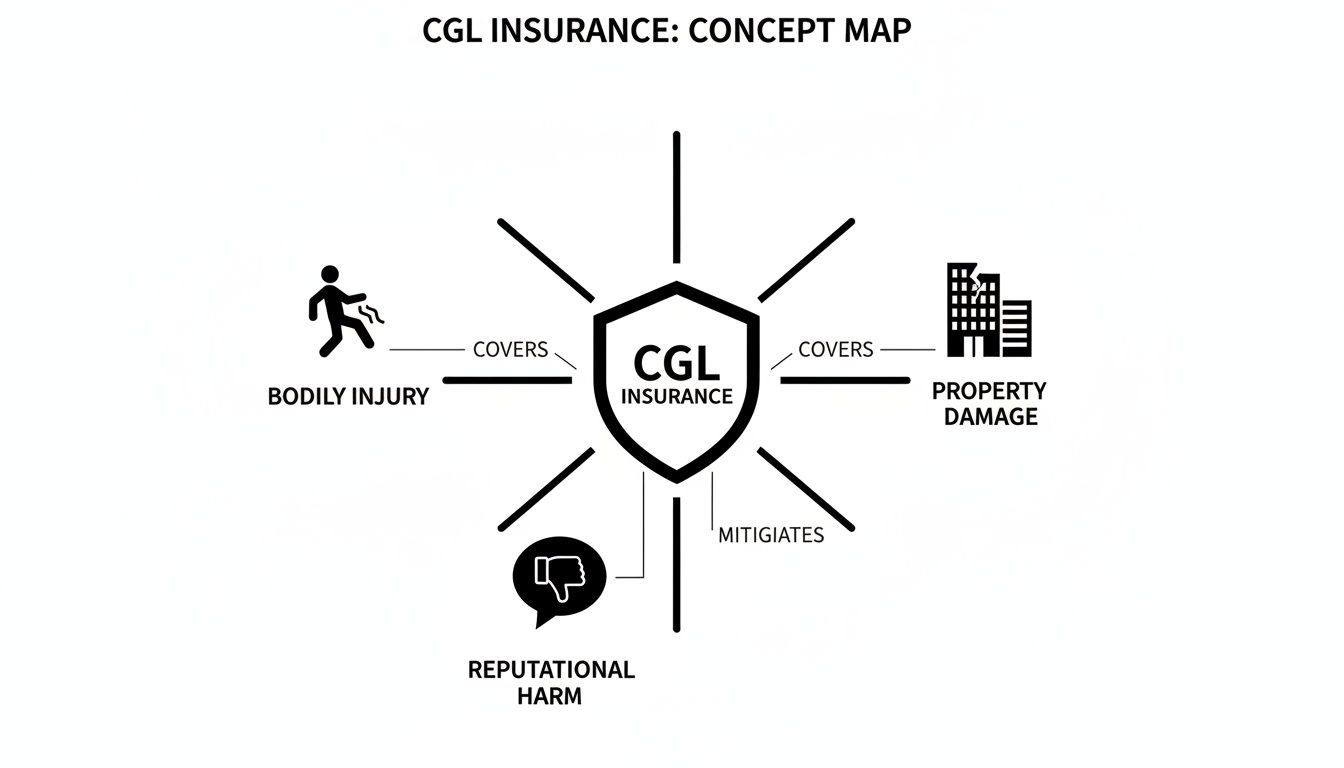
Let’s break down exactly what this shield protects.
Core CGL Coverages at a Glance
This table offers a quick snapshot of the three main components of a CGL policy, with real-world examples for Alberta businesses to make it tangible.
| Coverage Area | What It Covers | Alberta-Based Example | | :--- | :--- | :--- | | **Bodily Injury** | Pays for medical costs, lost income, and legal fees if a non-employee (like a client, vendor, or visitor) gets hurt on your premises or due to your operations. | A customer slips on an icy patch outside your Red Deer storefront, breaks an arm, and sues you for their medical bills and lost wages. | | **Property Damage** | Covers the cost to repair or replace someone else’s property that your business accidentally damages. This is crucial for anyone working off-site. | Your landscaping crew in Lethbridge accidentally backs a mower into a client’s expensive garden fence, destroying a section of it. | | **Personal & Advertising Injury** | Protects against claims related to reputational or non-physical harm, such as libel, slander, copyright infringement, or invasion of privacy. | Your Calgary-based marketing agency uses a stock photo in an online ad that you didn't have the proper licence for, and the photographer sues. |
Each of these pillars is designed to tackle a different—but equally common—risk that modern businesses face every single day.
1. Bodily Injury Liability
This is the one most people think of first. **Bodily injury** coverage kicks in if a third party—meaning anyone who isn't an employee—gets physically hurt because of your business. This could happen on your property or out on a job site.
It's the classic slip-and-fall scenario. If someone is injured, they can sue your business for everything from medical bills and rehabilitation costs to lost income. Your CGL policy is designed to handle those expenses, including the hefty cost of a legal defence, right up to your policy limit.
2. Property Damage Liability
Next up is **property damage**. This coverage is for those "oops" moments when your business operations accidentally wreck someone else's stuff. It’s an absolute must-have for contractors, cleaners, consultants, or anyone who works on client property.
Without this coverage, you’d be on the hook for the repair or replacement costs yourself. A single mistake could easily wipe out your profits for the month, or worse.
3. Personal and Advertising Injury Liability
The third pillar is a bit different. **Personal and advertising injury** isn’t about physical harm—it’s about damage to another person’s or business’s reputation and rights. In today's digital world, this protection is more critical than ever.
This coverage protects against claims of: * **Libel or Slander:** You say or write something that harms someone’s reputation. * **Copyright Infringement:** You accidentally use someone else’s creative work (a photo, music, or text) in your marketing without permission. * **Wrongful Eviction:** An issue that can pop up for property managers and landlords.
> For an Alberta business, this could be as simple as an employee making a false statement about a competitor online. The resulting lawsuit could be a financial nightmare, but CGL is there to manage that risk.
These three pillars are the foundation of a solid risk management plan. To see how CGL fits into a complete strategy for protecting your company, explore the full suite of **[business insurance](https://www.insuranceshope.ca/insurance/business)** solutions available.
Understanding Common CGL Policy Exclusions
Knowing what your Commercial General Liability (CGL) policy covers is vital, but it’s just as important to understand what it *doesn’t* cover. A CGL policy is a powerful shield, but it has limits. Recognizing these boundaries helps you avoid dangerous gaps in your protection and highlights the need for a complete insurance strategy.
Think of CGL as your public-facing liability shield. Its main job is to protect you from claims brought by third parties—people like customers, vendors, or the general public. It was never designed to cover every possible risk your business might face, especially those involving your own employees, your own property, or your professional judgment.
Why Some Risks Are Not Covered by CGL
Certain incidents are deliberately left out of a standard CGL policy because they are better handled by other, more specialized types of insurance. One of the most common and costly mistakes a business owner can make is assuming their CGL policy is a catch-all solution.
Here’s a breakdown of the most common exclusions and the specific policies designed to cover them:
* **Employee Injuries:** If an employee gets hurt on the job, that’s a matter for **Workers' Compensation Benefits (WCB)**. CGL specifically excludes employee injuries because, in Alberta, WCB is the official, mandated system for handling these workplace incidents.
* **Professional Mistakes:** Let's say your professional advice or a service you provided causes a client a significant financial loss. CGL won't step in here. This is the territory of **Professional Liability Insurance**, often called Errors & Omissions (E&O) insurance. It’s built to cover financial losses stemming from negligence or mistakes in your professional capacity.
* **Damage to Your Own Property:** If a fire damages your office or your essential equipment gets stolen, you'll need **Commercial Property Insurance**, not CGL. CGL only pays for damage you cause to *someone else's* property.
* **Business Vehicle Accidents:** Any accident involving a vehicle used for business—whether it's a delivery van or a car used for client meetings—requires a **Commercial Auto Insurance** policy. Both your personal auto policy and your CGL will wash their hands of these incidents.
> Understanding these exclusions is the first step toward building a truly secure business. Each policy is a piece of a larger puzzle, and a gap in one area can leave your entire operation exposed to significant financial risk.
Once you can tell these different coverages apart, you can start building a more resilient business. To get a better handle on the risks tied to professional mistakes, you can explore our detailed guide on [Professional Liability Insurance in Alberta](https://www.insuranceshope.ca/blog/professional-liability-insurance-alberta). An experienced broker is your best ally in this process; they can help you spot these critical gaps and make sure every piece of your insurance puzzle is firmly in place.
How CGL Insurance Premiums Are Calculated in Alberta
If you're a business owner in Alberta, the bottom line is always top of mind. Once you understand what commercial general liability insurance is, the next question is always, "How much is this going to cost me?" Insurers don't just pull a number out of a hat; they use a detailed risk assessment process to figure out your premium.
The final price tag is highly specific to *your* business. Think about it: a construction company in Red Deer faces a whole world of different risks than a small retail shop in Lethbridge. It only makes sense that their insurance premiums would reflect that reality.
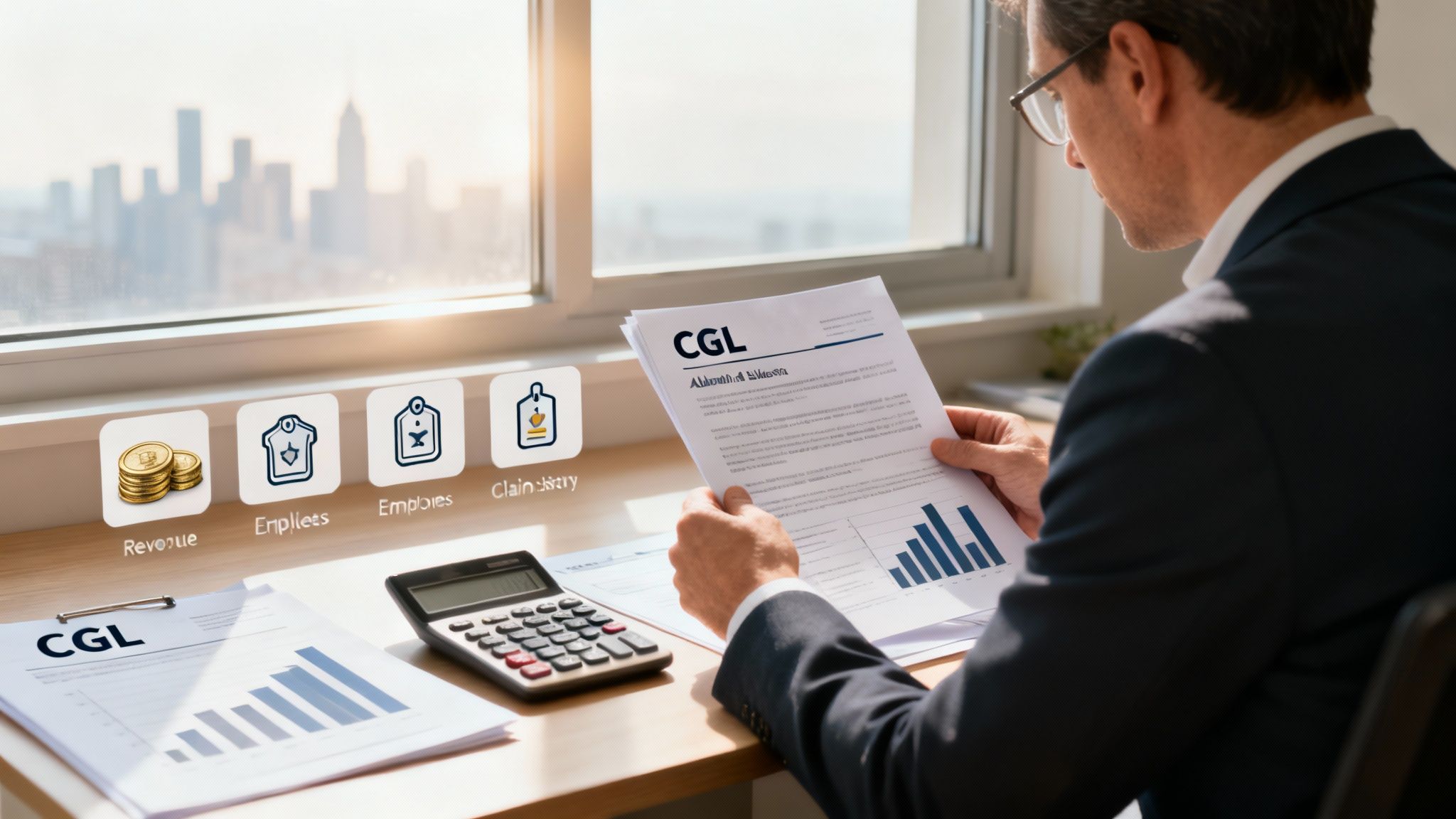
Key Factors That Determine Your CGL Cost
Insurers look at several key variables to build a risk profile for your business. Getting a handle on these factors not only clarifies the pricing process but also shows you how you can potentially influence your costs.
The main ingredients that go into your premium include:
* **Industry and Operations:** Higher-risk industries like construction or manufacturing will naturally see higher premiums. There's simply a greater chance of a bodily injury or property damage claim compared to a quiet, office-based business. * **Annual Revenue:** More business activity usually means more interaction with the public, clients, and suppliers. This increased exposure bumps up the potential for an incident, which can influence your premium. * **Number of Employees:** A larger team often means bigger projects and more widespread operations. To an insurer, this translates to more opportunities for a liability claim to occur. * **Claims History:** Just like with your personal car insurance, a clean track record helps. A history free of claims can lead to lower costs, while a pattern of frequent or large claims signals higher risk.
These factors explain why costs can vary so much. For instance, a solo entrepreneur might pay as little as **$30 per month**, while a larger incorporated business could be looking at rates closer to **$195 monthly**. Many small businesses with standard **$1 million** per occurrence and **$2 million** aggregate limits find their annual premium lands somewhere between **$400 and $1,200**.
To break it down further, here’s a look at the key variables that insurers weigh when calculating your premium.
Factors Influencing Your CGL Premium
| Factor | Why It Matters to Insurers | Impact on Premium | | :--- | :--- | :--- | | **Industry** | Some sectors (e.g., construction, hospitality) have inherently higher risks of accidents or injuries. | **High Impact** | | **Annual Revenue** | Higher revenue often correlates with more extensive operations and greater public exposure. | **Moderate Impact** | | **Claims History** | A history of past claims suggests a higher likelihood of future claims. A clean record is rewarded. | **High Impact** | | **Location** | Operating in a high-traffic urban area can increase risk compared to a remote, rural location. | **Low to Moderate Impact** | | **Experience** | A long-established business with a proven track record is often seen as a lower risk. | **Low to Moderate Impact** | | **Coverage Limits** | Higher limits for per-occurrence and aggregate coverage mean more potential payout from the insurer. | **High Impact** |
Understanding these elements helps demystify the underwriting process and shows that the final price is a direct reflection of your business's unique risk profile.
The Impact of Your Coverage Limits
Beyond your business's profile, the actual coverage limits you choose play a huge role in the final cost. You’ll need to select a **per-occurrence limit** (the maximum payout for a single claim) and an **aggregate limit** (the total maximum the policy will pay out during the term).
> Choosing higher limits gives you a much stronger financial safety net, but it will also increase your premium. The trick is to find that sweet spot between robust protection and a cost you can comfortably manage.
This is where having a knowledgeable insurance broker in your corner is a game-changer. They can help you properly assess your real-world risks and choose appropriate limits so you aren't overpaying for coverage you don't need. It's also helpful to understand the broader market forces at play; learn more about the factors driving [high insurance rates in Alberta](https://www.insuranceshope.ca/blog/why-insurance-rates-high-alberta) in our detailed guide. At the end of the day, shopping the market is the smartest way to lock in competitive rates for the essential protection your business deserves.
Customizing Your CGL Policy With Essential Add-Ons
A standard Commercial General Liability (CGL) policy is a fantastic starting point, but it's rarely a perfect, one-size-fits-all solution. Every business in Alberta faces its own unique set of risks, and your insurance should reflect that reality. That’s where you can start fine-tuning your coverage with **endorsements**—often called riders—to build a policy that truly protects the way you operate.
Think of your CGL policy as a well-built house. It has a solid foundation and strong walls. But endorsements are the custom upgrades that make it your home, like adding a security system for peace of mind or finishing the basement to expand your living space. Without them, you could be leaving some pretty big doors unlocked.
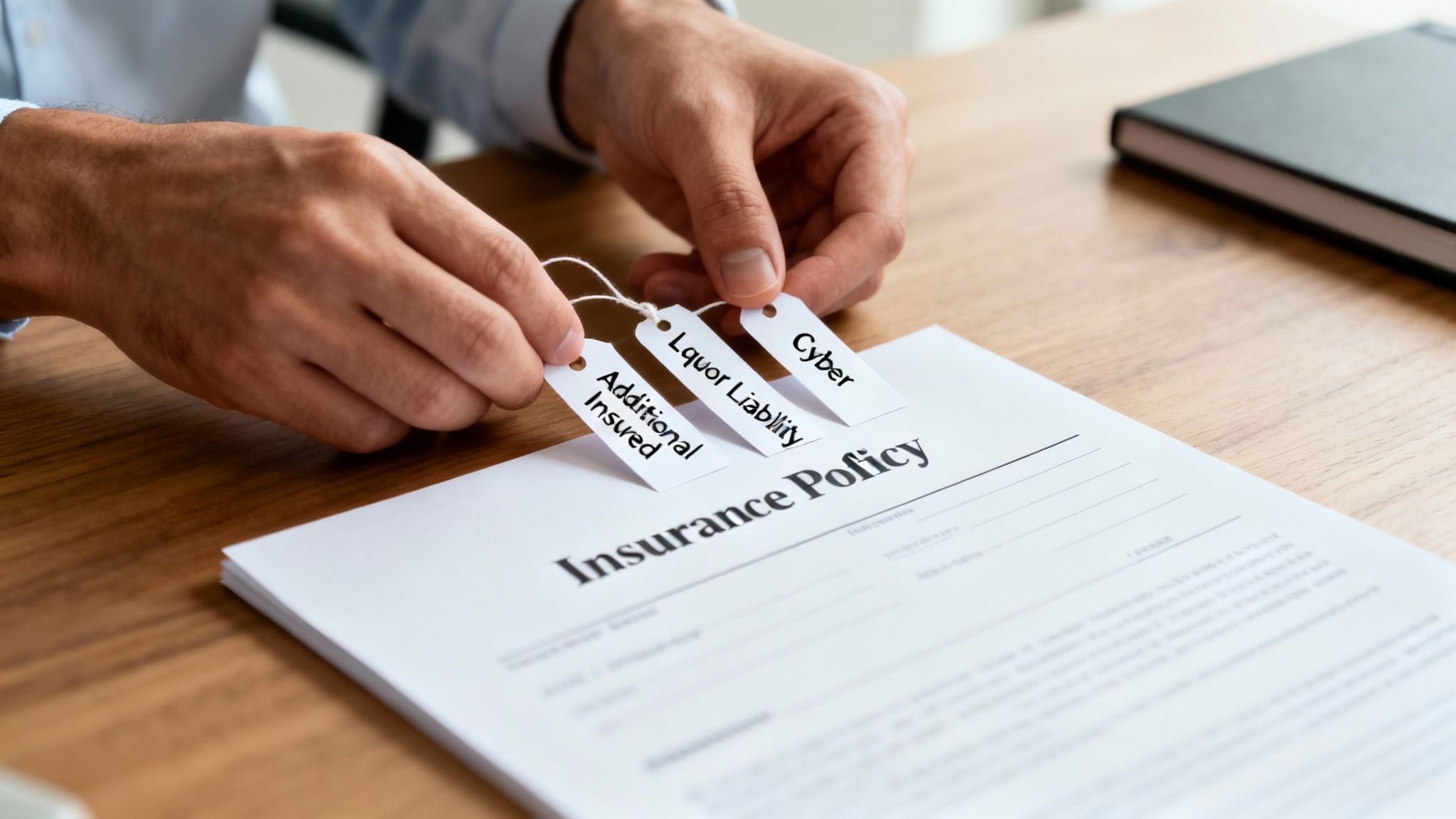
Common Endorsements For Alberta Businesses
For many Alberta businesses, certain endorsements aren't just nice to have; they're practically non-negotiable. They're designed to plug common gaps and satisfy contractual requirements you'll almost certainly run into.
Here are a few essential add-ons to consider:
* **Additional Insured:** This one is huge if you work with partners, landlords, or general contractors. For instance, a property manager will almost always require you to add them as an "additional insured," which extends your liability coverage to protect them from claims related to your business activities on their premises. * **Liquor Liability:** Your standard CGL policy almost always excludes incidents related to serving alcohol. If you run a restaurant, host events, or even have a licensed patio, this endorsement is absolutely critical. It protects you from the serious liability that can arise if a patron becomes intoxicated and causes harm. * **Non-Owned Auto Liability:** What happens if an employee uses their own car to run a work errand and gets into an accident? This endorsement extends your CGL to cover claims involving vehicles you don’t own but are used for business purposes.
Building a Complete Safety Net
While endorsements help customize your CGL, it's just as important to understand how CGL fits into your bigger insurance picture. Relying on CGL alone is a risky strategy because it was never designed to cover every single threat your business faces. It needs to work hand-in-hand with other specialized policies.
> A robust protection plan isn't a single policy—it's a carefully integrated set of coverages. Each policy is a puzzle piece designed for a specific risk, and together, they create a comprehensive safety net that leaves no room for costly surprises.
To build out this complete shield, your CGL policy should be complemented by other key coverages:
* **Commercial Property Insurance:** Protects your physical assets—your building, equipment, computers, and inventory—from things like fire, theft, or a burst pipe. * **Professional Liability (E&O) Insurance:** A must-have for any service-based business. It covers financial losses a client suffers because of your professional errors, bad advice, or negligence. * **Cyber Insurance:** This is no longer optional. It helps you recover from the crippling costs of data breaches, ransomware attacks, and other digital disasters. * **Commercial Auto Insurance:** This is mandatory for any vehicles your business owns and operates. For a closer look, check out our guide on [commercial auto insurance in Alberta](https://www.insuranceshope.ca/blog/commercial-auto-insurance-alberta).
Pairing your CGL with these policies is how you build a real defence against nearly any threat that comes your way. The best path forward is always to work with an experienced broker who can help you analyze your specific risks and assemble a protection plan that lets you focus on growing your business.
How to Get the Right CGL Coverage and Save
Now that you understand what CGL insurance is, the next step is turning that knowledge into the right protection for your Alberta business—at the best possible price. The goal is simple: find coverage that fits what you do without paying a penny more than you need to.
First things first, you'll need to pull together some key details about your company. Any insurer or broker will ask for your projected annual revenue, the number of people on your payroll, and a clear description of your operations. They’ll also need to know your physical address. This isn't just paperwork; it’s how they get a clear picture of your specific risks.
The Broker Advantage: Shop the Market to Save
You *could* call individual insurance companies one by one, but that's the long, inefficient way to do it. The smartest path is to partner with an independent insurance broker. A broker is your advocate in the insurance world—they aren't tied to any single company, so their only goal is to find you the best deal.
Here’s what a good broker brings to the table:
* **They Shop the Market for You:** A broker takes your business profile and compares quotes from multiple insurers. This creates competition and ensures you get the best possible terms and pricing. * **You Get Unbiased Advice:** Remember, they work for *you*, not the insurance company. That means you get straight-up, honest guidance on which policy offers the best protection for your specific operation. * **They Translate the Fine Print:** Let's be honest, insurance policies are full of jargon. Your broker cuts through the complexity so you know exactly what is—and just as importantly, what isn't—covered.
> Working with a broker ensures your CGL policy is built for your business. It’s about more than just satisfying contracts; it’s about aligning your coverage with your real-world risks and your budget.
This partnership takes the guesswork out of buying insurance. It gives you the confidence that your business has rock-solid protection at a price that makes sense.
Got Questions About CGL? We've Got Answers.
When it comes to business insurance, a few key questions always pop up. Let's tackle some of the most common ones we hear from Alberta business owners to clear up any confusion and help you feel confident about your coverage.
Is CGL Insurance Mandatory in Alberta?
This is a great question. While the province doesn't have a blanket law forcing every single business to carry CGL insurance, it’s often a **non-negotiable requirement of doing business**.
Think about it: landlords won't hand over the keys to a commercial space without it. Clients, especially larger corporations or government bodies, will demand to see proof of insurance before signing a contract. And if you're a subcontractor, the general contractor will almost certainly require it. So, while it may not be legally mandatory for everyone, it's a practical necessity for most.
What's the Difference Between CGL and Professional Liability Insurance?
This is a really important one to get right, as confusing the two can leave a massive gap in your protection.
Commercial General Liability (CGL) is for tangible, physical harm. It covers claims of **bodily injury or property damage** that your business operations cause to someone else. A customer slipping on a wet floor, or an employee breaking a window at a client’s site—that's CGL territory.
Professional Liability (often called Errors & Omissions or E&O) is all about financial harm stemming from your expertise. It protects you from claims of **financial loss** a client suffers because of your professional advice, a mistake you made, or a service you failed to deliver. It’s for mistakes in your work, not physical accidents.
> Simply put: CGL covers the physical things you *do*, while Professional Liability covers the advice you *give* or the professional services you *provide*.
Can I Bundle CGL with Other Policies to Save Money?
Absolutely. Bundling is one of the smartest and easiest ways to get comprehensive coverage while saving money.
Most insurance providers offer something called a **Business Owner’s Policy (BOP)**. This package typically rolls your CGL, Commercial Property Insurance, and often Business Interruption coverage into one neat, tidy policy. Not only does this simplify managing your insurance, but it almost always comes at a lower price than if you bought each policy on its own. It's an excellent way to get broad protection and great value.
How Quickly Can I Get Covered?
In most cases, very quickly. Once you've gathered the key details about your business—things like your annual revenue, what your day-to-day operations look like, and how many employees you have—a broker can usually get you quotes and have your policy active within **24 to 48 hours**. This speed is crucial when you need to show proof of insurance to land a new contract or finalize a lease.
---
Ready to find the right CGL protection for your Alberta business? The expert brokers in the **InsuranceShope** network are here to help. They'll do the heavy lifting, comparing options from Canada's top insurers to find you a great rate on coverage that fits your business perfectly.
**[Request Your Free CGL Insurance Quote from InsuranceShope](https://www.insuranceshope.ca)**