What Is Comprehensive Insurance and How Can It Save You Money?
When you hear “comprehensive insurance,” it’s easy to think it covers absolutely everything. While it’s definitely broad, its real job is very specific: to protect your car from damage from almost anything that *isn't* a direct collision with another vehicle or an object like a pole.
Understanding this coverage is the first step toward building a smarter auto insurance policy—one that protects your investment without breaking the bank. By knowing what it covers and how it works, you can make informed decisions that could save you thousands.
Defining Comprehensive Insurance in Simple Terms
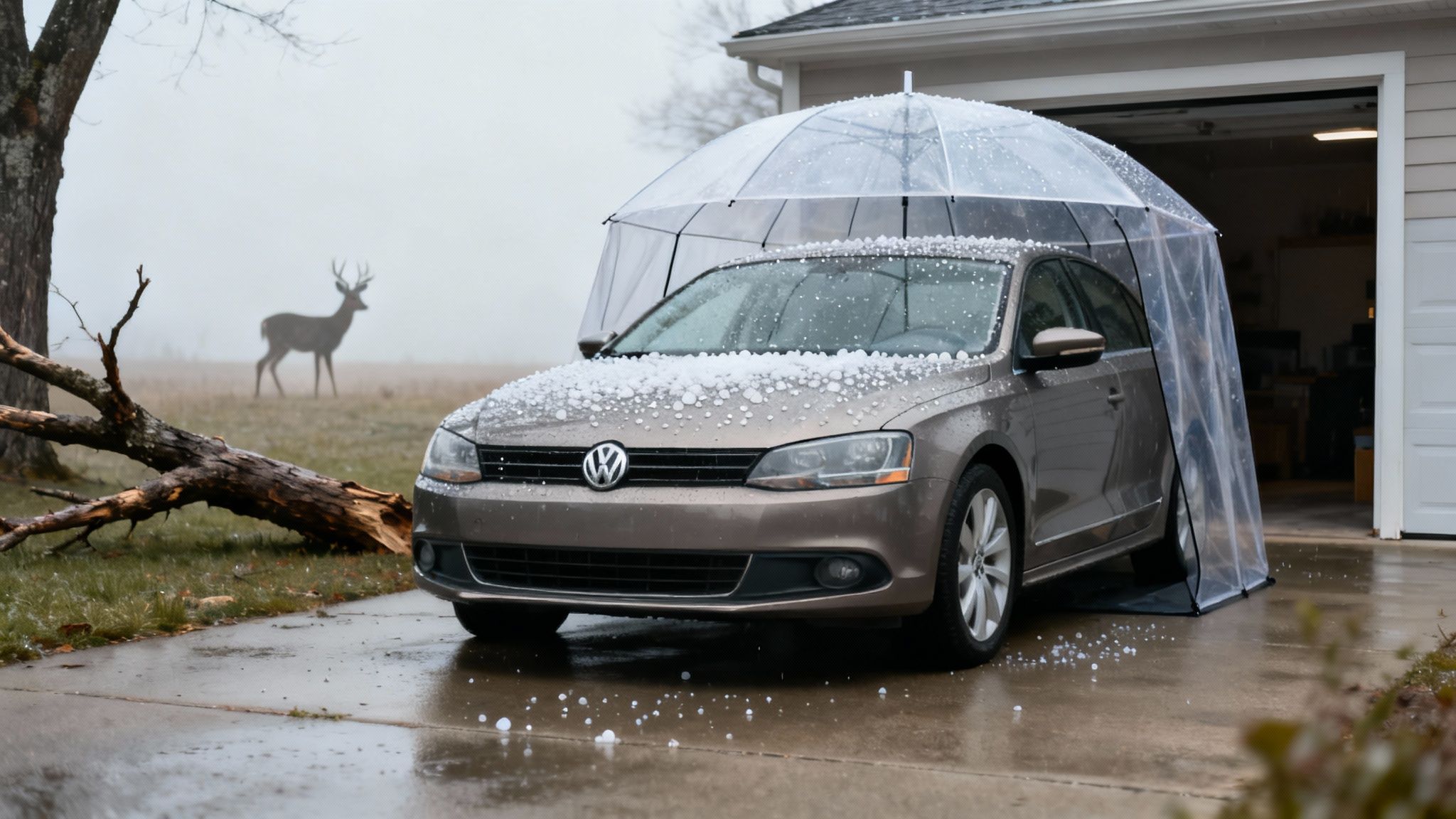
Think of your auto insurance policy like a toolkit. **Liability** is the wrench you're legally required to have. **Collision** is the hammer for fixing dents after an accident. And **comprehensive**? It's the versatile multi-tool that handles all the bizarre, unexpected problems that happen when you're not even driving.
It’s the coverage you need for situations that are completely out of your control—the true “life happens” moments.
For those of us driving in Alberta, this protection is especially relevant. Our province’s unpredictable weather and vast rural landscapes introduce unique risks you don’t see everywhere. A cracked windshield from flying gravel on the QE2, hail damage during a Calgary summer storm, or an unfortunate run-in with a deer on a back road—that's what comprehensive is for.
The Scope Of Coverage
To make it crystal clear, let's quickly break down what comprehensive insurance is and isn't. This table gives you a snapshot of its specific role in protecting your vehicle.
Comprehensive Insurance At A Glance
| Covered (Non-Collision Events) | Not Covered | | :--------------------------------------------- | :------------------------------------------------- | | Theft and Vandalism | Damage from a collision you cause with another car | | Fire, Floods, and Earthquakes | Your medical expenses after an accident | | Falling Objects (e.g., tree branches, hail) | Damage to another person's property | | Collisions with Animals (e.g., deer) | Routine vehicle maintenance or wear and tear |
This comparison really highlights how comprehensive fills the gaps left by other types of coverage, focusing squarely on protecting your vehicle's value from non-crash events.
Why It Matters In Alberta
The value of this coverage here isn't just a hypothetical. The data backs it up. According to Statistics Canada, comprehensive claims in Alberta have been on the rise, especially as severe weather events become more common. Protecting your vehicle from these non-collision threats is more important than ever.
> **Comprehensive insurance** is your financial backstop against chaos. It’s for the moments you can't predict—a hailstorm, a deer on the road, or waking up to find your car stolen—ensuring one unfortunate event doesn't become a major financial crisis.
Ultimately, getting a solid grip on comprehensive coverage is the first step toward building an auto policy that actually works for you. To see how it all fits together, check out our guide on [understanding auto insurance in Alberta](https://www.insuranceshope.ca/blog/understanding-auto-insurance-in-alberta-what-every-driver-should-know-in-2025). This knowledge empowers you to choose protection that truly matches your needs and helps you shop smarter.
What Comprehensive Insurance Actually Covers
Okay, so we've covered the basic idea. Now, let's get into the real-world situations where comprehensive coverage becomes your financial MVP. This isn't just a boring list of possibilities; these are the kinds of things that happen to Albertans every single year, turning a normal day into a costly nightmare if you don't have the right protection.
Just think about the sheer variety of conditions across our province. You've got sudden, violent storms down south and the constant risk of wildlife on rural highways up north. Your vehicle is exposed to threats that have absolutely nothing to do with your driving skills. This is exactly where comprehensive insurance steps in.
Coverage For The Truly Unpredictable
Think of comprehensive insurance as your financial shield against damage from sources that are completely out of your hands. It’s built to handle the repair or replacement costs for a whole range of non-collision problems.
Here are the main things it protects you from:
* **Theft and Vandalism:** This is a big one. It covers you if your vehicle is stolen or intentionally damaged. Whether it’s a thief smashing your window, someone slashing your tires, or your entire car vanishing from the driveway, this is the part of your policy that kicks in. * **Weather and Natural Disasters:** From fire and floods to those wild windstorms we get, comprehensive is designed to handle damage from Mother Nature. This is especially crucial in a province known for its dramatic and sudden weather shifts. * **Falling Objects:** If a heavy tree branch snaps in a storm and crushes your roof, or if debris falls from a construction site and shatters your windshield, comprehensive has your back for the repairs.
This protection is all about the chaotic, random events you simply can't avoid by being a safe driver. It’s about securing your vehicle against the world happening around it.
Alberta-Specific Risks
While those scenarios can happen anywhere, some risks are just a bigger deal here in Alberta. Understanding these local threats really drives home how valuable comprehensive coverage can be.
One of the most notorious risks is **catastrophic hail damage**. Every summer, parts of Alberta get hammered by hailstorms that can cause thousands of dollars in damage in just a few minutes, leaving cars covered in dents and with shattered glass. Alberta actually experiences more severe weather claims than any other province, and hail is a massive reason why.
> A single hailstorm in Calgary back in 2020 caused over **$1.2 billion** in insured damage, making it the fourth costliest natural disaster in Canadian history. For countless vehicle owners, comprehensive coverage was the only thing that saved them from a crippling repair bill.
For a deeper dive into protecting your vehicle from this specific threat, check out our [Alberta hailstorm insurance guide](https://www.insuranceshope.ca/blog/alberta-hailstorm-insurance-guide). It’s packed with essential info for local drivers.
Animal Collisions
Another all-too-common danger, especially once you get outside of Calgary and Edmonton, is **collisions with wildlife**. Hitting a deer, moose, or elk can cause devastating damage to your vehicle, often making it impossible to drive.
A common mistake is thinking this falls under your collision coverage. It doesn't. Because the incident involves an animal—not another car or a lamp post—it’s specifically handled by your **comprehensive insurance**. Given the huge wildlife populations across Alberta's parks and rural areas, this coverage provides critical financial protection against a very real risk on our roads.
From a shattered windshield caused by flying rocks on a gravel road to that sinking feeling of finding your car stolen, comprehensive is the part of your policy that tackles these frustrating and expensive non-crash events, making sure you aren’t left paying for it all yourself.
Comprehensive Versus Collision and Liability Coverage
If you’ve ever felt like you’re learning a new language trying to understand auto insurance, you’re not alone. Words like liability, collision, and comprehensive get thrown around, and it's easy to assume they all do the same thing. They don't.
Each one is a distinct piece of the puzzle, designed to protect you from different kinds of financial trouble. Getting a handle on how they differ is the first step to building an insurance policy that actually has your back when you need it.
The Three Pillars Of Auto Protection
Think of your car insurance policy like a three-legged stool. Liability is the first leg, and it’s legally required. The other two—collision and comprehensive—are optional but crucial for keeping the stool steady if something goes wrong.
Here’s a quick rundown of what each leg supports:
* **Liability Coverage:** This is the bare-bones, mandatory coverage every driver in Alberta needs. It pays for injuries to other people or damage to their property when you're the one at fault. Crucially, it does **nothing** for your own car. * **Collision Coverage:** This is your "oops" coverage. It pays to fix or replace your vehicle after a crash with another car or an object, like a fence post or a guardrail. It kicks in whether the accident was your fault or not. * **Comprehensive Coverage:** This is the "everything else" policy. As we've been talking about, it handles the non-crash stuff: theft, vandalism, fire, that classic Alberta hailstorm, or hitting a deer on a back road.
This is where comprehensive really shows its value, stepping in to cover those random, unpredictable events that have nothing to do with your driving.
As you can see, it's all about protecting you from the kind of bad luck that can strike when your car is just sitting in the driveway or when a deer decides to cross the highway at the worst possible moment.
A Head-to-Head Comparison
Putting the three main coverage types side-by-side makes their unique roles crystal clear. They aren't overlapping; they’re complementary, working together to form a complete safety net.
Let's break down the core differences in a simple table.
Comparing Liability, Collision, and Comprehensive Coverage
| Coverage Type | What It Covers | Is It Mandatory in Alberta? | | :--- | :--- | :--- | | **Liability** | Injuries to other people and damage to their property when you are at fault. | **Yes** | | **Collision** | Damage to your own vehicle from a crash with another car or an object. | No | | **Comprehensive** | Damage to your own vehicle from non-collision events like theft, hail, or fire. | No |
The takeaway here is simple but vital: while you're only legally required to have liability, skipping collision and comprehensive leaves your own vehicle completely unprotected from a whole world of potential risks.
> **The Key Takeaway:** Liability protects *others* from you, while collision and comprehensive protect *you* from different kinds of damage to your own vehicle.
For example, if you back into someone in a parking lot, your collision coverage would fix your dented bumper, and your liability coverage would pay for the damage to the other car. For a deeper dive on this mandatory protection, check out our guide on [what is third-party liability coverage](https://www.insuranceshope.ca/blog/what-is-third-party-liability-coverage).
How They Work Together In A Real Scenario
Let's walk through a real-world example. Imagine a massive thunderstorm hits your neighbourhood one night. A heavy branch cracks and falls right on your parked car, crushing the roof. In this situation, **comprehensive insurance** is what you'd use to pay for the repairs. Your car wasn't in a collision; it was damaged by a non-driving event.
Fast forward a few days. You’re driving in the lingering rain, hit a slick spot, and slide into a stop sign. This time, it’s **collision insurance** that would step in to cover the damage to your front end.
Notice how liability wasn't involved in either scenario? That's because you didn't cause damage to anyone else's property. This is precisely why having both collision and comprehensive is so important for protecting your investment from all angles—not just from accidents that happen on the road.
Understanding Deductibles and Policy Costs
Knowing what comprehensive insurance covers is one thing, but understanding how it affects your wallet is where you can truly take control and save money. When you have to make a claim, two key numbers come into play: your **deductible** and your **premium**.
Think of them like a seesaw—when one goes up, the other goes down. Learning to balance them is the secret to building an affordable policy that still gives you the protection you need. It’s all about figuring out what you’re comfortable paying upfront versus what you pay over time.
How Deductibles Work in a Real Claim
Your **deductible** is simply the amount you agree to pay out-of-pocket for a repair before your insurance company steps in. It’s your share of the bill, and you choose this amount when you buy your policy.
Let's walk through a classic Alberta scenario to see it in action.
* **Scenario:** A surprise hailstorm barrels through Red Deer, leaving your car's hood looking like a golf ball. * **Repair Estimate:** The body shop quotes you **$2,500** to fix the damage. * **Your Deductible:** You chose a **$500** deductible for your comprehensive coverage.
In this case, you would pay the first **$500** of the repair bill yourself. Your insurance provider would then cover the remaining **$2,000**. Simple as that. But if the damage was only $450, you’d pay for it all yourself, since the cost is below your deductible.
> **The Deductible Relationship:** A higher deductible means you’re taking on more of the financial risk, which earns you a lower insurance premium. A lower deductible means less risk for you, but your insurer will charge a higher premium for that peace of mind.
For a deeper dive, check out our guide on [how car insurance deductibles work](https://www.insuranceshope.ca/blog/what-is-deductible-car-insurance). It’s essential knowledge for tailoring a policy to fit your budget.
Factors That Determine Your Comprehensive Premium
Insurance providers in Alberta don't just pull numbers out of a hat. They use a specific set of data to calculate the risk of you making a comprehensive claim. While some of these factors are out of your hands, you have more control over others than you might think.
Here are the main ingredients that go into your premium:
* **Your Vehicle's Make, Model, and Value:** This is a big one. An expensive, brand-new truck costs a lot more to repair or replace than an older, common sedan. Insurers also look at theft statistics for certain models—if your vehicle is a popular target for thieves, your premium will reflect that risk. * **Your Postal Code:** Where you live and park your car matters. If your neighbourhood has higher rates of theft, vandalism, or is located in an area prone to flooding or hail, your premium will likely be higher. For example, drivers in areas known as "hailstorm alley" definitely see this reflected in their rates. * **Your Driving and Claims History:** A long track record of safe driving with no claims shows an insurer you're a low-risk client, which usually leads to better rates. On the other hand, a history of frequent claims, even for non-collision events, can push your costs up over time. * **Your Chosen Deductible:** This is the factor you have the most direct control over. Bumping your deductible from **$500** to **$1,000** can make a noticeable difference in your annual premium.
By understanding these factors, you can have a much more productive conversation with a broker and find ways to save. Choosing the right vehicle, keeping a clean driving record, and picking a deductible that matches your financial comfort zone are all practical steps you can take to manage the cost of your comprehensive insurance.
Deciding If Comprehensive Insurance Is Worth It for You

Is comprehensive insurance worth the money? There's no single right answer here—it's all about what makes sense for *you*. This is a personal financial call that boils down to balancing the monthly premium against the potential cost of a sudden, unexpected disaster.
Making the right choice means taking a practical, honest look at your car, your finances, and your personal comfort level with risk. By walking through a few key questions, you can figure out if comprehensive coverage is a smart investment or just an extra expense you could do without.
Key Questions To Guide Your Decision
Before you make a move, take a minute to think about your specific situation. Your answers here will paint a clear picture of how much protection your vehicle really needs.
* **How much is my car actually worth?** This is the big one. The whole point of comprehensive coverage is to protect your car's value. If your vehicle is worth **$15,000**, a total loss from a fire or hailstorm would be a massive financial hit. On the other hand, if it's worth **$1,500**, the cost of the insurance might not add up.
* **Could I afford to repair or replace it out of pocket?** Be realistic. If your car got stolen or totalled tomorrow, do you have the cash on hand to buy a new one without derailing your finances? If not, comprehensive acts as your financial safety net.
* **Is my vehicle financed or leased?** This question often makes the decision for you. Nearly every lender and leasing company **requires you to carry both collision and comprehensive coverage** until the loan is paid off. It's how they protect their investment in the vehicle.
* **What's my annual premium for just the comprehensive part?** Check your insurance documents. A popular rule of thumb is to think about dropping the coverage when your yearly premium is more than **10%** of your car's current market value.
When Comprehensive Is A Financial Lifesaver
For a lot of drivers, keeping comprehensive coverage is just part of being a responsible car owner. In these situations, the protection it provides is easily worth the cost.
> **Key Insight:** Comprehensive insurance isn't just about paying for damage; it's about buying financial peace of mind. It ensures that a random act of nature or a bit of bad luck doesn't destroy your budget and leave you without a way to get around.
It's a smart move to keep your coverage if:
* **Your car is new or has a high value.** If your vehicle is one of your biggest assets, you need to protect that investment. The costs to repair the advanced electronics, sensors, and specialty parts on newer cars can be astronomical.
* **You live in a high-risk area.** Let's face it, driving in Alberta means dealing with real threats like hail, wildlife on the roads, and theft. If you live in an area known for severe weather or you have to park on the street in a busy urban centre, your odds of making a comprehensive claim are higher.
* **You absolutely depend on your vehicle.** Can you get to work, take the kids to school, or run errands without your car? If the answer is no, the cost of being without it—even for a short time—can be huge. Comprehensive helps you get back on your feet quickly.
When You Might Consider Dropping It
There comes a time in every car's life when paying to insure it against non-collision events just doesn't make financial sense anymore. Dropping this coverage frees up some cash, but remember, it also means you're accepting all the risk yourself.
You could think about dropping comprehensive if:
* **Your car's value is very low.** If you're driving an older car and its market value is less than a few thousand dollars—maybe not much more than your deductible plus the annual premium—it might be time to let the coverage go.
* **You have a healthy emergency fund.** If you've got enough savings stashed away to comfortably handle a major repair or replace your vehicle without breaking a sweat, you could essentially "self-insure" against these kinds of risks.
Ultimately, it's a simple cost-benefit analysis. Weigh what you pay each year against your car's value and your ability to absorb a major, unexpected expense. This clear-headed approach will help you make a choice that fits both your budget and your peace of mind.
How to Find the Best Comprehensive Insurance Rates in Alberta
Alright, you understand what comprehensive coverage is and why you might need it. That puts you in the driver’s seat. The next step? Finding a policy that actually protects your vehicle without costing an arm and a leg. Getting a great price isn't about luck—it's about having a smart, simple strategy.
Here’s the single most effective way to save money on your auto insurance: **compare quotes** from different providers. Insurers all have their own secret sauce for calculating risk, which means the premium one company offers can be wildly different from another for the exact same coverage. If you don't shop around, you could easily be leaving hundreds of dollars on the table every year.
The Power of an Independent Broker
Trying to navigate the insurance market on your own can be overwhelming. This is where a local, independent broker becomes your biggest ally. Unlike agents who work for a single company and can only sell that company's products, brokers work for *you*. They have access to a huge range of insurers and can do the comparison shopping for you.
This approach has some major advantages:
* **Market Expertise:** Brokers live and breathe the Alberta insurance market. They know which companies offer the best rates for your specific vehicle, your neighbourhood, and your driving history. * **Unbiased Advice:** Their goal is to find the best fit for you, not to meet a sales quota for one particular company. They'll help you understand the fine print and choose a policy that truly covers your needs. * **Discount Discovery:** Brokers are pros at sniffing out discounts you might never find on your own, like those for bundling home and auto policies or even for having winter tires.
> Think of a broker as your personal insurance shopper. They do all the heavy lifting, turning the confusing process of buying insurance into a simple, informed decision. They match your needs with the best options out there, saving you time and money.
Making Shopping Simple with InsuranceShope
So, how do you find one of these trusted local brokers? That’s where we come in. **InsuranceShope** is the modern solution. We connect you directly with licensed, experienced Alberta brokers in our network. Instead of slogging through form after form on a dozen different websites, you make one simple connection and let an expert handle the rest.
Our partner brokers know the market inside and out. They'll find policies that offer real value, translate all the industry jargon into plain English, and make sure your coverage is just right—not too much, not too little. This is how you go from just knowing what comprehensive insurance is to being empowered to get the best possible deal on it.
Of course, a big part of getting a good price is understanding what influences your costs in the first place. For a deeper dive into the numbers, check out our guide on what goes into determining [Alberta auto insurance rates](https://www.insuranceshope.ca/blog/alberta-auto-insurance-rates). Combining that knowledge with the expertise of a great broker gives you the ultimate advantage.
Common Questions About Comprehensive Insurance
We've covered a lot of ground, from what comprehensive insurance is to whether it makes sense for your ride. To wrap things up, let's tackle a few of the questions we hear most often from Alberta drivers.
Does Comprehensive Insurance Cover Windshield Replacement?
Yes, in almost all cases. A stone chip that turns into a crack, a shattered windshield from falling debris, or even damage from vandalism are classic examples of non-collision events. This is exactly what comprehensive coverage is built for, though you'll still have to pay your deductible.
Is Comprehensive Insurance Mandatory In Alberta?
Nope, it's not legally required. In Alberta, the only coverage you absolutely must have is **third-party liability and accident benefits**. Comprehensive is an optional add-on that protects your own vehicle from specific types of damage.
That said, if you're leasing or have a loan on your vehicle, your financing company will almost certainly make you carry it. It's their way of protecting their investment until you've paid it off.
Can I Have Comprehensive Without Collision Coverage?
You sure can. While brokers often bundle them together as part of a "full coverage" package for convenience, you can typically purchase them separately. We see this all the time—a driver with an older, paid-off car might drop the more expensive collision coverage but keep comprehensive to protect against theft, fire, or our infamous Alberta hail storms.
> **The Bottom Line:** You're in the driver's seat when it comes to customizing your policy. You can choose to have comprehensive, collision, or both, depending on what makes sense for your car's value and your budget.
Will A Comprehensive Claim Increase My Insurance Rates?
It's possible, but it’s far less likely to cause a major rate hike compared to an at-fault collision claim. Insurers generally see comprehensive claims—like hitting a deer or getting hail damage—as unfortunate events that were mostly out of your control.
However, a string of comprehensive claims in a short time frame might flag you as a higher risk, and that could lead to a premium increase at renewal. If the damage is minor, it's always a smart move to chat with your broker about the potential impact before you decide to file a claim.
***
Ready to stop wondering and start seeing real numbers? The simplest way to find out what comprehensive insurance will cost for your vehicle is to compare quotes from trusted local experts. At **InsuranceShope**, we connect you with licensed Alberta brokers who do the shopping for you, finding the best coverage at a competitive price. [Get your free, no-obligation auto insurance quote today](https://www.insuranceshope.ca).