Discover What Errors and Omissions Insurance Is (and Why You Need It)
Even the most dedicated professionals can make a mistake. A simple oversight, a miscalculation, or a piece of advice that doesn't pan out can have serious financial consequences for a client. When that happens, your business is on the line. Getting the right protection is key, and it's easier and more affordable than you might think.
This is where Errors and Omissions (E&O) insurance comes in. Think of it as a crucial safety net specifically designed for businesses that provide professional services or advice. It’s built to protect you from claims of negligence, mistakes in your work, or failing to deliver on a promised service. Let's explore what it is, who needs it, and how you can find the right policy to safeguard your business and save money.
Your Professional Safety Net: Errors and Omissions Insurance Explained

Let's make this real. Imagine you're a business consultant in Calgary whose strategic advice, unfortunately, leads to a major project failure for your client, costing them thousands. Or maybe you’re an IT specialist in Edmonton, and a software bug you overlooked causes a massive, costly business interruption for one of your customers.
These scenarios are exactly what E&O insurance is for. Even if a mistake was completely unintentional, you could be facing a lawsuit that threatens everything you've built.
But it’s not just about covering you when you've done something wrong. E&O is also there to defend you against baseless claims. Just the cost of hiring a lawyer to prove your innocence can be financially crippling for a small or medium-sized business. This coverage steps in to handle those legal defence costs, settlements, and judgments, protecting both your bank account and your hard-earned reputation.
To give you a clearer picture, here's a quick summary of what E&O insurance is all about.
E&O Insurance at a Glance
This table breaks down the fundamental purpose and scope of Errors and Omissions coverage.
| Core Concept | Who It Protects | Primary Purpose | | :--- | :--- | :--- | | A specialized form of liability insurance. | Professionals, consultants, and service-based businesses. | To cover financial losses to clients caused by your professional mistakes or negligence. |
Essentially, it's about protecting the intellectual side of your business—your advice, your expertise, and your professional services.
The Growing Need for Professional Protection
It's no surprise that the demand for this kind of protection is on the rise. The global E&O insurance market was valued at roughly **USD 15 billion in 2023** and is expected to climb to USD 25 billion by 2032. This isn't just a global trend; it reflects a growing awareness among Canadian businesses that professional risks are real and require a solid defence plan.
Ultimately, this coverage acts as a critical shield. It gives you the confidence to do what you do best without the constant worry that one client dispute could derail your entire operation.
> **E&O insurance** is the policy that protects you, the professional, from claims of negligence or failure to perform your professional duties. A client who suffers a financial loss because of your work can sue, and this policy is what stands between your business and a potentially crippling financial judgment.
This type of insurance is distinct from other policies you might have in a standard [business insurance](https://www.insuranceshope.ca/blog/what-is-business-insurance-in-alberta-a-plainlanguage-guide-for-local-owners) package. E&O is designed to fill a very specific gap, making sure your primary assets—your knowledge and services—are properly protected.
Who Really Needs E&O Insurance in Alberta?

If your business gets paid for its advice, designs, or professional skills, you're carrying a certain level of risk every single day. One unhappy client who feels your work didn't measure up can quickly turn into a lawsuit that puts your finances—and your business—in jeopardy.
The real question isn't *if* you need Errors and Omissions insurance, but how vulnerable your specific profession is without it. This coverage is absolutely crucial for any professional whose expertise is the product they sell. Protecting your livelihood starts with understanding your risk.
Is Your Profession on This List?
While countless businesses can benefit, some professions in Alberta are walking a much finer line when it comes to liability claims. If you find your business described below, think of E&O insurance as a non-negotiable part of your risk management plan.
* **Consultants (Business, IT, Marketing):** Your advice shapes your clients' biggest decisions. Imagine an IT consultant in Edmonton whose network security advice fails, leading to a costly data breach for their client. That consultant would be on the hook for the financial fallout. * **Accountants and Financial Advisors:** You're trusted with sensitive financial details and critical guidance. A simple bookkeeping mistake or a flawed investment strategy could cost a client dearly, paving the way for a negligence claim. * **Architects and Engineers:** Your designs have massive safety and financial consequences. An architect in Red Deer drafts a plan with a flaw that causes major construction delays and cost overruns—a classic scenario where E&O insurance is a business-saver. * **Marketing and Advertising Agencies:** Your campaigns are judged on results. If a Calgary-based agency doesn't hit the metrics promised in their contract, the client could sue for their lost investment and unrealized revenue.
> Any professional whose work can cause a client a financial loss—without causing bodily injury or property damage—operates in the exact space that E&O insurance is designed to protect.
Seeing the Risk in Your Daily Operations
A claim often starts with something small and completely unintentional. It could be a missed deadline, a minor oversight in a contract, or advice that just didn't work out as planned. Let's be honest, nobody is perfect, and human error is an unavoidable risk in any business.
All it takes is one dissatisfied client to claim your professional service failed them, and suddenly you’re facing a mountain of legal bills just to defend yourself. For a closer look at how this protection is tailored for different fields, you can explore the options available for **[professional services insurance in Alberta](https://www.insuranceshope.ca/business/professionals)**. Taking the time to understand your industry’s specific risks is the first step toward getting the right coverage at the best price.
Real-World E&O Claims: What This Insurance Actually Covers
Understanding Errors and Omissions (E&O) insurance in theory is one thing, but seeing it in action is what really makes its value click. Let's move past the jargon and look at real-world situations where this coverage becomes a business's lifeline.
At its core, E&O insurance kicks in when your professional service or advice causes a client a **financial loss**—not physical injury or property damage. That’s the key difference. This protection is usually triggered by three main types of professional missteps: negligence, errors, and omissions.
Negligence: A Failure in Professional Duty
Negligence is all about failing to provide the standard of care expected in your profession, which then directly causes a client to lose money. Think of it as not meeting the professional bar for the quality of your work or advice.
Imagine a financial advisor in Alberta who recommends a high-risk investment portfolio to a client saving for retirement. When the market dips and the client's savings take a huge hit, they could sue the advisor for providing negligent advice that didn't match their goals. This is exactly where the E&O policy would step in to cover legal defence costs and any potential settlement.
Errors: A Mistake in Execution
An error is a more straightforward mistake—a technical glitch, a miscalculation, or a simple flaw in the work you deliver. These are especially common in fields that demand precision, like tech and design.
* **Example:** A software developer in Calgary builds a custom e-commerce website for a local boutique. A small but critical coding error causes the payment system to crash during their biggest Black Friday sale. The boutique loses thousands in revenue and sues the developer for the financial damages. The developer’s E&O insurance is what responds to that claim.
Omissions: Leaving Something Important Out
An omission is the flip side of an error; it’s about what you *didn't* do or say. It happens when you fail to share crucial information that your client needed to make an informed decision.
> A key takeaway is that your E&O policy defends your business even against baseless or frivolous lawsuits. The cost to simply prove your innocence can be staggering, and your policy protects your finances and reputation, regardless of whether you've actually done anything wrong.
For instance, a business consultant is hired to help an Edmonton company expand into a new market. They forget to mention a critical regulatory requirement for that industry. The client moves ahead, only to be slapped with heavy fines and operational delays. This omission directly caused a financial loss, creating a clear-cut E&O claim.
It's crucial to remember that E&O handles these specific professional risks, which are totally different from the slip-and-fall type incidents covered by other policies. For a clearer picture of the differences, check out our guide on **[what is commercial general liability insurance](https://www.insuranceshope.ca/blog/what-is-commercial-general-liability-insurance)** to see how these two coverages protect different parts of your business.
Cracking the Code: Key Terms and Common Gaps in Your E&O Policy
An insurance policy can feel like it's written in another language, but understanding a few key terms empowers you to choose the right coverage and avoid costly surprises. Demystifying your Errors and Omissions (E&O) policy is the key to feeling confident that your Alberta business is truly protected.
This diagram breaks down the core concepts that trigger an E&O claim.
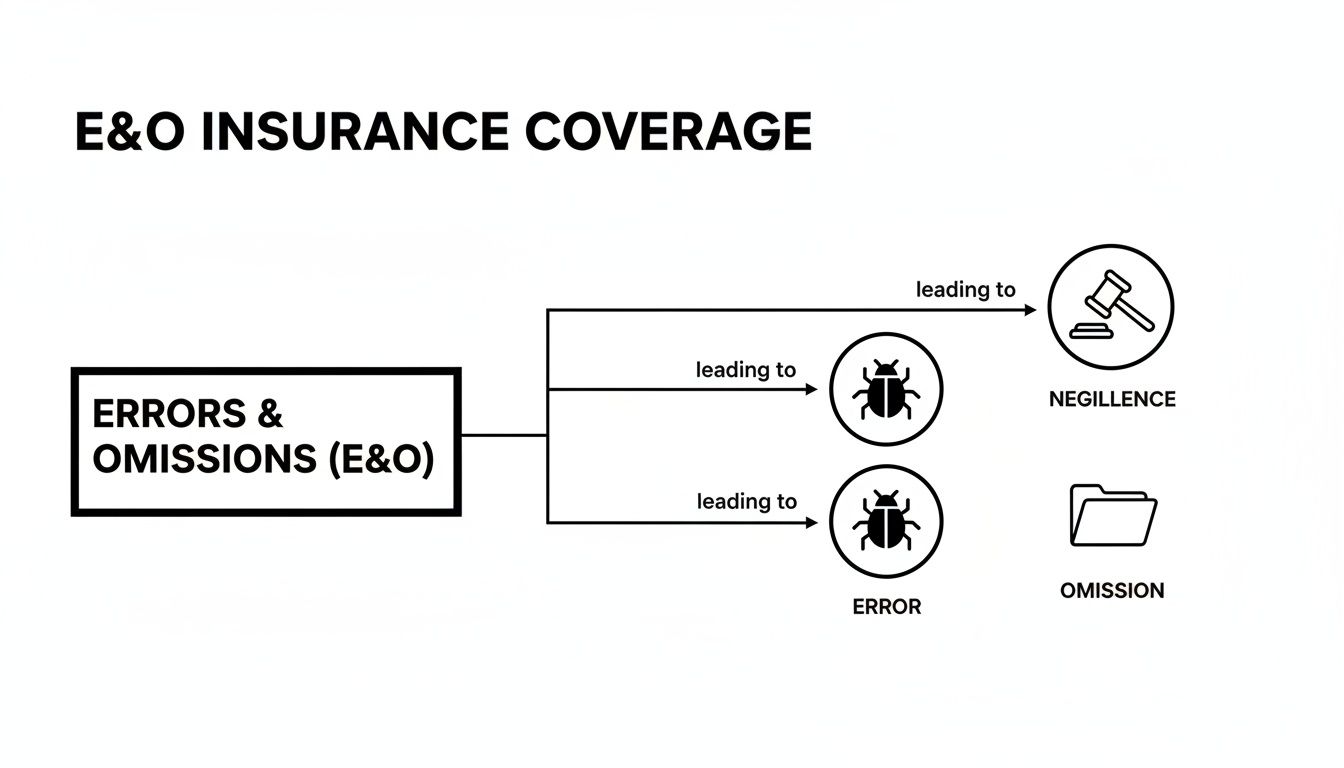
As you can see, the coverage is specifically designed for professional missteps—negligence, honest errors, or accidental omissions—that lead to a client's financial loss.
Navigating Your Policy's Fine Print
Let's translate some of the most important terms you'll find in your E&O policy into practical, real-world language. Think of these as the operating rules for your coverage.
* **Policy Limit:** This is the absolute maximum your insurer will pay for a single claim or for all claims during your policy period. Picking the right limit is vital, as legal defence costs alone can skyrocket surprisingly fast.
* **Deductible:** Simply put, this is the amount you have to pay out-of-pocket before your insurance coverage kicks in. A higher deductible often means a lower premium, but it also means you'll shoulder more of the initial expense if a claim happens.
* **Claims-Made Policy:** This is a critical concept for E&O. A claims-made policy means your coverage must be active **when the claim is filed**, not just when you did the work. This is why maintaining continuous, uninterrupted coverage is essential to avoid gaps that could leave your past projects uninsured.
> It's a common misconception that E&O is a catch-all for any business dispute. In reality, it’s highly specific. This insurance is there to cover financial losses caused by your professional services, not every single problem a business might run into.
What E&O Insurance Typically Excludes
Just as important as knowing what's covered is understanding what isn't. Every policy has exclusions, and E&O is no different. Being aware of these common gaps helps you manage your overall business risk more effectively.
You can generally expect these types of claims to be excluded:
* **Intentional Fraud or Criminal Acts:** E&O insurance is for honest mistakes, not for deliberate wrongdoing. * **Employee Disputes:** Issues like wrongful termination or discrimination claims are handled by a separate policy called Employment Practices Liability Insurance (EPLI). * **Bodily Injury or Property Damage:** These classic "slip-and-fall" scenarios fall squarely under a Commercial General Liability (CGL) policy.
E&O vs CGL: A Critical Distinction
Many Alberta business owners understandably get tangled up trying to figure out the difference between E&O and CGL insurance. They are designed to work together, but they cover entirely different types of risk. Getting this distinction right is fundamental to building a complete insurance safety net for your business.
The table below breaks down the core differences in what each policy is designed to protect.
E&O Insurance vs. Commercial General liability (CGL)
| Coverage Aspect | Errors & Omissions (E&O) | Commercial General Liability (CGL) | | :--- | :--- | :--- | | **Primary Risk** | Financial loss due to professional mistakes or negligence | Bodily injury to a third party or damage to their property | | **Example Scenario** | An accountant makes a calculation error, causing a client to pay fines. | A customer slips on a wet floor in your office and breaks their arm. | | **Covered Losses** | Client's financial damages, legal defence costs, settlements | Medical bills, repair costs for damaged property, legal fees | | **Trigger Event** | A client alleges your service caused them financial harm. | An accident occurs causing physical injury or property damage. |
Think of it this way: CGL protects you from things you *do* (like accidentally causing an injury), while E&O protects you from things you *know* (your professional advice and services). For a deeper dive into this topic, you can explore more about **[professional liability insurance in Alberta](https://www.insuranceshope.ca/blog/professional-liability-insurance-alberta)** and see how it fits into your broader protection strategy.
What Does E&O Insurance Cost in Alberta?
Trying to pin down the exact cost of Errors and Omissions (E&O) insurance isn’t like picking an item off a shelf with a clear price tag. Your premium is calculated based on your unique business profile, reflecting the specific risks that come with the professional services you provide. The good news is that shopping around and understanding the key factors can help you find affordable, high-quality coverage.
One of the biggest drivers of cost is simply your **industry**. Think about it: a freelance graphic designer in Red Deer faces a completely different level of risk than a large engineering firm in Calgary managing multi-million-dollar projects. It makes sense that high-risk professions, where a single mistake could trigger massive financial losses for a client, will naturally see higher premiums.
Key Factors Influencing Your Premium
The specific details of how you run your business play a direct role in shaping what you’ll pay for insurance. When you get a quote, an insurer will look closely at these things to figure out your rate:
* **Annual Revenue:** Higher revenue often means bigger projects and more clients, which can increase both the potential size and frequency of claims. * **Number of Employees:** More staff means more people providing services under your company’s name, which naturally increases the overall exposure to potential errors. * **Claims History:** A clean track record with no previous claims is a great sign. It shows you have strong risk management practices and usually leads to a lower premium. * **Contracts and Risk Management:** Businesses that use solid client contracts and have documented procedures for managing risk often qualify for better rates.
Realistic Cost Expectations
While every policy is unique, it helps to have a general idea of what to expect. For many small businesses and sole proprietors in Canada, a baseline E&O policy often costs between **$500 and $1,000 annually**.
Most small and mid-sized businesses in Alberta will typically choose coverage limits between **$1 million and $2 million**. Why so high? Because legal costs alone can spiral out of control during a lawsuit. If you want to dive deeper into the numbers, this post on [E&O insurance costs in Canada from marathoninsurance.ca](https://www.marathoninsurance.ca/blog/how-much-is-errors-and-omission-insurance/) offers some great insights.
> Ultimately, the cost of E&O insurance shouldn't be seen as just another expense. It's a critical investment in your business’s stability and future. The price of a policy is tiny compared to the potentially devastating cost of defending a lawsuit out of your own pocket.
Seeing how these factors come together is the first step in understanding your potential costs. For a clearer picture, check out our guide on **[business insurance in Alberta and how to compare quotes](https://www.insuranceshope.ca/blog/business-insurance-in-alberta-how-to-compare-quotes-and-choose-the-right-broker)**. It’ll help you get prepared for the quoting process.
Finding the Right E&O Coverage for Your Business (and Saving Money)
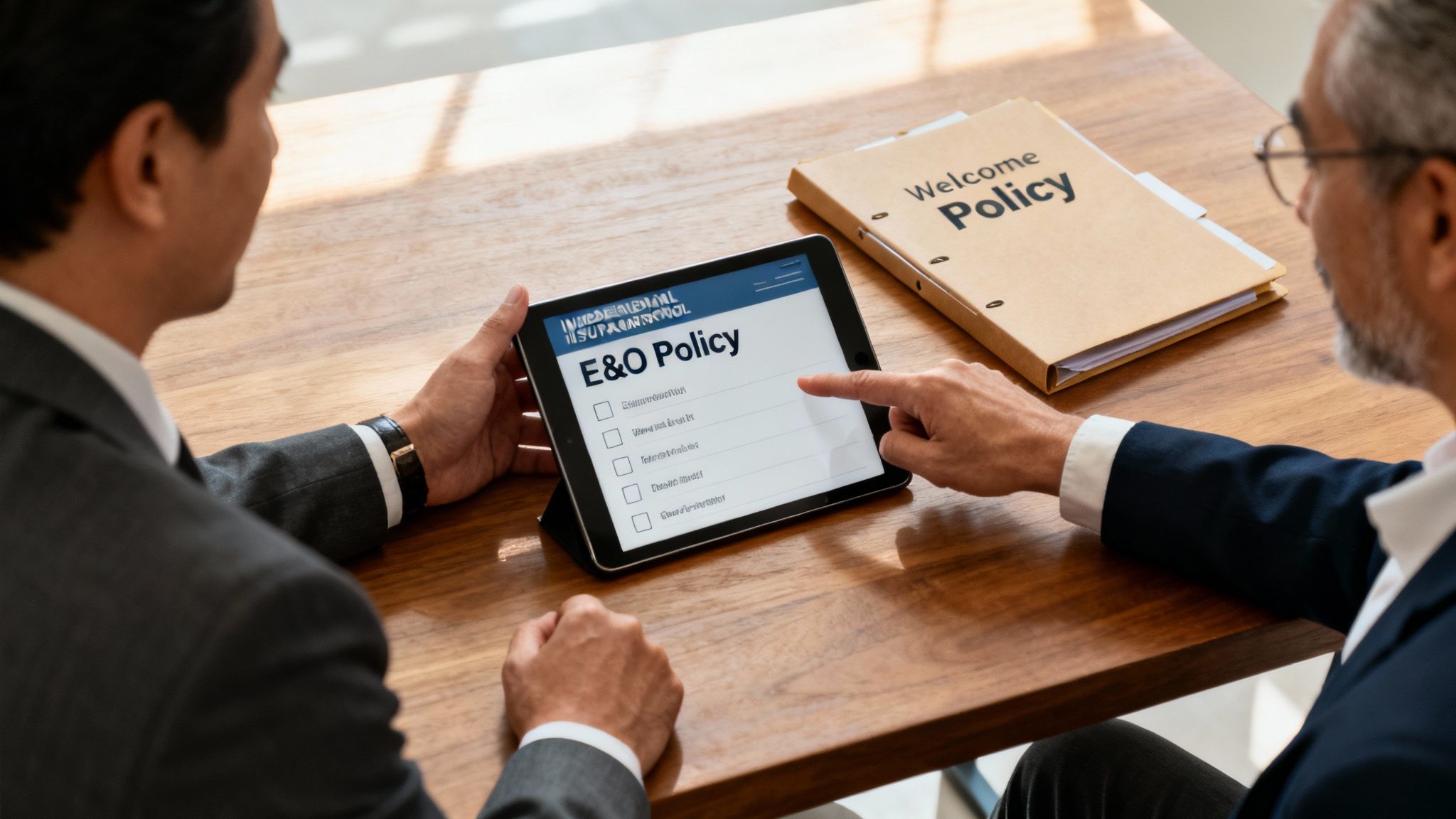
Securing the right Errors and Omissions (E&O) insurance for your Alberta business doesn't have to be a complicated ordeal. The trick is to work smarter, not harder. Instead of spending hours contacting individual insurance companies one by one, you gain a huge advantage by partnering with an independent insurance broker.
A broker works for *you*, not for any single insurance company. Their entire job is to understand the unique risks your business faces, then shop the market to find coverage that fits your specific needs and budget. This approach not only saves you time but often leads to better rates and policy terms you wouldn't find on your own.
Preparing for a Smooth Quoting Process
To help your broker find the best options quickly, it’s a good idea to have some key information ready to go. This allows them to accurately represent your business to insurers and negotiate the best possible terms on your behalf.
Before you connect with a broker, try to gather these details:
* **A clear description of your services**, including the types of clients you typically work with. * Your **estimated annual revenue** for the current and upcoming fiscal years. * Any details about **past claims**, if you have them. * Information about your **client contracts** and any risk management procedures you already have in place.
Having this information handy makes the whole process more efficient and ensures the quotes you receive are accurate from the get-go.
> Partnering with a local Alberta broker gives you an expert advisor who understands regional risks, from the specific liabilities facing Calgary tech firms to the challenges for consultants in Edmonton. They act as your advocate, ensuring you get the right protection without overpaying.
An experienced broker is trained to spot potential gaps in your coverage and can help customize a policy that protects you without leaving you exposed to unnecessary risks. They’ll lay out the options from multiple providers, explain the differences in plain English, and help you lock in the best value for your hard-earned money.
Take the first step toward protecting your hard work. Connect with a licensed broker in the [InsuranceShope network](https://www.insuranceshope.ca/business-insurance) to get a free, no-obligation quote and find the E&O coverage that gives your business the security it deserves.
Burning Questions About E&O Insurance
When you're digging into the details of Errors and Omissions insurance, a few key questions almost always come up. Let's tackle some of the most common ones we hear from Alberta business owners to clear up any confusion.
Is E&O Insurance the Same Thing as Professional Liability Insurance?
Yes, it is. Think of **Errors and Omissions (E&O) insurance** and **Professional Liability Insurance** as two different names for the exact same coverage. They both exist to protect professionals and service-based businesses from claims of negligence or shoddy work.
While you might hear certain industries use one term more than the other—tech companies often say "E&O," while consultants might say "Professional Liability"—the protection they offer is identical.
I've Incorporated My Business. Doesn't That Protect Me from Lawsuits?
Incorporating your business is a fantastic and crucial step. It creates a legal wall that protects your *personal* assets, like your house or your car, from being seized to cover business debts. But that's where the protection stops.
Incorporation doesn't protect the business itself. If a client sues your company for professional negligence, the business's bank accounts, equipment, and other assets are still very much on the line.
> E&O insurance is the shield for your business's assets. It's what pays for the legal defence and potential settlements that your incorporation status simply can't cover.
What Happens if a Client Sues Me After My Policy has Expired?
This is an absolutely critical point to understand. Most E&O policies are what’s known as **'claims-made' policies**. In simple terms, this means your insurance policy must be *active when the claim is filed*, not necessarily when the original work was done.
This is why maintaining continuous, uninterrupted coverage is so important. Your policy includes a 'retroactive date,' which covers work you did in the past—but only if you’ve kept your policy active without any gaps. Letting it lapse could leave you exposed for years of past projects.
--- Ready to protect your professional reputation and all the hard work you've put in? The expert brokers at **InsuranceShope** can help you compare quotes from multiple top providers to find the right E&O coverage for your Alberta business.
Get your free, no-obligation quote today at [https://www.insuranceshope.ca](https://www.insuranceshope.ca).