What is umbrella insurance coverage? A Guide to Protecting Your Financial Future
Think of your standard home or auto insurance as a good, reliable raincoat. It’s perfect for the everyday showers life throws at you—a minor fender bender, a visitor slipping on your icy walkway. It keeps you dry and handles the usual mishaps without any fuss.
But what about that once-in-a-decade superstorm? The kind of torrential downpour that soaks right through a normal raincoat, leaving you completely exposed. That’s where **umbrella insurance** comes in, offering a critical layer of protection that can help you save your hard-earned assets when you need it most.
Understanding Umbrella Insurance with a Simple Analogy

Simply put, umbrella insurance is an extra layer of liability protection. It sits quietly on top of your existing home and auto policies, waiting for a crisis that’s too big for them to handle on their own.
It's not designed for the everyday drizzle; it’s your emergency protection for a financial hurricane.
> An umbrella policy is like a giant, reinforced umbrella that you keep folded away. When a catastrophic event occurs and the financial "rain" overwhelms your primary policies, you open it up for an extra, crucial layer of protection.
These situations are rare, but they are financially devastating. We're talking about a serious car accident that results in a multi-million-dollar lawsuit or a major injury on your property. An umbrella policy is the powerful tool that shields your life’s savings, your home, and your future income from a legal storm that could otherwise wash everything away.
Protecting Your Assets from Major Claims
So, what is **umbrella insurance coverage** in practical terms? It’s a secondary liability policy that only kicks in when you need it most. Let's break down its core job:
* **It Activates When Needed Most:** Umbrella insurance doesn’t replace your other policies. It only springs into action after you’ve completely used up the liability limit on your home or auto insurance. * **It Covers Catastrophic Costs:** This policy is built for the big stuff. Think major lawsuits, significant medical bills from an accident you caused, or other high-cost legal claims that far exceed standard coverage. * **It Provides Peace of Mind:** At the end of the day, it's about safeguarding everything you've worked so hard to build. It ensures that one terrible accident doesn’t lead to financial ruin for you and your family.
By seeing it this way, it’s clear that umbrella insurance isn’t just another policy—it's a critical piece of a strong financial safety net. It’s designed specifically for those "what if" scenarios that, while unlikely, have the potential for life-altering consequences.
How an Umbrella Policy Works with Your Existing Insurance
Think of your insurance portfolio like a layered defense system. Your primary policies, like home and auto insurance, are your foundational protection—they handle the everyday risks you're most likely to face. An umbrella policy isn't a replacement for these. Instead, it’s a powerful secondary layer of coverage that sits quietly on top, ready to spring into action when a major claim happens.
This creates a clear sequence of events. When you face a liability claim, your primary policy is always the first to respond. It pays out right up to its coverage limit. Only after that foundational policy is completely tapped out does your umbrella policy kick in to cover the rest.
The Activation Threshold
For your umbrella policy to even exist, your primary policies need to be strong enough on their own. Insurers won't sell you an umbrella policy unless your foundational home and auto insurance meet certain minimum liability limits. This is a crucial checkpoint. It ensures the umbrella is reserved for truly catastrophic events, not the smaller claims your primary policy is designed to handle.
For example, an insurer will typically require you to have at least: * **$500,000** in liability coverage on your auto policy. * **$300,000** in liability coverage on your homeowner's policy.
These aren't just random numbers; they establish the "trigger point." Your umbrella policy knows it doesn’t need to step in until a claim blows past these underlying amounts. Making sure you meet these minimums is a critical step in building a seamless safety net without any dangerous gaps. For a refresher on what your base coverage includes, you can explore our resources on [Alberta auto insurance](https://www.insuranceshope.ca/insurance/auto).
A Real-World Example of Stacked Protection
Let's walk through a scenario to see how this works in real life. Imagine you’re found at fault in a serious multi-car pile-up on an Edmonton highway. The total judgment against you for medical bills, lost wages, and property damage hits a staggering **$1.5 million**.
Here’s how your layers of insurance would work together to protect you: 1. **Primary Policy Responds First:** Your auto insurance policy, which has a **$1 million** liability limit, pays out its full amount. 2. **The Remaining Gap:** After your auto policy is maxed out, you're still on the hook for **$500,000**. Without any other coverage, that money would have to come straight from your savings, investments, or future income. 3. **Umbrella Policy Activates:** This is the exact moment your umbrella policy comes to the rescue. It covers the entire remaining **$500,000**, shielding your personal finances from what would have been a devastating blow.
> This layered approach is precisely what makes umbrella insurance so powerful. It lets your primary policies handle the common risks, while the umbrella provides a high-limit safety net for those rare but financially ruinous events.
This system gives you massive protection without having to pay for sky-high limits on every single policy. And the risk of these massive claims is on the rise. For instance, in insurance markets like California—which often sees trends that later appear in Alberta due to similar litigation risks from severe weather and busy highways—umbrella claims actually doubled between 2010 and 2020. Even more telling, the average payout surged by **67%** to about **$500,000** per claim.
This trend toward higher liability costs is a clear signal. It underscores why more and more Albertans should be seriously considering an umbrella policy to protect what they’ve worked so hard to build.
Real-World Scenarios Where Umbrella Coverage Is a Lifesaver
So, what does this extra layer of liability protection actually *do*? It can feel a bit abstract until you see it in action. Let’s move past the definitions and look at some real-world situations where an umbrella policy can be an absolute financial lifesaver.
These aren’t far-fetched stories. They’re the kind of unfortunate events that can happen to anyone, and the costs—from legal defence to massive settlement amounts—can easily blow past even a good home or auto policy limit. This is exactly the gap an umbrella policy is built to fill.
The Multi-Car Pile-Up on a Snowy Highway
Picture this: you're driving on a major Alberta highway during a sudden winter storm. Black ice forms in a split second, your car slides, and you end up causing a chain-reaction pile-up involving four other vehicles. Several people are badly injured, including a surgeon whose hand injury means they can no longer operate.
The lawsuits for medical bills, property damage, and lost future income start rolling in. The total claim against you hits a staggering **$1.8 million**. Your auto insurance has a solid liability limit of **$1 million**, but that still leaves you on the hook for an **$800,000** shortfall.
Without umbrella insurance, your savings, home, and retirement funds would all be at risk to cover that balance. But with an umbrella policy, it steps in to pay the entire **$800,000**, preventing one terrible accident from wiping out your financial future.
The Backyard Injury during a Social Gathering
You’re hosting a summer barbecue, and the kids are having a blast on your trampoline. Suddenly, a friend’s child tries a flip, lands wrong, and suffers a severe spinal injury. The medical costs for surgeries, long-term care, and rehabilitation are going to be astronomical.
The child's family, facing a lifetime of expenses, files a lawsuit against you for **$1.5 million**. Your homeowner's insurance provides **$500,000** in liability coverage, but that gets eaten up fast by the initial legal and medical bills. You are now personally on the hook for the remaining **$1 million**.
This is another classic case where an umbrella policy proves its worth. It covers that **$1 million** gap, ensuring the injured child gets the care they need without bankrupting your family. It protects your assets from a tragic accident that happened on your property. To get a better handle on how this works, you can learn [what is third-party liability coverage](https://www.insuranceshope.ca/blog/what-is-third-party-liability-coverage) in our detailed guide.
The chart below really helps visualize how an umbrella policy bridges the gap.
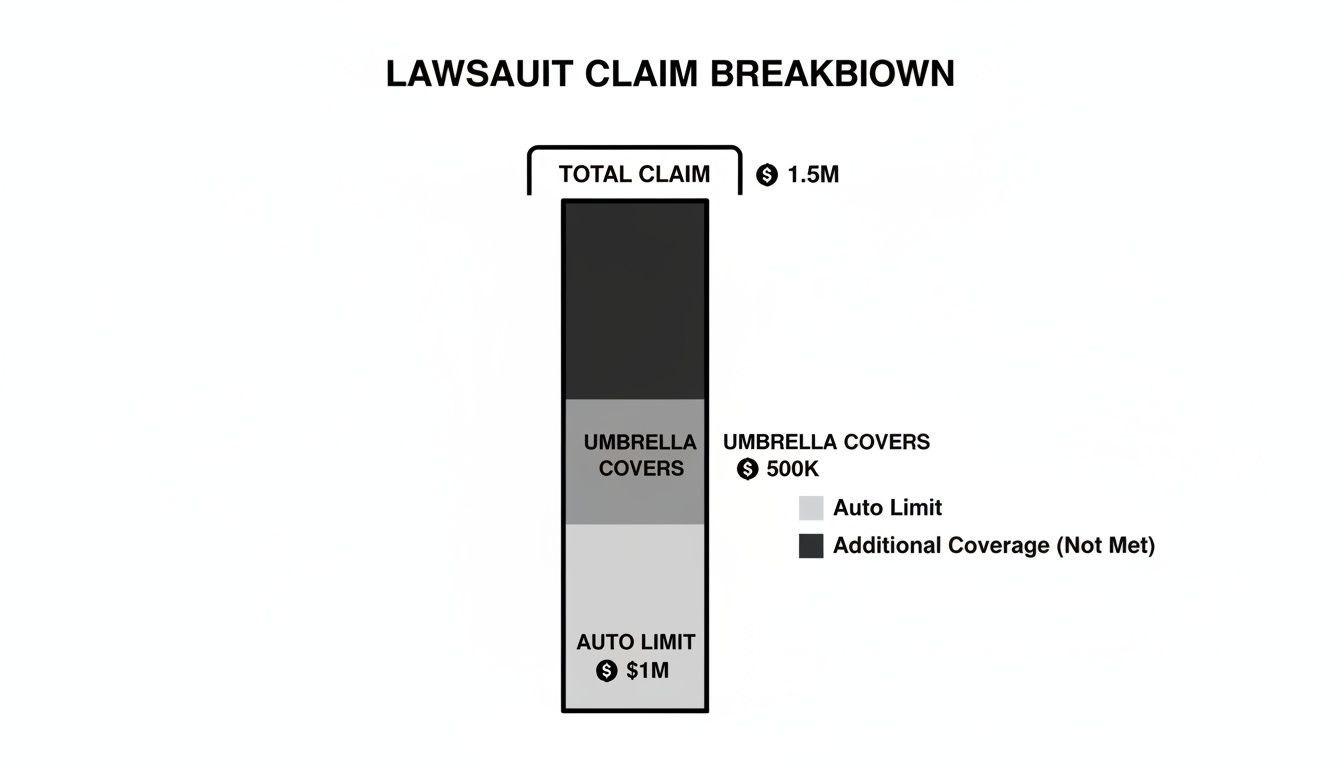
As you can see, even a substantial primary policy can fall short in a catastrophic claim. The umbrella policy is what saves the day.
The Negative Online Review That Turns into a Lawsuit
In today’s connected world, liability isn't just about physical accidents. Let’s say you’re frustrated with a local contractor and post a scathing online review, accusing them of fraud and shoddy work. The review goes viral, and the contractor loses a ton of business. They turn around and sue you for libel and slander, claiming **$750,000** in damages.
> Many standard home insurance policies offer little to no coverage for "personal injury" offenses like libel, slander, or defamation. This leaves a massive and often overlooked gap in protection.
An umbrella policy, however, often *does* cover these types of claims. It would step in to handle your legal defence costs and pay for any settlement or judgment, right up to your policy limit. Without it, you’d be paying for a high-priced legal battle entirely out of your own pocket.
The Unfortunate Dog Bite Incident
Your family dog, who is normally a sweetheart, gets startled by a jogger at an off-leash park and bites them. The injury is serious, requiring surgery and leaving a permanent scar. The jogger sues you for medical bills, lost wages, and pain and suffering.
The total liability claim comes to **$600,000**. Your homeowner's policy covers **$300,000** of it, but you're left facing the remaining **$300,000**. An umbrella policy would cover this difference, protecting you from a situation that, while completely unintentional, carries severe financial penalties.
Who Truly Needs an Umbrella Insurance Policy?

There’s a common myth floating around that umbrella insurance is just for the super-rich. In reality, this powerful coverage isn’t about how much money you have today; it's about protecting everything you could lose tomorrow. If you have assets and a future you want to keep safe, you might be a perfect candidate.
The real question isn’t, "Am I wealthy enough for this?" Instead, you should be asking, "Could a single, devastating lawsuit derail my entire life and financial future?" Getting a clear picture of your personal risk is the first step toward making a smart choice.
Key Indicators You Should Consider Umbrella Coverage
Certain assets, life stages, and even hobbies can dramatically increase your liability risk. If you find yourself nodding along to one or more of the points below, it’s a strong sign that you should be seriously looking into an umbrella policy.
* **You Own a Home:** For most Albertans, their home is their biggest asset. A major liability claim that goes beyond your standard home insurance limit could put your equity—or the home itself—on the line.
* **You Have Significant Savings or Investments:** Think about your RRSPs, TFSAs, and other investment portfolios. In a lawsuit, these are often the first assets targeted to cover judgments that exceed your primary insurance limits.
* **You Have a Teenage Driver:** Young, inexperienced drivers are a statistically higher risk for causing serious accidents. One mistake behind the wheel could lead to a catastrophic claim that blows past a standard auto policy limit.
* **You Own a Boat or Recreational Vehicle:** The fun of owning a boat, quad, or snowmobile also comes with a higher potential for serious accidents and injuries, making extra liability coverage a very wise move.
An umbrella policy acts as a financial shield for these assets, helping to ensure one terrible day doesn’t wipe out years of your hard work and planning.
Lifestyle Factors That Increase Your Risk Profile
It’s not just about your big-ticket assets; your everyday life and hobbies can also put you at greater risk. People often overlook these factors, but they can easily lead to situations where that extra layer of liability protection becomes essential.
Ask yourself if any of these sound familiar:
* **You Have a Swimming Pool or Trampoline:** In the insurance world, these are known as "attractive nuisances." They can attract kids and carry a high risk for serious injuries, even if someone is on your property without permission.
* **You Coach Youth Sports:** When you volunteer as a coach, you could be held personally liable if a child gets hurt during a practice or game.
* **You Are Active on Social Media:** In today's world, a heated online comment or a negative review can quickly spiral into a lawsuit for slander or libel—something your standard home policy might not cover.
* **You Own a Rental Property:** Being a landlord comes with a unique set of risks. You could be held liable for a tenant’s injury or other incidents that happen on your rental property.
> The core purpose of umbrella insurance is to protect your net worth and your future earning potential. The more you have to protect—and the more risk factors you have in your life—the more valuable this coverage becomes.
Ultimately, anyone who has built a life they want to safeguard should at least explore their need for this coverage. It's a surprisingly affordable way to get serious peace of mind, knowing you have a powerful safety net ready for a worst-case scenario.
What Umbrella Insurance Covers (and What It Doesn't)
To make a smart call on your financial protection, you need to know exactly what you’re buying. Umbrella insurance coverage is incredibly broad, but it’s not a magic wand that covers every possible risk. Getting a handle on both its powerful benefits and its specific limitations is key.
An umbrella policy acts as a massive shield, but only for certain types of claims. It’s designed exclusively for **liability**—that is, situations where you’re held financially responsible for injuring someone else or damaging their property. It doesn’t cover your own injuries or damage to your own stuff; that’s the job of your primary home and auto policies.
What Umbrella Insurance Typically Covers
Think of this coverage as your personal defence fund against a wide range of liability lawsuits. It kicks in when your foundational insurance, like your home or auto policy, runs out of steam.
Here are the four main pillars of what umbrella insurance generally includes:
* **Bodily Injury Liability:** This is the big one. It covers the astronomical costs if you’re found responsible for someone else’s injuries—from medical bills and rehab to lost wages and even long-term care. * **Property Damage Liability:** This applies when you’re at fault for wrecking someone else’s property. This could be another car in an accident or even a neighbour’s house in a non-auto mishap. * **Personal Injury Offences:** This is a crucial area where many standard policies fall short. Umbrella coverage often extends to lawsuits for things like slander (spoken defamation), libel (written defamation), false arrest, and invasion of privacy. * **Legal Defence Fees:** The cost of defending yourself in court can be staggering, even if you ultimately win. Umbrella policies typically cover your lawyer’s fees, court costs, and other legal expenses for a covered claim, often without even touching your liability limit.
By understanding what is protected under your [**Alberta home insurance**](https://www.insuranceshope.ca/insurance/home), you can really see how an umbrella policy builds upon that essential foundation.
What Is Commonly Excluded from Coverage
Just as important as knowing what’s covered is understanding what isn’t. An umbrella policy is not a catch-all solution and has very specific exclusions. You can’t rely on it for everything.
> An umbrella policy is designed to protect you from accidental harm you cause to others. It is not intended to cover your own losses, intentional acts, or professional mistakes, which require different types of insurance.
Here are some of the most common things you’ll find are not covered:
* **Damage to Your Own Property:** If your own home, car, or personal belongings get damaged, you’ll need to file a claim under your standard homeowner's or auto insurance policy. The umbrella is for other people's property, not yours. * **Intentional or Criminal Acts:** You are not covered for any liability that comes from an act you committed on purpose or as part of a criminal activity. Insurance is for accidents, not deliberate harm. * **Business-Related Liabilities:** Standard personal umbrella policies are for your personal life only. They typically exclude any claims related to your business or professional services. For those risks, you’d need a separate commercial liability policy.
This last point is especially important for business owners. While a personal policy won't cover your business, you *can* get a commercial umbrella policy. This can be a lifesaver for Alberta small businesses, from Calgary restaurants to Edmonton contractors, covering excess liability that goes beyond your standard commercial policies. With legal costs skyrocketing—**excess liability costs have tripled** in recent years—having that extra layer of protection is more critical than ever.
Finding the Right Umbrella Coverage for Your Needs
Getting the right umbrella policy isn't just about buying more insurance—it's about buying *smarter* insurance. This is where you make sure the policy you choose is a perfect fit for your financial situation and lifestyle, giving you a real, powerful shield to protect everything you've worked so hard to build. The goal is simple: find great coverage at a price that makes sense.
For most Albertans, the easiest and most effective way to do this is by working with an independent insurance broker. Unlike agents who only work for one company, a broker shops the entire market for you. They’ll compare what different insurers have to offer and find the absolute best fit for your unique needs, saving you a ton of time and, often, a good bit of money.
Steps to Secure Your Policy
Getting started is actually pretty simple. It's all about taking a clear-eyed look at your finances and lifestyle so you can feel confident you're getting the right amount of protection.
1. **Figure Out Your Net Worth:** First things first, get a handle on your total assets. Add up the value of your home equity, savings, investments like RRSPs and TFSAs, and any other big-ticket items you own. This number is your starting point—it's the minimum amount of umbrella coverage you should consider, because it’s what's on the line in a major lawsuit.
2. **Check Your Current Policies:** Before you can add an umbrella policy on top, your existing home and auto insurance have to meet certain liability minimums. A broker can quickly review your current policies to make sure they're up to snuff. Typically, you'll need around **$500,000** for auto liability and **$300,000** for home liability.
3. **Talk About Your Lifestyle Risks:** Have an honest chat with a professional about your personal risk factors. Do you own a swimming pool or a trampoline? Do you have a teenage driver in the house? Maybe you coach a kids' sports team? A good broker will help you spot these potential liabilities and make sure your coverage is truly up to the task.
> Choosing the right umbrella insurance is an active step in securing your financial future. By assessing your assets and risks with a professional, you can get a policy that provides true peace of mind.
Working with a broker also opens up opportunities to save. They can see if bundling your policies together makes sense. You can learn more about how this works by checking out our guide on [multiple policy discounts in Alberta](https://www.insuranceshope.ca/blog/multiple-policy-discounts-alberta-insurance). This approach puts you in the driver's seat, allowing you to ask the right questions and secure protection that fits just right.
Have More Questions? We Have Answers.
It's completely normal to have a few questions floating around even after getting the big picture. Let's tackle some of the most common ones we hear from Albertans to clear up any lingering confusion.
Think of this as the final piece of the puzzle, giving you the confidence to make a smart call on protecting your financial future.
How Much Does Umbrella Insurance Typically Cost?
This is the part that surprises most people—in a good way. For how much protection it offers, umbrella insurance is remarkably affordable. Of course, the exact cost will depend on your personal situation (how many cars you have, if there's a teenage driver in the house, etc.), but the value is incredible.
For a standard **$1 million** umbrella policy, most folks in Alberta will pay somewhere between **$200 and $400 a year**. When you weigh that against the peace of mind that comes from having a multi-million-dollar safety net, it’s a pretty small price for a massive amount of protection.
Can I Get an Umbrella Policy From a Different Insurer?
Great question. The short answer is almost always no. Insurers generally require you to have your primary home and auto policies with them before they’ll sell you an umbrella policy. This is sometimes called a "supporting policy" requirement.
Why? Because the umbrella policy sits directly on top of your other coverage. The insurance company needs to be able to see and manage the whole picture, ensuring your base policies meet their minimum liability limits. It's their way of making sure the foundation is solid before they add the next layer. Plus, this often leads to bundling discounts, which can save you money.
Does Umbrella Insurance Cover Me Internationally?
In most cases, yes—and this is a huge benefit. Many personal umbrella policies extend your liability coverage worldwide. This is a massive step up from a typical auto policy, which usually stops at the Canada-U.S. border.
But, and this is important, you have to read the fine print. Some policies might have exclusions for certain countries or high-risk activities. If you’re a frequent traveller, make sure you flag this with your broker. They’ll help you confirm you have the global protection you need.
> An umbrella policy often extends your liability shield well beyond national borders, providing a layer of security for incidents that might occur while you're travelling abroad.
Is It Worth It if I Don’t Own a Home?
Absolutely. It’s a common misconception that umbrella insurance is only for homeowners. The reality is, this coverage is about protecting your **future income** just as much as your current assets.
Think about it. Even if you rent, you could be on the hook for a massive judgment from a serious car accident or even a libel or slander claim. A lawsuit like that could lead to your wages being garnished for years, taking a chunk out of every single paycheque. An umbrella policy shields your future earning potential, making it a critical tool for anyone building a career, not just those who own property.
---
Ready to see how an affordable umbrella policy can stand guard over everything you've worked for and everything you're still building? The experienced brokers in the **InsuranceShope** network are here to help. They’ll take the time to understand your needs and shop the market to find the right fit, giving you the peace of mind you deserve.
[Request your free, no-obligation quote from an Alberta broker today!](https://www.insuranceshope.ca)